Introduction
Most business leaders aren't failing because they lack ambition. They're working harder than ever — and still watching growth stall, teams underperform, and decisions pile up faster than they can process them. What's missing is a structured system that converts that effort into consistent, sustainable results.
That's where executive coaching enters — not as a personal development perk, but as a direct investment in the leadership capacity that determines your company's ceiling.
This article breaks down what executive coaching actually is in 2026, why it's become a growth strategy for small and mid-size business leaders — not just Fortune 500 C-suites — and how to assess whether it's the right move for your business right now.
Key Takeaways
- Executive coaching delivers measurable ROI — the ICF/PwC Global Coaching Client Study found a median company ROI of 700%
- Leadership conditioning builds performance habits that hold under pressure — training informs; conditioning changes how leaders actually behave when it counts
- Structured accountability closes the gap between what leaders intend to do and what they actually execute
- The right coaching engagement connects day-to-day decisions directly to long-term business goals — turning strategy into consistent action
- When a leader's performance improves, the effect ripples through their team — raising clarity, accountability, and execution at every level
What Is Executive Coaching?
Executive coaching is a one-on-one strategic partnership that helps leaders sharpen decision-making, close performance gaps, and build the internal capacity to lead through complexity.
The distinction from similar services matters:
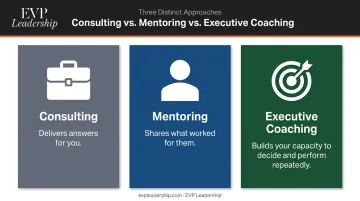
- Consulting solves problems for you — the consultant delivers answers
- Mentoring shares experience — the mentor recounts what worked for them
- Executive coaching builds your capacity to solve problems and make better decisions yourself, repeatedly, under pressure
Who Executive Coaching Serves in 2026
The outdated image of executive coaching as an exclusive Fortune 500 benefit no longer holds. Access has expanded significantly. According to ICF's 2025 Global Coaching Study, more than 50% of coaching clients are now employer-sponsored, reflecting how organizations at every size have integrated coaching into their leadership development approach.
That shift is visible in who's actually seeking coaching today. At EVP Leadership, engagements span a wide range of leadership roles:
- Founders and co-founders navigating growth transitions
- Owner-operators moving toward leading a team of leaders
- CEOs, COOs, and managing partners under sustained operational pressure
- Family business principals managing succession and complexity
What these leaders share is a common constraint: their personal capacity is the primary limiting factor on the business. When the leader is the bottleneck, coaching isn't a luxury. It's an operational priority.
Why Executive Coaching Is a Smart Growth Strategy in 2026
The Leadership Environment Has Changed
The 2026 business climate is demanding in specific ways: faster market shifts, AI disruption across nearly every industry, pressure to scale without proportionally scaling costs, and leadership teams stretched thin. The data on leader stress is direct — the DDI Global Leadership Forecast 2025 found that 71% of leaders reported increased stress, with 40% of stressed leaders seriously considering leaving their roles entirely.
That's not a wellness issue. That's a business risk. When leadership breaks down under pressure, the downstream effects are concrete: slow decisions, inconsistent execution, missed revenue opportunities, and team misalignment.
Why Strategy Alone Won't Fix This
Most businesses don't struggle with strategy. They struggle with readiness — the ability to execute that strategy when pressure is high, stakes are real, and the margin for error shrinks.
Growth in this environment requires a leader who can:
- Perform consistently under pressure, not just in ideal conditions
- Adapt to changing circumstances without losing organizational direction
- Communicate with clarity that keeps the team aligned and accountable
- Make decisions quickly without constant second-guessing
Executive coaching builds those capabilities deliberately, through a structured engagement rather than trial, error, and accumulated scar tissue.
The Financial Case Is Measurable
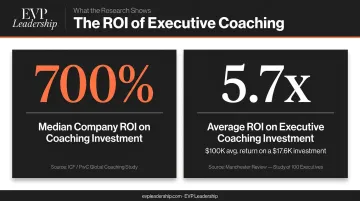
The objection that coaching is "soft" doesn't survive contact with the research. A joint ICF/PwC study found a median company ROI of 700% — organizations recovered seven times their coaching investment in measurable business outcomes. An earlier Manchester Review study of 100 executives found average ROI of nearly $100,000, or 5.7 times the initial investment.
Those returns aren't coincidental. They trace directly back to leaders who perform under pressure, hold their teams accountable, and make decisions with discipline — the same capabilities that structured coaching is built to condition.
How Executive Coaching Accelerates Business Growth
From Reactive to Strategic
One of the clearest shifts executive coaching produces is moving leaders out of constant firefighting and into proactive strategic execution. A skilled coach builds clarity around the business's true priorities and establishes decision-making frameworks that don't require the leader's involvement in every call.
The discipline to protect strategic time from operational noise is a learned skill — and one of the most valuable a leader can develop.
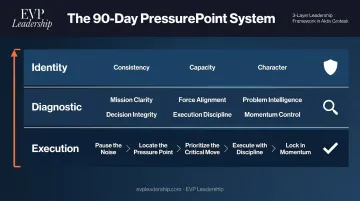
EVP Leadership's PressurePoint System addresses this through the Diagnostic Layer — a framework that trains leaders to separate Mission Clarity, Decision Integrity, and Execution Discipline into distinct performance categories rather than treating them as one undifferentiated "leadership problem."
Surfacing Blind Spots
Growth barriers invisible from inside the business are often the most costly. Common blind spots EVP Leadership identifies in small and mid-size business engagements include:
- Poor delegation habits — the leader's inability to hand off work caps the organization's ceiling
- Communication gaps — unclear direction from the top creates inconsistent execution below
- Absence of accountability structures — teams can't own outcomes if ownership isn't clearly defined
- Decision bottlenecks — when every significant call routes through the founder, speed and scale both suffer
These patterns are self-reinforcing. More effort doesn't fix them. Breaking the cycle requires an outside perspective and a structured framework to interrupt it.
The Team Multiplier Effect
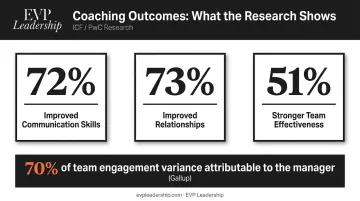
Coaching the leader produces a multiplier effect on the team. Gallup research finds that 70% of the variance in a team's engagement is attributable to the manager. When the leader communicates with greater clarity, resolves conflict faster, and creates real accountability, the entire organization operates at a higher level.
The ICF/PwC study reported that coaching clients attributed positive outcomes across multiple dimensions: 72% noted improved communication skills, 73% saw improved relationships, and 51% reported stronger team effectiveness. Those are the direct drivers of organizational performance, not peripheral wins.
Building a Business That Doesn't Depend on You
Sustainable growth requires building processes and structures that don't route every decision through the owner. EVP Leadership addresses this through delegation, accountability, and operating discipline work — treating all three as reinforcing systems, not isolated skills.
The results show up in operations:
- The leader recovers time previously consumed by decisions others can own
- The team takes on more with clearer accountability structures in place
- Decisions move down the organization as frameworks replace founder instinct
- The bottleneck pattern breaks — and stays broken
That's the structural foundation that makes scaling possible without burning out the leadership team in the process.
Leadership Conditioning vs. Leadership Training: Why the Difference Matters
The Knowledge-Performance Gap
Consider how elite athletes train. They don't just study plays — they repeat them under simulated pressure until the right response becomes instinctive. No amount of film study substitutes for that conditioning when the game is on the line.
Leadership works the same way. Research cited by ATD consistently shows that less than 30% of workplace learning is actually applied on the job — meaning roughly 70% of training investment doesn't change behavior. HBR has reported that U.S. corporations spend approximately $160 billion annually on employee training, yet leadership behavior frequently reverts under stress regardless.
The problem isn't the content of training programs. It's that knowledge without repetition doesn't hold under pressure.
What Leadership Conditioning Actually Looks Like
EVP Leadership defines conditioning as the systematic repetition of high-leverage leadership behaviors until they become the leader's default response — not a conscious effort deployed when things are calm, but an instinctive pattern that holds when pressure is highest.
The behaviors targeted through conditioning include:
- Strategic clarity under competing demands
- Confident communication without over-explaining or hedging
- Composure in high-stakes decision moments
- Disciplined prioritization when everything feels urgent
- Accountability follow-through that doesn't require external pressure
EVP Leadership's 90-Day PressurePoint System is built specifically around this conditioning model. Its three-layer framework creates the structured repetition required to convert intention into durable habit change:
- Identity — consistency, capacity, and character
- Diagnostic — Mission Clarity, Force Alignment, Problem Intelligence, Decision Integrity, Execution Discipline, and Momentum Control
- Execution — a five-step protocol for navigating critical moments
The firm's core belief captures the distinction clearly: "Leaders don't rise to expectations — they fall back on conditioning." Sustainable business growth requires leaders who are conditioned to perform, not just trained to understand what performance looks like.
What to Look for When Choosing an Executive Coach
Not every coaching relationship produces real results. The selection criteria matter.
Evaluate coaches on these factors:
- Look for direct experience operating in or advising businesses at your stage — credentials alone don't qualify someone to advise on business growth
- Confirm there's a defined framework with measurable outcomes — open-ended conversation is not a system
- Match track record to context — a Fortune 500 coach isn't automatically the right fit for a founder-led $10M company with different pressures and constraints
- Ask how they handle accountability — a coach who only listens is different from one who challenges avoidance, holds commitments between sessions, and functions as a genuine strategic partner
Common mistakes to avoid:
- Choosing based on likability rather than methodology and fit
- Selecting a coach with no direct business experience — personal development expertise doesn't transfer
- Entering an engagement without defined success metrics and a clear structure
- Expecting results without genuine willingness to change behavior
The right coach will make you uncomfortable. If every session feels validating rather than challenging, you're being managed — not developed. EVP Leadership's engagements are built on exactly this premise: structured methodology, direct business experience, and accountability that extends well beyond the session itself.

Is Executive Coaching Right for You?
Signals That Coaching Is Worth Exploring Now
The leaders who benefit most from executive coaching share recognizable patterns. Consider whether any of these describe your current situation:
- Working harder without seeing proportional growth results
- Struggling to delegate — most significant decisions still route through you
- Leading a team that lacks alignment, accountability, or direction
- Making more reactive decisions than proactive ones
- Running a business that would stop if you stepped back for two weeks
- Experiencing the early signs of burnout: chronic overload, decision fatigue, loss of purpose
One signal is worth noticing. Several at once means the pattern is already in motion — and waiting rarely improves the outcome.
What Coaching Actually Requires
Coaching is not the right fit for every leader at every moment. It requires:
- Consistent time commitment over a defined engagement period — not passive consumption
- A financial investment treated against improved profitability and organizational performance, not as a line-item expense
- Real willingness to change behavior — leaders seeking validation rather than growth won't see the return
If the signals above resonate and you're prepared to invest in a structured process rather than a quick fix, the next step is a direct conversation to assess where you are and what the right engagement looks like.
EVP Leadership offers a complimentary scoping conversation for exactly that purpose: a disciplined look at your current situation and whether coaching is the right next move.
Frequently Asked Questions
What is the difference between executive coaching and business coaching?
Executive coaching focuses on the leader's capacity — decision-making, presence, composure under pressure, and strategic thinking. Business coaching typically centers on business systems, processes, and growth tactics. The most effective engagements, like those EVP Leadership structures, integrate both — because leadership capacity and business performance are inseparable.
How long does it take to see results from executive coaching?
Most leaders notice meaningful shifts in decision confidence, clarity, and team dynamics within 60–90 days of consistent engagement. Deeper organizational results — changes in team performance, accountability culture, and scalable systems — typically emerge over a 6–12 month period.
How do I know if executive coaching is right for my stage of business?
Coaching delivers the highest value when the business has outgrown the leader's current operating system — when growth feels chaotic, decisions bottleneck at the top, or the team lacks direction. It applies at startup, scale-up, and stabilization stages. If the leader is the ceiling, coaching directly addresses that constraint.
What is leadership conditioning, and how is it different from traditional coaching?
Leadership conditioning is the systematic repetition of high-leverage behaviors until they become instinctive under pressure. Traditional coaching and training often deliver knowledge without building the habits that hold in high-stakes moments. Conditioning closes that gap — it builds performance that actually shows up when the pressure is on.
How much does executive coaching typically cost for small business owners?
Pricing varies based on coach experience, engagement structure, and duration. The 2025 ICF Global Coaching Study found active practitioners charge an average of $234 per hour globally, while specialized engagements are often structured as monthly or program-based investments. EVP Leadership uses custom engagement pricing; a complimentary scoping conversation precedes every engagement to define scope and fit.
Can executive coaching help with team performance, not just individual leadership?
Coaching the leader produces a direct multiplier effect on the team. Improvements in the leader's communication, delegation, and accountability practices raise the ceiling for what the team can execute. Gallup finds 70% of team engagement variance traces back to the manager — so developing the leader is one of the most effective investments you can make most effective investments you can make for team performance.