That tension — between the support HR provides everyone else and the development HR rarely receives — is exactly why leadership coaching has become essential rather than optional for HR professionals at every level.
This guide covers what leadership coaching means specifically for HR professionals, why the unique pressures of the role demand it, the key areas where coaching creates measurable impact, and how to implement it in a way that builds lasting change.
Key Takeaways
- Leadership coaching helps HR professionals close the gap between functional expertise and strategic influence.
- HR professionals carry unique emotional and organizational pressures that require conditioning beyond skill-building alone.
- Coaching drives the greatest impact in influence without authority, executive presence, accountability conversations, and manager development.
- Lasting change requires a structured, goal-oriented framework — one that builds capacity over time rather than delivering a single event.
What Is Leadership Coaching for HR Professionals?
Leadership coaching, in the HR context, is a goal-oriented, structured development process where an HR professional works with a coach to strengthen their own leadership capacity — not just their ability to run programs or coach others. That distinction separates it from several adjacent practices:
- Mentoring — which shares experience and guidance from someone further along a similar path
- HR training — which builds functional skills like employment law, HRIS proficiency, or benefits administration
- Consulting — which provides expert recommendations to solve a specific business problem
The International Coaching Federation defines coaching as a client-centered partnership that helps individuals maximize their personal and professional potential through a thought-provoking, creative process — not advice-giving or instruction.
Two Dimensions HR Professionals Should Understand
Leadership coaching for HR professionals operates on two levels simultaneously:
- Receiving coaching — developing your own leadership identity, strategic influence, clarity under pressure, and consistent performance in high-stakes environments
- Applying coaching skills — strengthening how you support the managers and teams you develop
The first dimension is where most HR professionals have the largest gap. They invest heavily in developing others and rarely prioritize their own development.
Leadership coaching isn't only for executives or designated high-potentials. HR professionals at all levels benefit from having a dedicated, confidential space to grow, reflect, and build the habits that make leadership consistent — particularly those navigating the dual pressure of leading people strategy while managing their own performance under scrutiny.
Why HR Professionals Need Leadership Coaching
The Expanded Strategic Role
The HR profession has shifted. People professionals are no longer primarily administrators — they're expected to influence C-suite decisions, drive culture, navigate organizational change, and develop future leaders. According to McKinsey, the CHRO role is evolving rapidly, with HR now playing a central role in helping organizations navigate complexity.
Yet CIPD's 2023 People Profession survey found that while 64% of UK and Ireland people professionals agree their function adds strategic value, fewer than half — 47% — feel their teams are actually acknowledged by the business for that impact. HR's strategic role is expanding faster than organizational recognition of it. Leadership coaching directly addresses that gap by building the communication, business acumen, and coalition-building skills that translate into genuine organizational influence.
The Emotional Weight No One Talks About
HR professionals routinely handle conflict resolution, performance management, layoffs, organizational crises, and employee mental health — often without a confidential space of their own to process any of it.
SHRM reported in 2024 that nearly 40% of HR professionals said hearing employees' stories related to death, illness, and workplace trauma negatively affected their own mental health. A separate 2024 peer-reviewed study of HR professionals found 66.2% reported feeling mentally exhausted sometimes, often, or always.
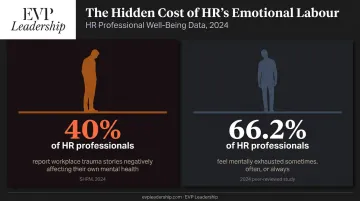
That's not a wellness problem — it's a structural one. HR professionals absorb enormous emotional weight with no formal outlet. Coaching provides the confidential, reflective space that allows HR leaders to process pressure, reset, and show up consistently rather than reactively.
The Career Complexity Challenge
That emotional load also makes intentional career navigation harder. HR career paths are rarely linear — professionals move across functions including:
- Talent acquisition and recruiting
- Learning & development (L&D)
- DEI program management
- HR business partnering (HRBP)
- Organizational development
Without deliberate guidance, career progression happens by default rather than design.
Coaching helps HR leaders clarify their trajectory, identify skill gaps, and make deliberate moves forward — so the next role is chosen, not inherited.
Key Areas Where Leadership Coaching Creates Impact
Influence Without Authority
HR leaders drive change, shape culture, and advocate for people strategies — without direct authority over most outcomes. That requires a different kind of leadership muscle.
Coaching helps HR professionals:
- Frame arguments in business terms that resonate with finance and operations leaders
- Build coalitions across functions before decisions reach the executive level
- Navigate political dynamics with strategic intent rather than frustration
- Present people strategies as business strategies, not HR initiatives
Executive Presence and Communication
Executive presence for HR professionals means commanding a board presentation, managing a difficult conversation with a senior leader, or delivering a clear strategic narrative under pressure — and doing it consistently, not just on a good day.
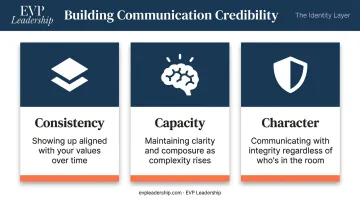
EVP Leadership's work on the Identity Layer — developing consistency, capacity, and character — directly supports this. Consistency means showing up aligned with your values over time. Capacity means maintaining clarity and composure when complexity rises. Character means communicating with integrity regardless of who's in the room.
Together, these three elements build the communication credibility that HR leaders need in high-stakes conversations.
Accountability and Performance Conversations
HR professionals regularly coach managers on accountability. Holding those same conversations with peers or senior leaders is a different challenge — and one that doesn't get enough attention.
Coaching builds the ability to:
- Set clear expectations without hedging
- Address performance gaps directly, even with people who outrank you
- Follow through consistently so accountability becomes the norm, not the exception
When HR leaders model this behavior, it shifts the cultural standard — accountability stops being an HR initiative and starts being how the organization operates.
Manager Development and Coaching Culture
Gallup research shows that managers account for up to 70% of the variance in team engagement — making manager effectiveness one of the highest-leverage investments an organization can make. HR professionals are at the center of that investment.
When HR leaders have experienced structured coaching themselves, they design better development programs and ask sharper questions in manager 1:1s. They model the coaching behaviors they want to see across the organization. That firsthand experience is the difference between an HR professional who understands coaching conceptually and one who can actually build a coaching culture.
Resilience and Sustainable Performance
High-pressure environments, reactive decision-making, and emotional exhaustion are occupational realities for HR professionals. Without deliberate conditioning, performance degrades over time — not because of lack of skill, but because capacity erodes.
Coaching builds the psychological resilience and mental habits that allow HR leaders to perform consistently — not just in favorable conditions, but under stress, uncertainty, and organizational complexity. That capacity is what separates HR leaders who last from those who quietly burn out at the top.
How to Implement Leadership Coaching: A Practical Framework
Step 1: Define Your Leadership Goals and Gaps
Start with a specific self-assessment:
- What leadership behaviors do you want to strengthen?
- Where do you lose confidence or consistency — and under what conditions?
- What does performing at your best look like when the pressure is highest?
Vague goals produce vague results. The more precisely you can name the gap, the more targeted and effective the coaching engagement becomes.
Step 2: Select the Right Coaching Format and Partner
Not all coaching is equal. When evaluating a leadership coach or program, look for:
- Relevant experience with organizational leadership, not just general life coaching
- A structured methodology rather than open-ended conversation without a framework
- A track record of building sustainable habits, not just short-term motivation
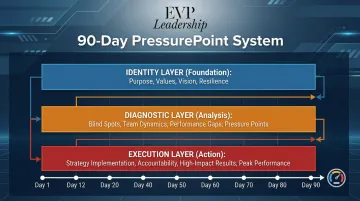
EVP Leadership's 90-Day PressurePoint System offers HR professionals a time-bound conditioning framework built specifically for leaders who need to perform consistently under pressure — available for individuals and leadership teams alike. The system works through an Identity Layer, Diagnostic Layer, and Execution Layer, conditioning leaders to respond with clarity under pressure rather than reverting to reactive defaults.
Step 3: Build Consistent Coaching Habits Into Your Workflow
Coaching only creates lasting change when insights translate into daily behaviors. Treat coaching commitments like any high-priority meeting — protected, prepared for, and followed through on.
Durability comes from repetition, not intensity. Small habits practiced consistently over time produce more durable leadership growth than any intensive training event — a conclusion supported by peer-reviewed research on spaced practice and long-term knowledge retention.
Step 4: Measure Progress Against Clear Outcomes
Define what success looks like at the start of the engagement, not after it ends. Track both:
- Qualitative indicators — confidence in executive conversations, clarity under pressure, consistency in communication
- Quantitative indicators — manager development outcomes, employee satisfaction scores, leadership pipeline readiness
Coaching ROI is most visible when goals are defined upfront and reviewed regularly throughout the engagement.
Step 5: Scale Coaching Skills Across Your Organization
Once you have firsthand data on what effective coaching produces, you're in a stronger position to make the case for building that capacity organization-wide. That means:
- Designing manager development programs grounded in real coaching experience
- Embedding coaching conversations into performance cycles, not treating them as separate initiatives
- Advocating for leadership development investment at the executive level with firsthand data
Building Lasting Change: Conditioning vs. One-Time Training
Most HR professionals have attended leadership workshops. Most have walked out motivated. And most have reverted to default behaviors within weeks.
The problem isn't motivation. It's conditioning.
Harvard Business Review's foundational research on leadership development found that leadership training fails because people revert to old behaviors when the surrounding system doesn't support and sustain change. A single event, no matter how well-designed, cannot overcome an organizational environment that pulls leaders back to familiar patterns.
The Conditioning Difference
Elite athletes don't perform well under pressure because they memorized the playbook. They perform because they have conditioned responses built through consistent, repeated practice under realistic conditions.
The same principle applies to HR leaders facing high-stakes conversations, board-level scrutiny, or organizational disruption. The goal isn't to absorb more information. It's to build the reflexes, habits, and emotional capacity to lead consistently — especially when circumstances are difficult.
EVP Leadership's core thesis captures this directly: "Because leaders don't rise to expectations — they fall back on conditioning."
The PressurePoint System's Execution Layer is built to become an automatic response through repeated practice — not a checklist consulted in the moment:
- Pause the Noise
- Locate the Pressure Point
- Prioritize the Critical Move
- Execute with Discipline
- Lock in Momentum
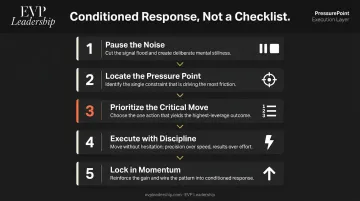
That's the difference between knowing what to do and being conditioned to do it.
For HR professionals serious about sustained growth, the measure of any development investment isn't how well it's received in the room — it's whether the behaviors it builds survive contact with pressure six months later.
Frequently Asked Questions
What is the difference between leadership coaching and mentoring for HR professionals?
Coaching builds the coachee's own thinking and leadership capacity through a structured, forward-looking process. Mentoring shares experience and perspective from someone further along a similar path. Both have value, but coaching is particularly effective for developing strategic influence and consistent performance under pressure.
How do HR professionals know they're ready for leadership coaching?
Readiness is less about career stage and more about genuine desire to grow, honest self-reflection, and having a real leadership challenge to work through. HR professionals who feel stretched, stuck, or moving into more strategic roles are often the best candidates.
How long does it typically take to see results from leadership coaching?
Meaningful shifts in confidence and communication often appear within the first few sessions of a structured engagement. Deeper behavioral change — the kind that holds up under pressure — typically requires 60–90 days of consistent, goal-oriented work with accountability built in.
Can HR professionals at small businesses benefit as much as those in large organizations?
Small business HR leaders often benefit more, since they operate with broader responsibilities, fewer peer resources, and less access to formal development programs. Coaching provides the strategic sounding board and leadership development that larger organizations build into their L&D infrastructure.
How is leadership coaching different from HR consulting or performance management?
Coaching helps the individual discover their own solutions, build self-awareness, and strengthen how they lead under pressure. Consulting provides expert recommendations to solve a specific business problem. Performance management addresses gaps against defined standards. Coaching develops the leader; the other two address the work.