Introduction
Most change initiatives don't fail because the strategy was wrong. They fail because the people leading the change weren't ready for what leadership through disruption actually demands.
That's a hard truth for small business owners and C-suite executives who've invested time and resources into a transformation — only to watch it stall, erode, or collapse under the weight of team resistance, communication gaps, and leadership uncertainty.
McKinsey reports that 70% of change programs fail to meet their goals, citing employee resistance and lack of management support as the primary culprits. Not flawed strategy. Not bad timing. Leadership gaps.
Change leadership coaching addresses this directly. Unlike general leadership development, it doesn't just build skills in the abstract. It conditions leaders to communicate, decide, and perform when their organization is in motion and the stakes are real.
Key Takeaways
- 70% of change programs fail — and leadership gaps, not flawed strategy, are the primary cause
- Change leadership coaching conditions leaders for transformation — general leadership development does not
- The most effective change leaders combine emotional intelligence, communication clarity, and sound decision-making under pressure
- Sustainable transformation requires embedded behavioral change over time — not a single intervention
- Small business owners and C-suite executives need coaching built around their specific context, not enterprise-scale frameworks
Why Most Change Initiatives Fail Without Strong Leadership
The 70% failure rate is widely cited, but the more important question is why. The answer is consistent across research: leadership, not strategy, is the common denominator.
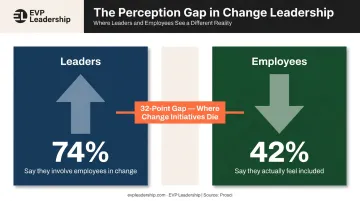
Prosci's benchmarking research surfaces a revealing gap: 74% of leaders say they involve employees in change initiatives, but only 42% of employees say they actually feel included. That 32-point gap is where change initiatives die — not in the planning document, but in the space between what leaders think they're communicating and what teams are actually experiencing.
The failure pattern typically looks like this:
- Communication breaks down or becomes vague as pressure increases
- Teams interpret silence as either incompetence or dishonesty
- Resistance grows — not from stubbornness, but from uncertainty
- Leaders double down on the what without addressing the why
- Momentum collapses before adoption takes hold
The Small Business Reality
At smaller organizations, the margin for error is narrower. Teams are more interdependent. Change feels more personal — to the leader and to the people they're leading. There's no organizational buffer to absorb a six-month communication breakdown or a poorly managed restructuring.
Founders and owner-operators face an additional layer: they're often the architect, the sponsor, and the primary change communicator simultaneously. Few leaders are conditioned for that level of concentrated pressure — and fewer still recognize the gap until something breaks.
Knowing vs. Being Conditioned
Most leaders understand what needs to change. They can articulate the vision, the rationale, the desired outcome. What they haven't developed is the emotional and behavioral capacity to navigate the journey under real pressure — when teams push back, when milestones slip, when the initial momentum stalls.
Resistance to change is predictable. It's not stubbornness — it's a human response to uncertainty. Two responses define how that resistance plays out:
- Acknowledge and redirect: Leaders who name the uncertainty, address it openly, and channel resistance constructively keep teams engaged through the difficult middle.
- Push through and dismiss: Leaders who treat resistance as an obstacle to overcome tend to accelerate the distrust they're working to prevent.
That capability isn't built through awareness alone. It's built through practice.
What Is Change Leadership Coaching?
Change leadership coaching is a structured, ongoing partnership between a coach and a leader — or a leadership team — focused specifically on developing the mindset, behaviors, and communication capacity required to guide an organization through transition successfully.
That's a narrower definition than most people expect.
Coaching for Change vs. Coaching for Development
General leadership development focuses on the individual: executive presence, career trajectory, interpersonal effectiveness, skill building. These have real value — but they're not the same as coaching designed to move an organization through transformation.
Change-focused coaching is built around a specific organizational outcome. The coach and leader work in tandem toward adoption, alignment, and momentum. Success isn't measured by the leader's self-improvement; it's measured by what happens to the organization during and after the transition.
That difference changes what gets worked on, how progress is defined, and what accountability looks like.
General leadership development centers on the leader's growth. Change leadership coaching centers on the organization's movement.
Both matter — but only one is built for transformation.
Conditioning vs. Training
Understanding what change coaching is points to a harder question: why do trained leaders still struggle when transformation gets difficult?
EVP Leadership's answer is direct: under pressure, leaders don't rise to expectations — they fall back on their conditioning. Most leaders have been trained. Very few have been conditioned for real pressure.
Training delivers frameworks, models, and awareness. Conditioning builds the internal capacity to perform when stakes are high, information is incomplete, and teams are watching for signals. The difference surfaces when a restructuring hits unexpected resistance, when a communication breaks badly, or when a leader has to make a consequential call at the worst possible moment.
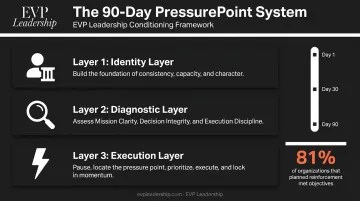
EVP Leadership's 90-Day PressurePoint System is built on this principle — conditioning leaders through a structured, three-layer framework rather than equipping them with playbooks they'll struggle to execute under real conditions.
Who benefits most:
- Small business owners scaling operations or navigating structural transitions
- C-suite executives managing restructuring, succession, or cultural shifts
- Founder-CEOs moving from operator to leader-of-leaders
- Leadership teams where misalignment is undermining change momentum
The Core Skills Change Leadership Coaching Builds
Emotional Intelligence and Empathy
Leaders who can recognize and respond to the emotional experience of their teams during change — the fear, the frustration, the ambiguity — dramatically reduce resistance before it hardens into full-scale resistance.
A 2026 peer-reviewed study published in PMC found empathetic leadership was positively correlated with employee engagement (r = 0.591, p < 0.001). That's a measurable relationship between how leaders show up emotionally and how engaged their teams remain during disruption — not a soft finding.
Coaching builds this through deliberate practice: helping leaders develop language for what their teams are experiencing, creating space for honest dialogue, and resisting the impulse to push through resistance rather than address it.
Communication Clarity and Overcommunication
Most leaders underestimate how much communication change requires. They communicate the decision. They don't communicate the reasoning, the timeline, the tradeoffs, or what it means for individuals. Then they're surprised when adoption stalls.
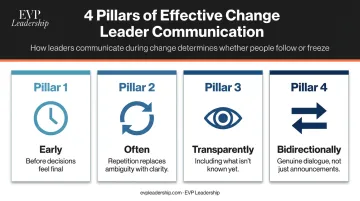
Effective change leaders communicate:
- Early — before decisions feel final, when people still feel included
- Often — repetition isn't redundancy; it's how ambiguity gets replaced with clarity
- Transparently — including what isn't known yet
- Bidirectionally — creating genuine dialogue, not just announcements
Coaching builds the discipline to maintain this standard when the instinct is to go quiet, get heads down, and push through. Leaders who default to silence during change don't create calm. They create a vacuum that teams fill with speculation.
Decision-Making Under Pressure
This is one of the most underdeveloped capabilities in change leadership. The situations that derail transformations — unexpected resistance, missed milestones, conflicting priorities — require leaders to make sound decisions quickly with incomplete information.
EVP Leadership addresses this through the PressurePoint System's Execution Layer, which conditions a specific response protocol for high-stakes moments: Pause the Noise, Locate the Pressure Point, Prioritize the Critical Move, Execute with Discipline, Lock in Momentum. The goal is to make clear, grounded decision-making instinctive rather than effortful.
Resilience and Vision Articulation
Resilience means absorbing setbacks without losing composure. Teams look to leaders for stability signals. A leader who visibly panics when a transition hits friction teaches their team to do the same. Coaching builds the emotional capacity to adjust course without projecting anxiety.
Vision articulation is what makes change feel meaningful rather than imposed. Leaders who can connect the organizational change to individuals' values and day-to-day realities generate buy-in. Leaders who communicate at the mission level without translating it to the team level get compliance at best, and quiet resistance at worst.
A Practical Framework for Change Leadership Coaching
Phase 1: Establish Clarity Before Action
Before any behavioral change is possible, the leader needs to be clear on what is actually changing, why it matters now, and what success looks like — not just on paper, but in their own understanding and conviction.
Coaching at this stage focuses on honest self-assessment. Three questions drive this work:
- Where are the current leadership gaps?
- Where is the leader's mindset misaligned with the change they're trying to lead?
- What assumptions are they carrying that will create friction downstream?
EVP Leadership's Diagnostic Layer addresses this directly through components like Mission Clarity (does the team know exactly what must be achieved and why?) and Decision Integrity (are decisions grounded in truth, or distorted by noise and emotion?). These are diagnostic tools for pinpointing exactly where a leader isn't yet ready to lead what they're asking their team to follow.
Skipping this phase is common, and costly. Leaders who charge into change without this clarity tend to communicate inconsistently, make reactive decisions, and lose credibility with teams who sense the misalignment even when they can't name it.
Phase 2: Build Relational Capacity Across the Team
Once the leader has clarity, the work expands to the team. This phase focuses on:
- Establishing communication structures that create genuine two-way dialogue
- Building psychological safety — the conditions under which people will say what's actually true
- Identifying informal influencers: the team members whose buy-in (or resistance) will shape how others respond
Prosci's research found that organizations using formal change-agent networks met objectives 50% of the time, compared to 41% for organizations without such networks. The informal version of this — identifying who on the team carries influence and investing in their understanding — is just as important.
Teri Evans, EVP Leadership's Leadership Facilitator, delivers team-level work specifically designed for this phase: leadership alignment workshops, psychological safety-building, and post-transition team development across healthcare, education, nonprofit, and business contexts.
Leaders who build strong personal clarity but fail to extend it to their teams end up carrying the entire transformation alone. The change may be real at the top and invisible everywhere else — and that gap is where most initiatives stall.
Phase 3: Embed and Reinforce New Behaviors Over Time
Sustainable change doesn't come from a strategy session or a leadership offsite. It comes from consistent practice, accountability, and reinforcement over time.
Prosci reports that 81% of organizations that planned reinforcement met project objectives, compared to just 15% of those that didn't. That's not a marginal difference — it's the difference between a change initiative that holds and one that reverts within months.
EVP Leadership's 90-Day PressurePoint System is structured specifically around this principle. The three-layer conditioning framework — Identity, Diagnostic, Execution — isn't a one-time exposure. It's a 90-day structured engagement that builds the new behaviors leaders need through repetition, real-scenario testing, and embedded accountability, until those behaviors become the default response rather than a conscious effort.
How to Choose the Right Change Leadership Coach
Three criteria matter most:
1. Context fit over credentials. Enterprise-scale change management experience doesn't transfer cleanly to a founder-led organization or a small business where the CEO is also the primary cultural carrier. Look for a coach with experience at your business size, in your type of transition, with leaders at your stage. The frameworks built for a 10,000-person restructuring rarely translate to a 40-person company navigating leadership succession.
2. Conditioning over framework delivery. Be cautious of coaches whose primary offering is a model or methodology — a playbook you receive but aren't conditioned to execute under pressure. Ask specifically: How do you measure behavioral change, not just participant satisfaction? How do you build execution capacity, not just awareness? The right coach builds leaders who perform when the pressure is real, not just when everything is calm and the plan is clear.
3. Accountability structures and defined outcomes. A strong coaching engagement sets clear objectives at the outset, includes regular progress assessments, and operates as a results-driven partnership. The coach should be as invested in your organizational outcomes as you are. If the engagement lacks defined success metrics and accountability structures, you're paying for development conversations — not organizational change.
EVP Leadership begins every engagement with a complimentary scoping conversation to assess fit, understand the specific change context, and determine the right engagement structure before any commitment is made.
Frequently Asked Questions
What are the C's of change leadership?
The Center for Creative Leadership identifies three core C's: Communicate, Collaborate, and Commit. Frameworks vary across sources, but effective change leadership is behavioral and relational, not procedural. Models don't lead change. Leaders do.
What is change leadership coaching?
Change leadership coaching is a targeted coaching engagement designed to develop a leader's mindset, emotional capacity, and communication skills for guiding an organization through transformation. It differs from general leadership development in both purpose and focus — the outcome is organizational adoption and momentum, not just individual growth.
How is change leadership different from change management?
Change management focuses on the processes, tools, and plans used to transition an organization. Change leadership focuses on the human element — how leaders inspire buy-in, manage resistance, and sustain momentum throughout the journey. Leadership is what determines whether the management plan actually takes hold.
What skills does change leadership coaching develop?
Core capabilities include emotional intelligence, communication clarity under pressure, resilient decision-making, vision articulation, and the ability to build trust and alignment across teams during uncertainty. These are trainable — but they require sustained conditioning, not a single workshop or one-time exposure.
When should a business leader seek change leadership coaching?
The best time is before or at the start of a major transition — scaling, restructuring, culture shifts, or leadership succession. Coaching is also valuable when a change initiative has stalled or is meeting unexpected resistance that leadership alone hasn't been able to redirect.
How long does change leadership coaching take to show results?
Meaningful behavioral change typically requires 60-90 days of sustained engagement. EVP Leadership's 90-Day PressurePoint System is built around this reality — conditioning new leadership habits through consistent practice and accountability, not one-time exposure.