Burnout at the executive level isn't a personal weakness or a scheduling problem. It's a systemic breakdown — and it carries consequences that reach far beyond the leader themselves.
Gennifer Baker, founder of EVP Leadership and a C-level executive consultant with 30+ years in business strategy and leadership, has worked with founders, CEOs, and small business owners since 2009. Burnout — in various forms and stages — is one of the most consistent patterns she encounters. This article covers what makes CEO burnout distinct, the warning signs leaders most often miss, what drives it structurally, and what actually works to reverse it.
Key Takeaways
- CEO burnout is the chronic depletion of the systems, habits, and emotional capacity that sustain leadership performance — running far deeper than simple overwork.
- Warning signs are behavioral and subtle long before they become obvious, making early recognition critical.
- Burnout at the top cascades directly into decision quality, team culture, and business outcomes.
- Sustainable prevention is built through proactive conditioning — strengthening the capacity to lead before pressure becomes crisis.
Why CEO Burnout Is Different From Employee Burnout
Burnout can affect anyone in an organization. But CEO and small business owner burnout carries a distinctly heavier burden — and understanding why is the first step toward addressing it.
The Isolation Factor
Employees experiencing burnout can escalate to a manager, vent to a peer, or quietly reduce their pace. CEOs have none of those options.
There's no one above them to escalate to, no easy way to take a sick day, and a constant expectation to project strength and certainty — which makes it far harder to acknowledge the problem, let alone address it.
The research on CEO loneliness is striking. According to an RHR International study reported in Harvard Business Review, roughly half of CEOs report experiencing loneliness in the role, and 61% of those say it actively hinders their performance. That social isolation removes the release valve that employees at lower levels typically have access to: peer venting, mentorship, shared problem-solving. When there's no one to process pressure with, pressure accumulates.
The Identity-Performance Trap
Many CEOs — founders and owner-operators especially — fuse personal identity with business performance. Company results become a direct measure of personal worth, which means any sign of struggle feels like failure rather than a systemic signal that rest or restructuring is needed.
EVP Leadership's work with founder-CEOs surfaces this pattern consistently. Their approach focuses on building a leadership identity grounded in consistency, capacity, and character — one that holds regardless of what the quarterly numbers say.
The WHO Definition and Why It Fits the C-Suite
The World Health Organization classifies burnout as an occupational phenomenon characterized by three dimensions:
- Energy depletion or exhaustion — chronic fatigue that rest alone no longer resolves
- Increased mental distance from one's job — cynicism and disengagement that creep in gradually
- Reduced professional efficacy — a measurable drop in output quality and decision-making confidence
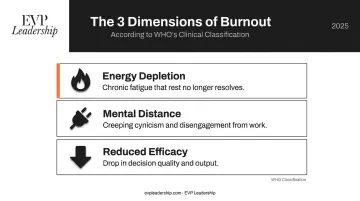
The distinction matters because it separates burnout from general stress. Stress is short-term activation. Burnout is chronic depletion — and the WHO definition maps directly onto what happens when a CEO has been operating without adequate recovery for too long.
For small business CEOs: the pressure compounds further. No HR department, no board pushing back, no executive coach on retainer. They absorb pressure without the institutional buffers that large-corporation executives typically have access to.
The Warning Signs CEOs Often Ignore
The early signals of burnout are rarely dramatic. They're easy to rationalize, easy to push past, and often don't trigger concern until they've compounded for months.
Physical and Cognitive Signals
Most CEOs don't take the early physical signals seriously:
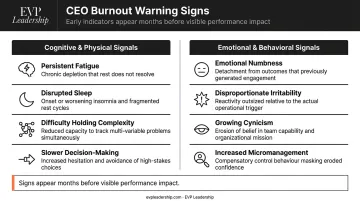
- Persistent fatigue that doesn't improve after a weekend
- Disrupted sleep even when exhausted
- Frequent headaches or GI issues
- Increasing reliance on caffeine or alcohol to regulate energy
These get attributed to a busy quarter, a stressful deal, a difficult season. The cognitive signals are more telling — and harder to self-identify:
- Difficulty holding complexity across multiple priorities
- Slower decision-making and increased second-guessing
- Rising reactivity to routine friction
- Inability to think strategically; defaulting to tactical fire-fighting instead
Emotional and Behavioral Markers
The emotional indicators are where burnout becomes unmistakable in hindsight:
- Emotional numbness or detachment from wins that would previously have energized
- Irritability that feels disproportionate to the actual trigger
- Growing cynicism about the business — the work that once felt meaningful now feels like obligation
- Withdrawal from team meetings and strategic conversations the CEO once championed
A counterintuitive behavioral signal: increased micromanagement. When CEOs trust themselves less, they often try to control more. Reduced delegation isn't a sign of high standards — it's frequently a sign of depletion.
A 2022 Deloitte Canada study of senior leaders found that more than 80% of senior leaders reported exhaustion consistent with burnout risk. More than half worried that acknowledging mental health struggles would harm their careers. That fear doesn't protect the leader — it delays recovery until the cost is much higher.
The Masking Problem
High-functioning CEOs often develop sophisticated performance behaviors — projecting energy and confidence publicly while privately depleted. This mask delays both self-recognition and help-seeking, until a crisis forces the issue: a health event, a significant business failure, or a relationship breakdown. The longer the mask holds, the more severe the eventual reckoning.
The Root Causes of CEO Burnout
CEO burnout rarely comes from laziness or weakness. It comes from structural conditions that make sustained recovery nearly impossible — no matter how disciplined the person at the top.
Chronic Overresponsibility
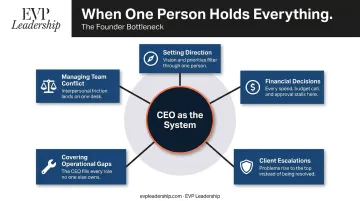
Many small and mid-size business CEOs carry a disproportionate cognitive and emotional load. In a single day, they may hold the vision, manage people, navigate finances, represent the brand, and still handle operational tasks that belong elsewhere:
- Setting direction and communicating it across the org
- Making financial decisions that no one else is empowered to make
- Managing team dynamics and conflict
- Fielding client escalations personally
- Covering gaps where roles are undefined or unfilled
When no systems exist to distribute that load, depletion is structural — not personal. EVP Leadership consistently identifies this "founder bottleneck" as one of the most common roots of CEO burnout: when a business depends entirely on one person's output, scale stalls and exhaustion is predictable.
The Always-On Trap
73% of C-suite executives reported being unable to take time off and fully disconnect, according to a 2022 Deloitte study on executive well-being. CEOs often set a hustle-culture tone for their organizations and then become trapped inside it. Without genuine disconnection periods, the nervous system never fully recovers. Stress accumulates in the background until the body forces the issue.
Absent Psychological Safety at the Top
The CEO is most responsible for creating psychological safety on their team and yet typically has the least of it themselves. Who challenges them constructively? Who do they process pressure with?
Without peer support, a trusted advisor, or a structured coaching relationship, there's no release valve for accumulated pressure. Confidential executive coaching fills this gap — creating a protected space where founders and CEOs can think clearly, outside the organizational dynamics that color every other conversation they have.
Systems That Depend on One Person
When delegation frameworks, documented processes, and clear decision rights don't exist, the CEO becomes the system. That structural fragility has a direct cost: the leader can't take a real vacation, get sick, or step into a higher-level role without the business degrading behind them. Building delegation frameworks, documented processes, and clear decision rights is the work that allows a CEO to lead the business rather than be the business. EVP Leadership's operating discipline work focuses specifically on this transition — building the infrastructure that lets founders and CEOs step back without stepping away.
The Business Cost of Burning Out at the Top
Burnout at the CEO level doesn't stay contained. The consequences ripple outward into the entire organization.
Decision Quality Deteriorates
Chronic stress directly impairs the prefrontal cortex — the seat of strategic thinking, impulse control, and nuanced judgment. Research by Arnsten published in PMC shows that even mild uncontrollable stress can cause rapid loss of prefrontal cognitive function, while prolonged stress produces structural changes in how the brain processes information.
A burnt-out CEO becomes more reactive, less able to process competing priorities, and prone to either excessive risk-aversion or recklessness — the exact failure modes that compound fastest at the executive level.
Team and Culture Destabilization
That cognitive deterioration doesn't stay internal. When the CEO is emotionally depleted, their behavior shifts in ways teams absorb immediately:
- Shorter fuse and disproportionate reactions
- Inconsistent communication and mixed signals
- Reduced presence in critical conversations
- Unpredictable decision reversals that erode trust
Morale drops and trust erodes. According to McKinsey, 35% of workers cite uncaring leaders as one of their top three reasons for leaving a role. Top performers — who have options — leave first.
Strategic Stagnation
Innovation slows when the leader's bandwidth for creative thinking is consumed by survival mode. Strategic planning becomes reactive. Growth initiatives stall. For small business owners, this can mean the business plateaus or begins declining at exactly the moment that demands forward movement.
Building Burnout Resilience Through Leadership Conditioning
The solution to CEO burnout is not working less. It's building the systems, habits, and emotional capacity to sustain high performance over time. This is the difference between coping — reacting when burnout arrives — and conditioning, which builds resilience before the breakdown happens.
Structural Changes That Reduce Vulnerability
The most critical structural shift is reducing the business's dependency on the CEO's personal output:
- Define delegation clearly — who owns what decision, with what authority, and how accountability gets tracked
- Document processes so operations don't stall when the CEO is unavailable for a week
- Push decision rights down the organization so fewer choices require CEO sign-off
- Build an accountability rhythm — 1:1 cadences, team check-ins, performance conversations that run without prompting
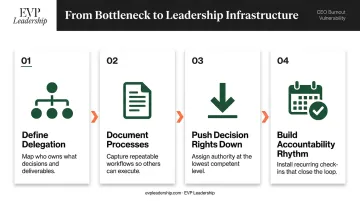
EVP Leadership's 90-Day PressurePoint System is built around exactly this kind of structural work — training leaders to pinpoint where performance is breaking down and fix the actual problem, not just manage the pressure it creates.
Practical Conditioning Habits
Structural changes alone aren't sufficient. Sustainable resilience also requires behavioral conditioning:
- Treat sleep, exercise, and disconnection as operational requirements — not aspirational habits to pursue when things slow down
- Build in a trusted outside voice: an executive coach, advisor, or peer group that gives honest pushback without organizational stakes
- Run regular capacity checks — honest read of energy levels, decision clarity, and emotional bandwidth before committing to major choices
A vacation is coping. A redesigned operating rhythm — built around genuine recovery and backed by a team that functions without constant CEO involvement — is conditioning.
For executives already in active burnout, EVP Leadership's Executive Burnout Recovery & Resilience Building engagements address the underlying drivers directly and build a resilience system the executive can sustain long after the engagement ends.
Frequently Asked Questions
How do CEOs handle burnout?
Effective CEO burnout management combines structural changes — delegation, documented processes, reduced personal dependency on the business — with behavioral habits like protected recovery time, peer support, and capacity awareness. Professional coaching is often part of the mix. The most effective approach is proactive conditioning before crisis hits, not waiting until capacity has already collapsed.
What are the 3 R's of burnout?
The Recognize, Rest, Rebuild framework is a practitioner heuristic, not a formal clinical model. For CEOs, Recognize is about catching behavioral and emotional signals early; Rest means genuine recovery, not just pausing; Rebuild is where structural changes — delegation, systems, operating rhythm — matter most and are most often skipped.
What is the 42% rule for burnout?
The 42% concept comes from Emily and Amelia Nagoski's burnout work, framing roughly 42% of a 24-hour day as needed for genuine rest — though it's not a peer-reviewed clinical threshold. Stanford economist John Pencavel's research is more rigorous: output stops rising proportionally with hours worked, and extended schedules compound depletion without producing meaningful results.
What are the early signs of CEO burnout?
The most overlooked early signals: persistent fatigue that doesn't resolve with rest, emotional detachment from the business, increased irritability or slowing decision-making, and a growing sense of cynicism about work that once felt genuinely meaningful. These typically appear months before any visible performance impact.
How does CEO burnout affect a company?
Burnout at the top produces cascading business damage: decision quality degrades as stress impairs strategic thinking, team culture destabilizes as depleted leadership behavior ripples downward, and growth planning gives way to survival mode. Burnout at the CEO level rarely stays contained.