That's the trap. High performers interpret the warning signs — the fatigue that sleep doesn't fix, the decisions that feel harder than they should, the growing disconnection from work that once felt meaningful — as signs they need to push harder. By the time the impact becomes undeniable, the damage has already spread: to their health, their judgment, and the team depending on their leadership.
Executive burnout isn't ordinary stress. It doesn't resolve with a long weekend or a vacation. According to the World Health Organization, it's a recognized occupational syndrome driven by chronic workplace stress that hasn't been successfully managed — and it carries consequences that extend well beyond the individual at the top.
For founders, small business owners, and C-suite executives, the stakes are compounded. When leadership capacity degrades, so does everything the business depends on.
Key Takeaways
- Executive burnout is WHO-classified (ICD-11, code QD85) — not ordinary stress, not a character flaw
- The root causes are structural: decision overload, perfectionism, isolation, and absent operating systems
- Three warning signs distinguish burnout from a rough quarter: persistent fatigue, emotional detachment, and deteriorating decision quality
- Untreated burnout spreads — from the leader into the team, culture, and bottom line
- Lasting recovery requires structural redesign, not a vacation
Common Causes of Executive Burnout
The WHO classifies burnout under ICD-11 (code QD85) as an occupational phenomenon defined by three dimensions: energy depletion or exhaustion, increased mental distance and cynicism toward work, and reduced professional efficacy. What makes it distinct from regular stress is chronicity — it results from sustained, unmanaged workplace pressure, and it doesn't improve with rest alone.
At EVP Leadership, where Gennifer Baker has spent 30+ years working with founders, CEOs, and small business owners, burnout is understood as a progressive deterioration — not a sudden breakdown. The structural drivers are consistent across nearly every engagement:
- Over-scope and unclear priorities
- Weak operating rhythm with no recovery cadence
- Poor delegation habits
- Identity fused to the business rather than separate from it
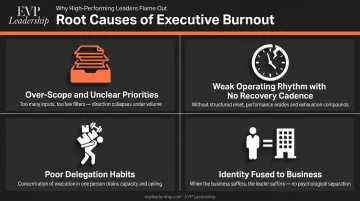
High performers are often the last to recognize what's happening. The same drive that built the business makes burnout easy to rationalize as dedication.
Relentless Decision Load and Always-On Culture
A 2022 Scientific Reports study found that leader depletion directly harms trust and performance — with depletion linked to lower trust at b = -0.27 (p < 0.001). A 2018 concept analysis defines decision fatigue as impaired decision quality after repeated decision-making, with measurable damage to executive functioning and reasoning.
The typical pattern: a leader who is mentally "on" from the moment they wake until they sleep, processing every escalation, every judgment call, every team question — and who mistakes this as commitment rather than depletion.
Perfectionism and Impossible Internal Standards
Many executives tie self-worth directly to performance outcomes. The result is a cycle where any pause feels like failure, delegation feels like a risk, and "good enough" isn't a legitimate option.
This manifests as the founder-bottleneck pattern — where the leader personally reviews every deliverable, absorbs complexity that should flow through systems, and inadvertently caps organizational growth by making themselves the single point of every decision. Breaking that pattern requires working at the identity level — specifically, building the internal consistency and capacity that allows a leader to trust others with meaningful responsibility.
Isolation at the Top and Suppressed Vulnerability
Executives frequently feel they cannot show uncertainty or seek support from their own teams. The result is chronic emotional suppression — carrying unprocessed pressure with no safe outlet, and treating emotional containment as a leadership requirement.
Over time, this form of loneliness accelerates burnout significantly. The leader appears composed in every meeting while operating with no recovery valve.
Absence of Systems and Unsustainable Operating Models
Founders and owner-operators who built their businesses on personal effort often never make the transition to systems that function without them. Every decision routes through them. Every problem surfaces to them.
EVP Leadership's delegation and operating discipline work targets this directly — establishing a clean delegation protocol (what gets delegated, to whom, with what authority and accountability), an accountability operating rhythm, and an execution-discipline framework. The result: decisions move down the organization, the leader reclaims time, and the business stops depending on one person to function.
What Happens When Executive Burnout Goes Untreated
Untreated burnout doesn't stay contained to the leader. Degraded performance erodes decision quality, which erodes team clarity, which erodes output and morale — and the leader is usually the last to see it. They're inside it.
The health data is clear. A 2024 meta-analysis of 25 studies and 26,916 participants found burnout associated with a 21% higher cardiovascular disease risk in adjusted models and an 85% higher prehypertension risk. A separate 2017 systematic review of 36 prospective studies linked burnout to outcomes including type 2 diabetes, coronary heart disease, prolonged fatigue, and mortality below age 45.
The longer burnout goes unaddressed, the harder recovery becomes. Executives who push through typically extend both the duration and severity of the condition — not because they're weak, but because pushing through is the strategy that got them where they are.
Warning Signs You're Approaching Executive Burnout
Burnout rarely announces itself loudly. Most executives misread early signals as "just a hard quarter." These three signs distinguish burnout from ordinary pressure:
- Persistent exhaustion that rest can't fix — vacation and sleep no longer restore functioning; the nervous system has been overridden by sustained overload with no recovery window
- Emotional detachment and growing cynicism — work that once felt meaningful now feels mechanical; the passion driving early decisions has been replaced by going through the motions
- Declining decision quality and strategic focus — more second-guessing, difficulty prioritizing, and a visible drift from proactive strategy toward reactive crisis management
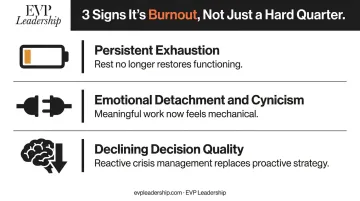
If all three are present together, this isn't a rough quarter. It's burnout.
How to Recover From Executive Burnout
Recovery isn't passive. It's an active, intentional process of rebuilding leadership capacity — and it requires the same strategic seriousness executives bring to their hardest business problems.
Acknowledge It and Break the "Push Through" Pattern
The first step is simply naming what's happening — without minimizing, rationalizing, or reframing it as a temporary cost of ambition.
Acknowledgment isn't a sign of weakness. It's a critical act of leadership self-awareness. It removes the internal resistance that keeps leaders trapped in burnout cycles and creates the psychological opening needed for real structural change.
Restructure Your Workload Through Delegation and Operational Systems
Reducing cognitive overload has to start immediately — not after the leader "feels better."
A practical audit covers three questions:
- What can be delegated? Define it clearly — to whom, with what authority, against what accountability
- What can be systemized? Identify where your presence is required by habit, not necessity
- What can be eliminated? Not every responsibility the executive holds is actually theirs to hold
This workload restructuring isn't a later-stage step. It removes the structural conditions that created burnout in the first place, and gives the executive the mental bandwidth needed for recovery and high-quality strategic thinking.
Rebuild Physical and Cognitive Foundations
Sleep deprivation's impact on executive performance is well-documented. Restricting sleep to four hours per night for 14 days produces cognitive deficits comparable to two nights of total sleep deprivation — and a 2023 fMRI study found that even one night of total sleep deprivation attenuates neural responses to outcomes from risky decision-making.
For executives, this isn't a lifestyle issue. It's a leadership performance issue.
Recovery practices that can't be skipped:
- Protected sleep treated as a performance input, not a personal luxury
- Defined off-hours with clear digital boundaries that create genuine cognitive rest
- Physical movement scheduled three to five days per week, built into the calendar like a meeting
- Recovery time built into the operating rhythm, not squeezed around it
EVP Leadership's burnout recovery engagements specifically redesign the operating rhythm to protect recovery time — framing these practices not as wellness recommendations but as structural leadership requirements.
Work With a Leadership Strategist to Build Conditioning, Not Just Coping
There's a meaningful difference between managing burnout symptoms and eliminating the conditions that produced them. A leadership strategist accelerates recovery by working on the structural and behavioral drivers — not just the surface-level exhaustion.
EVP Leadership's 90-Day PressurePoint System is built for executives who need both. The program works across three layers:
- Identity Layer: Rebuilds the internal foundations of consistency, capacity, and character that burnout systematically erodes
- Diagnostic Layer: Trains leaders to see clearly and think decisively across six dimensions — Mission Clarity, Force Alignment, Problem Intelligence, Decision Integrity, Execution Discipline, and Momentum Control
- Execution Layer: Installs a protocol for high-pressure moments — Pause the Noise → Locate the Pressure Point → Prioritize the Critical Move → Execute with Discipline → Lock in Momentum
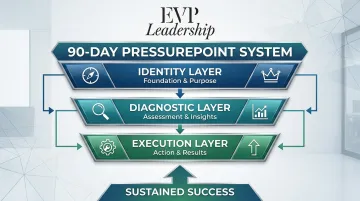
For executives in burnout recovery, this approach targets the root drivers — over-scope, weak operating rhythm, poor delegation, no recovery cadence — rather than treating symptoms. The outcomes are operational: restored decision-making clarity, a redesigned operating rhythm, and a delegation protocol that gives leadership back its time.
The resilience system executives build through this engagement is designed to run independently — so the same patterns don't recur once the engagement ends. That's the difference between coping and conditioning.
Long-Term Strategies to Keep Executive Burnout at Bay
Recovery creates the conditions for sustained performance — but only if you build what comes next. These four practices make that possible:
- Quarterly energy and alignment audit — regularly check whether daily activities align with your highest-value strategic priorities; flag early drift before it becomes depletion
- Confidential peer or advisory circle — having a trusted space to share challenges, test thinking, and receive honest feedback reduces the isolation that accelerates burnout
- Identity and investment beyond the role — executives whose sense of self isn't entirely fused to their title or business performance demonstrate greater resilience under sustained pressure; invest intentionally in relationships and interests outside work
- Treat conditioning as ongoing — leadership stamina is maintained through consistent daily habits, not rebuilt from scratch after each breaking point
Conclusion
Executive burnout has identifiable causes and recognizable warning signs. The leaders who catch it early retain the most options and recover fastest. Those who push through make both harder to undo.
Prevention and recovery are achievable. The path typically involves structural changes to how the business operates, deliberate conditioning built up over time, and outside perspective when the problem is too close to see clearly. For founders, small business owners, and C-suite executives, investing in leadership capacity isn't a soft priority. It's one of the highest-return decisions a business can make.
EVP Leadership offers a complimentary, confidential scoping conversation for executives who recognize these patterns — a focused conversation to identify where the pressure is concentrated and what a realistic recovery path looks like.
Frequently Asked Questions
How to recover from executive burnout?
Recovery requires both immediate load reduction (delegation, protected rest, clear boundaries) and longer-term structural changes to how you operate. Most executives see the most durable results with external strategic support to make lasting change, rather than cycling back into the same patterns that produced burnout in the first place.
What is the 42% rule for burnout?
The 42% rule comes from Emily and Amelia Nagoski's work on burnout and suggests that roughly 42% of a 24-hour period — about 10 hours — should be spent in rest or recovery activities. The framework comes from health and wellness writing, not an established clinical or WHO-recognized burnout protocol.
What are the 3 R's of burnout?
The most commonly cited version is Recognize, Reverse, Resilience — identify the signs of burnout, take steps to reverse the damage through rest and reduced load, and build long-term resilience to prevent recurrence. This framework circulates through health content sites like HelpGuide, though it isn't part of a formal WHO or clinical burnout protocol.
How long does it take to recover from executive burnout?
Recovery timelines vary by severity and the changes made. Meaningful improvement typically requires weeks to months of consistent structural change, not just rest. Without addressing root causes like workload design and operating rhythm, symptoms commonly return even after the leader feels better.
What is the difference between executive burnout and stress?
Acute stress is situational and resolves when the pressure passes. Burnout is chronic, systemic, and — per the WHO definition — the result of workplace stress that has not been successfully managed over time. The key distinction isn't intensity; it's duration and resolution. Executives frequently misidentify burnout as stress, which delays the structural changes needed for real recovery.