That's not a motivation problem. That's a capacity problem. And it's far more common among senior leaders and small business owners than anyone admits publicly.
Most executives have heard of burnout coaching. Very few know what it actually looks like — what gets examined, what gets built, and what genuinely changes. This post pulls back the curtain.
Key Takeaways
- Executive burnout hits differently when your identity and the business are the same thing
- Burnout coaching targets root causes — not symptoms — and is distinct from therapy, wellness programs, or generic coaching
- The coaching room surfaces what's generating depletion, then builds repeatable systems to replace it
- Lasting recovery requires conditioning, not a reset — research puts habit formation at roughly 66 days to become automatic
- The leaders who benefit most act on the signal before the cost becomes impossible to ignore
Why Executive Burnout Hits Differently at the Top
The pressures executives and small business owners face aren't a louder version of typical workplace stress. They're categorically different. There's no separation between the leader's identity and the organization's performance. Every decision carries downstream consequences for the entire team. And there is rarely — if ever — a safe space to admit that the weight is becoming unmanageable.
High-performing leaders mask burnout effectively. Externally, they appear fine. Internally, the erosion shows up in specific, measurable ways:
- Strategic thinking slows and decisions take longer
- Patience shortens, affecting team dynamics and communication
- Clarity and confidence that once came naturally now require conscious effort
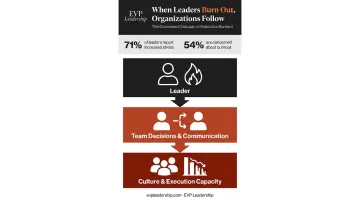
DDI's 2025 Global Leadership Forecast, drawing on data from nearly 11,000 leaders across 2,000+ organizations, found that 71% of leaders reported increased stress, with 54% of those concerned about burnout.
For small business owners and founder-CEOs, the stakes are more concentrated. Unlike corporate executives who have organizational support systems, founders are often the last line of defense. There's no peer group to absorb the pressure. Startup Snapshot's founder research found that 81% of founders are not open about their stress, fears, and challenges — and only 10% discuss it with employees at all.
The result: burnout at the top doesn't stay contained there. It moves through the organization — shaping team decisions, compressing execution capacity, and eroding the culture the leader worked to build. That's what makes recovery more than a personal issue. It's a leadership performance issue.
What Executive Burnout Coaching Actually Is (and Isn't)
Executive burnout coaching is a specific discipline. It's frequently confused with therapy, general coaching, and corporate wellness — and those distinctions matter before you invest in any of them.
What it is: A structured, private engagement focused on identifying the root causes of performance erosion under sustained pressure and building the specific systems that restore sustainable high performance.
What it isn't:
- Therapy — As the International Coaching Federation distinguishes, coaching is present-focused and future-oriented. Burnout coaching addresses what is happening now under real leadership conditions — not clinical diagnosis, personal history, or psychological treatment.
- Generic executive coaching — Traditional executive coaching assumes the leader has capacity and works on directing it more effectively. Burnout coaching starts one layer deeper: it addresses what happens when that capacity has been steadily depleted. Skill-building on a depleted foundation produces inconsistent results at best.
- Wellness programs — Corporate wellness is valuable at scale. But group programming cannot address the specific pressures, role demands, and decision patterns of a single leader. Burnout coaching is one-on-one, customized, and accountable.
What Burnout Coaching Actually Targets
The most important distinction is this: burnout coaching surfaces root causes, not symptoms. Those root causes commonly cluster around:
- A nervous system running on fumes with no mechanism to reset
- No structural recovery habits protecting the leader's restoration time
- Cognitive overload fragmenting strategic thinking into reactive noise
- Disconnection from the purpose that makes the work worth doing
- Self-worth tied so tightly to daily performance that any setback lands as a personal failure
What Happens Inside the Coaching Room
The Opening Phase: Honest Assessment
The first sessions aren't about strategy. They're about establishing a clear, honest baseline across energy, focus, decision-making quality, and relationships. This isn't a generic questionnaire — it's a candid conversation designed to surface patterns the leader hasn't had space to examine in months.
At EVP Leadership, this diagnostic work draws on the PressurePoint System's Diagnostic Layer, which examines six dimensions: Mission Clarity, Force Alignment, Problem Intelligence, Decision Integrity, Execution Discipline, and Momentum Control. Each functions as a question the leader rarely gets to answer honestly: Are our priorities actually clear? Are decisions being made from truth or from noise? Is there measurable progress on what actually matters?
Root-Cause Identification
Burnout rarely has a single cause. The coaching conversations in this phase surface the specific patterns generating depletion:
- Meeting structures that drain energy without creating decisions
- Decisions being made in isolation that should be distributed
- Recovery habits that have gradually eroded under workload pressure
- Roles and responsibilities that have grown beyond what any single person should carry
- Operating rhythms with no structural protection for restoration
The work here is diagnostic — understanding precisely what's generating the depletion, not simply acknowledging that it exists.
The Session Dynamic
Effective burnout coaching is not advice-giving. The coach asks the questions the leader rarely has space to ask themselves:
- What's actually non-negotiable here — and what just feels that way?
- What has been normalized that shouldn't be?
- Where is energy being spent in ways that don't match stated priorities?
The leader does most of the talking. The 80/20 dynamic — where the coach speaks roughly 20% of the time — is what differentiates coaching from consulting. Leaders often arrive at answers they already held but had never had room to articulate.
Practical Systems-Building
That clarity from the session work only holds if it's built into how the leader actually operates. Sustainable performance comes from repeatable systems, not willpower. EVP Leadership's burnout recovery work delivers concrete structural changes:
- Delegation protocol — defines what gets delegated, to whom, with what authority and success criteria
- Operating rhythm redesign — rebuilds the leader's week to protect recovery time structurally
- Accountability framework — 1:1 cadence, team rhythm, scorecards, and performance conversations
These aren't generic wellness tips. They're role-specific adjustments to how the leader actually operates day to day.

The Real Work: What Gets Uncovered and What Changes
The most significant early shift in burnout coaching often has nothing to do with external circumstances. It happens when the leader stops operating on the assumption that pushing harder is the answer.
For small business owners and founder-CEOs, burnout is often entangled with identity. When the business struggles, they struggle. When they slow down, they feel like they're failing.
EVP Leadership's PressurePoint Identity Layer, built around consistency, capacity, and character, directly addresses this pattern. The work creates space to examine what the firm calls "identity fused to the business" — and to build a leadership identity that exists independently of daily performance outcomes. The goal isn't to lower ambition. It's to decouple self-worth from daily output so the leader performs from a stable foundation, not a reactive one.
What Changes in Leadership Behavior
As coaching progresses, specific shifts become observable:
- Decision-making becomes clearer and less reactive
- Communication becomes more direct and less draining
- The leader builds capacity to perform under pressure without the hidden cost of chronic depletion
The research supports this. A 2023 meta-analysis of executive coaching RCTs found executive coaching produced stronger effects on behavioral outcomes than on attitudes or personal characteristics — meaning the observable behavior changes are where the real gains show up.
Real change accumulates through small, consistent habit shifts — not single breakthrough conversations. EVP Leadership's core thesis holds that leaders don't rise to expectations; they fall back on their conditioning. That's what the work is designed to rebuild.
The Conditioning Difference: Why a Reset Is Not Enough
A vacation removes a leader from pressure temporarily. Conditioning builds the capacity to perform sustainably under that same pressure — without the same erosion. Most burnout recovery strategies stop at the temporary fix. Effective burnout coaching builds what makes the fix unnecessary.
The distinction matters because behavioral science supports it. UCL's reporting on habit formation research found it takes an average of 66 days for a new behavior to become automatic — with a range of 18 to 254 days depending on the behavior and the individual. A long weekend or a course doesn't provide that runway.
The 90-Day PressurePoint System
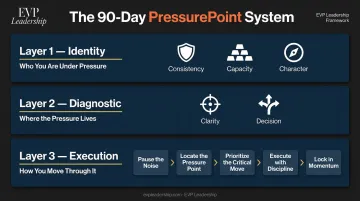
EVP Leadership's 90-Day PressurePoint System is built around this conditioning logic. Rather than addressing burnout after it has fully set in, the system builds the decision-making, communication, and operational structures that prevent capacity depletion from compounding over time.
The 90-day structure provides enough runway to move from awareness through systems-building to embedded habit change. The three-layer framework works together:
- Identity Layer: builds consistency, capacity, and character as the stable foundation
- Diagnostic Layer: trains leaders to see clearly and decide decisively under pressure
- Execution Layer: a five-step execution protocol — Pause the Noise → Locate the Pressure Point → Prioritize the Critical Move → Execute with Discipline → Lock in Momentum
The leaders who recover from burnout and stay recovered are the ones who build new operating patterns — not just new insights. A weekend workshop produces awareness. Ninety days of structured conditioning changes what a leader reaches for when pressure hits.
How to Know If Executive Burnout Coaching Is the Right Next Step
The leader who benefits most from burnout coaching isn't incapacitated. They're performing externally while something underneath is eroding under the surface.
Concrete signals to watch for:
- Decision fatigue that looks like indecisiveness in meetings
- Emotional reactivity that gets mistaken for poor judgment
- Difficulty accessing the strategic thinking that used to come naturally
- A persistent sense of "successful but not sustainable"
- Sleep loss, irritability, or loss of purpose — not dramatic, just consistent
- The drive is still there, but it costs more than it used to
Those signals point to one of two different needs. If the leader's foundation has been eroded by sustained pressure, adding skills on top of that depletion produces inconsistent results — that's where burnout coaching fits. If core capacity is intact and the leader needs sharper skills or clearer strategy, traditional executive coaching is the right tool.
Getting that distinction right determines whether the engagement actually moves the needle.
If you're reading this and recognizing yourself in that description, the right next step is a direct conversation — not a decision made alone. EVP Leadership offers a complimentary, confidential scoping conversation to assess where you are and what the right engagement would look like. Reach out at info@evpleadership.com or call (833) 991-0991.
Frequently Asked Questions
What is the 42% rule for burnout?
The "42% rule" appears in wellness media as a rest-ratio concept — the idea that roughly 42% of a 24-hour day should be protected for rest and recovery. It doesn't originate from peer-reviewed burnout research. The more relevant data point: 54% of leaders who report increased stress are concerned about burnout, according to DDI's 2025 Global Leadership Forecast. Proactive intervention is a more grounded response than a rest formula.
What is the 80/20 rule in coaching?
In effective coaching, the client speaks approximately 80% of the time while the coach speaks 20%. This question-led structure is what separates coaching from consulting or advice-giving — the leader surfaces their own answers rather than receiving solutions from the outside.
What are the 7 C's of executive presence?
The commonly cited 7 C's include confidence, clarity, credibility, communication, composure, connection, and commitment. Burnout directly erodes several of these — composure and clarity are typically the first to go, followed by the credibility that comes from consistent, grounded decision-making.
How is executive burnout coaching different from therapy?
Therapy addresses psychological and emotional health, often rooted in personal history and diagnosed mental health conditions. Executive burnout coaching is present-focused and performance-focused — it works on the systems, habits, and operational structures that make sustainable leadership performance possible. If clinical support is needed, a skilled coach will say so directly and refer accordingly.
How long does executive burnout coaching typically take to show results?
Meaningful shifts often begin within the first few sessions — not because circumstances change immediately, but because the leader stops operating on assumptions that aren't working. Embedded behavioral change, however, typically requires a structured engagement of 90 days or more.