That gap — between having leadership ability and demonstrating leadership readiness — is where most women stall. Not because the skills are gone, but because confidence erodes quietly during time away, and no amount of resume polishing addresses what is happening internally.
This is why leadership coaching designed specifically for women returnees matters. Not generic career advice. Not interview prep. Structured conditioning that prepares women to walk back in with clarity, influence, and authority — and sustain that performance once they are hired.
Key Takeaways
- Leadership coaching rebuilds professional identity and executive presence before the job search begins — not after.
- Addressing imposter syndrome early prevents it from steering women toward roles beneath their actual capability.
- Career breaks can be reframed as leadership assets, not gaps to apologize for.
- Structured, accountability-based programs produce results that self-directed job searching rarely matches.
- Effective coaching conditions women to lead consistently under pressure, not just show well in the hiring process.
Why Women Returning to Work Need Dedicated Leadership Coaching
The challenges women face when returning to work are specific — and general coaching does not fully address them.
A 2025 peer-reviewed study of women re-entering after career breaks of three to twenty years found a consistent pattern: identity distancing from being "just a mom," diminished self-efficacy, self-stigmatization, and fear that skills were no longer relevant. These are not attitude problems. They are documented psychological responses to extended time outside a professional context.
The structural backdrop makes it harder. According to McKinsey and LeanIn's 2024 Women in the Workplace report, for every 100 men promoted to manager, only 81 women are promoted — a broken rung that has barely shifted since 2018. Women returning from career breaks are re-entering a pipeline that was already stacked against them.
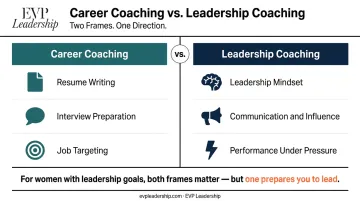
Career Coaching vs. Leadership Coaching
The distinction matters:
- Career coaching focuses on the job search: resume writing, interview preparation, job targeting
- Leadership coaching focuses on how you think, lead, communicate, and perform once you are in role
For women with genuine leadership goals, the second framing is the one that counts. The question is not just "how do I get hired" — it is "how do I walk in ready to perform and influence from day one."
That leadership framing only holds if the coaching lens accounts for gender dynamics. The barriers women face — imposter syndrome, perception bias, the confidence gap — are not personal failures. They are systemic patterns, and a skilled coach addresses them as such: with deliberate strategies, not generic mindset reframes.
Leadership Coaching Tips for Women Returning to Work
Tip 1: Rebuild Your Professional Identity as a Leader
After a career break — whether for caregiving, health, relocation, or other reasons — many women unconsciously begin to identify more as someone "out of the workforce" than as the capable leader they were before. By the time the job search begins, they are already operating from a diminished self-concept.
This work starts before the search begins. The process typically involves:
- Taking stock of accomplishments and leadership contributions prior to the break
- Identifying which leadership qualities remain fully intact
- Articulating a clear professional self-concept that anchors resume language, interview responses, and personal presentation
This is not motivational work. It is diagnostic. The Identity Layer within EVP Leadership's PressurePoint System is built on exactly this foundation — developing a leader grounded in three interconnected qualities:
- Consistency — acting in alignment with your values over time
- Capacity — carrying increasing responsibility and complexity
- Character — how you use both
In EVP Leadership's program, identity work is the starting point — not an afterthought folded in once the other pieces are in place.
Tip 2: Address Imposter Syndrome Before It Drives Decisions
Imposter syndrome during a return-to-work transition has a specific shape. Women underestimate their own qualifications. They over-prepare to compensate for perceived gaps. They default to applying for roles beneath their actual experience level — and tell themselves they are being realistic.
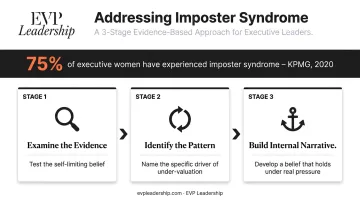
KPMG's 2020 survey of 750 high-performing executive women found that 75% had personally experienced imposter syndrome during their careers. Research also links imposter phenomenon to reduced career planning, lower motivation to pursue leadership, and less career striving — making it a direct risk to re-entry momentum, not just a confidence issue.
Addressing it requires more than a confidence boost. The real work involves:
- Examining the evidence behind the self-limiting belief (often, the evidence doesn't hold up)
- Identifying the specific patterns driving under-valuation
- Building a reliable internal narrative that holds under real pressure — not just in a coaching session
Within EVP Leadership's methodology, this work runs through the Identity Layer — treating self-limiting beliefs as identity-level issues rather than surface mindset problems that a motivational conversation can fix.
Tip 3: Translate Your Entire Experience Into a Leadership Narrative
Most women returning to work significantly undervalue what they built during their time away. Managing complex caregiving situations, leading volunteer organizations, running households under financial constraint, founding independent projects — these develop real leadership competencies. The problem is that women rarely frame them that way.
Closing that translation gap requires building a cohesive career story that:
- Connects pre-break accomplishments to current strengths
- Articulates skills maintained or developed during the break in professional language
- States clear future leadership intent without apology or qualification
The goal is a narrative that feels confident and complete — not one that constantly circles back to explaining the gap. A well-constructed leadership story does not treat the break as a liability. It treats it as context that adds dimension to an already credible professional.
Tip 4: Set Structured Goals with Built-In Accountability
One of the most common mistakes women make when returning to work independently is treating the process as an event rather than a progression. They write the resume, apply for roles, and wait — without a structured plan or anyone holding them accountable to milestones.
A structured coaching engagement changes that architecture:
- Clarity on the target role and environment — not a broad category, a specific type of organization, level, and function
- A prioritized action plan with sequenced steps rather than a to-do list
- Defined timelines that create urgency without panic
- Regular check-ins that maintain momentum when the process slows down
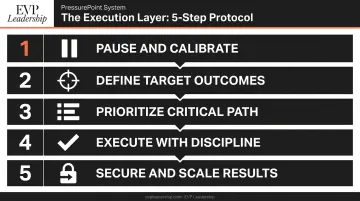
This is where EVP Leadership's conditioning-based philosophy is directly relevant. The 90-Day PressurePoint System is not a one-time session — it is a structured engagement that builds the habits, decision-making patterns, and resilience women need to perform consistently. The Execution Layer's five-step protocol gives returning leaders a practical framework for navigating re-entry without defaulting to reactive choices or paralysis:
- Pause the Noise
- Locate the Pressure Point
- Prioritize the Critical Move
- Execute with Discipline
- Lock in Momentum
Tip 5: Prepare to Lead Under Pressure, Not Just Perform in an Interview
There is a real difference between coaching that prepares women for the hiring process and coaching that prepares them to actually lead once hired. Many returning professionals get hired on competence — and then feel underprepared for what leadership actually demands once they are in the seat: reading political dynamics quickly, making decisions without complete information, managing their presence when the stakes are high.
Effective coaching for returnees includes pressure-testing:
- Practicing difficult conversations before they happen in real contexts
- Building decision-making frameworks that hold up under stress
- Rehearsing responses to complex scenarios so that performance does not depend on perfect conditions
EVP Leadership's Diagnostic Layer addresses this directly. The six components — Mission Clarity, Force Alignment, Problem Intelligence, Decision Integrity, Execution Discipline, and Momentum Control — train leaders to think clearly and act decisively in the moments that matter most, when reactive instinct or decisions made from fatigue are the default. For a woman returning to a leadership role after time away, that diagnostic training is what separates performing well in an interview from leading effectively once hired.
How Leadership Coaching Builds Lasting Confidence and Executive Presence
Executive presence — the ability to project authority, clarity, and trustworthiness in any room — is not something you either have or you don't. It is built through deliberate practice and feedback. For women returning to work, presence often diminishes during a career break simply from reduced professional exposure. Coaching accelerates its restoration.
Research by Coqual (formerly Center for Talent Innovation) found that executive presence accounts for 26% of what it takes to get the next promotion, and that gravitas — the core executive presence characteristic — includes demonstrating confidence and "grace under fire." These are learnable, not fixed traits.
Specific elements coaching addresses:
- Saying what you mean without over-explaining or hedging
- Pace, tone, and the confidence to let silence work for you
- Influence without formal authority — leading through credibility rather than title
- Managing exposure and perception in rooms where you are being assessed
Sustainable confidence — the kind that does not collapse when someone pushes back — does not come from a single motivating conversation. It comes from repeated practice with real feedback. EVP Leadership's 90-Day PressurePoint System is built on this principle: leaders are conditioned through structured frameworks and real-scenario application — repeated enough that confident performance becomes the default, not the exception.

What to Look for in a Leadership Coach
Choosing the right coach matters as much as the decision to engage one. Three factors should drive the evaluation:
- Direct experience with women in leadership transitions — not just general executive coaching, but familiarity with the specific dynamics of return-to-work and the gender-specific barriers involved
- A structured methodology — open-ended conversation is not a program; look for a defined framework with clear milestones and progression
- A willingness to hold you accountable — validation alone is not coaching; the challenge is as important as the support
On format and investment: Structured programs typically run 60 to 90 days, with 1:1 coaching the most common format for executive-level work. According to an ICF-LA pricing survey, experienced coaches commonly charge $300–$500 per hour, with structured three-month programs ranging roughly $5,000–$10,000 depending on scope.
EVP Leadership engagements are custom-scoped, with a complimentary scoping conversation preceding every engagement to assess fit and define the right program structure.
One last factor: trust your instinct on fit. A coaching relationship requires psychological safety and honest challenge in equal measure. If a coach only encourages without ever pushing back, that is not leadership coaching. The right coach surfaces blind spots, names the hard things, and holds the standard even when it would be easier not to.
Frequently Asked Questions
What are the 5 C's of leadership coaching?
The "5 C's of leadership coaching" is not a standardized framework — different sources use different models. Common themes include Clarity, Confidence, Commitment, Communication, and Courage, but the ICF's formal standard is its 8 Core Competencies. When evaluating a coach, ask about their specific methodology rather than a named framework.
How much does it cost to hire a leadership coach?
Costs vary based on coach experience, program scope, and format. Experienced executive coaches typically charge $300–$500 per hour, with structured 90-day programs often packaged in the $5,000–$10,000 range. Individual sessions with career-focused coaches may run lower. The best indicator of value is whether the engagement is structured, accountable, and designed for your specific goals — not the hourly rate.
Is leadership coaching worth it for women returning to work?
Research consistently shows coaching improves leader effectiveness, confidence, and decision-making quality. An ICF survey found 87% of respondents agreed executive coaching delivered high ROI. For women returning to leadership roles, the return extends beyond career outcomes: it includes reclaimed professional identity and the confidence to pursue roles commensurate with actual experience, not diminished self-assessment.
How is leadership coaching different from career coaching?
Career coaching focuses on the job search: resume, interviews, and job targeting. Leadership coaching focuses on how you think, lead, communicate, and perform once you are in role. For women with genuine leadership ambitions, the distinction is material — one prepares you to get hired, the other prepares you to lead effectively once you are.
How long does it take to see results from leadership coaching?
Meaningful shifts in confidence and clarity often begin within the first few sessions, as early work surfaces and reframes accumulated self-doubt. Lasting behavioral changes that hold under real pressure typically develop over a structured 60-to-90-day engagement with consistent accountability and practice.