This gap is more common than most leaders admit, and it costs real money. It shows up in missed deals, teams that execute reluctantly, and communication that doesn't translate strategy into motion.
This article breaks down what executive presence actually means, a practical framework for building it, strategies for strengthening it under real conditions, and how to build genuine influence even when you don't hold positional authority.
Key Takeaways
- Executive presence is built from observable, trainable behaviors — not personality traits you either have or don't
- Gallup research shows managers account for 70% of the variance in team engagement — presence is a performance issue, not just a polish issue
- Presence developed only in comfortable settings disappears exactly when it's needed most
- Influence without authority is built through consistency, not charisma
- Only about 15% of people are truly self-aware — structured feedback is non-negotiable for development
What Is Executive Presence? (Going Beyond the Buzzword)
Search "executive presence" and you'll return tens of millions of results. Ask ten senior leaders to define it precisely and you'll get ten different answers. That vagueness isn't evidence that the concept is empty — it's exactly why so many leaders struggle to develop it deliberately.
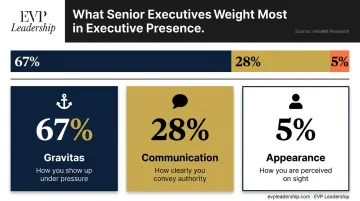
A definition worth building on comes from Sylvia Ann Hewlett's work, summarized in a 2024 HBR analysis: executive presence is a combination of gravitas, communication, and appearance — with senior executives weighting gravitas at 67%, communication at 28%, and appearance at just 5%. The practical takeaway: presence isn't about how you look. It's about how you carry your knowledge, communicate under uncertainty, and make others feel certain in your leadership — even before a decision is finalized.
Presence vs. Surface-Level Traits
That definition matters because presence gets misattributed constantly. Most leaders chasing it are chasing the wrong things:
- Loudness or dominance in a room
- Polished appearance or a commanding physical stature
- Assertiveness or confidence under easy conditions
- Seniority or tenure in a role
None of those are presence. True presence is alignment — when how you think, speak, and act point in the same direction. The clearest test isn't how you perform in a rehearsed setting. It's whether your team finds steady ground in you when the situation is uncertain and the stakes are real.
The 5 C's of Executive Presence
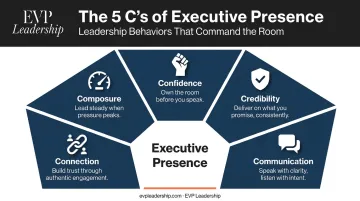
Rather than treating presence as a vague quality you either have or don't, this framework breaks it into five observable, developable behaviors. Assess where you're strong. Be honest about where you're not.
Confidence
Confidence here isn't bravado. It's the willingness to speak with conviction about what you know, own your decisions without deflecting, and stay grounded when challenged.
In practice, it's the difference between decisive language ("We're moving in this direction") and hedging ("I think we might want to consider possibly..."). It looks like a settled posture and a voice that doesn't rise at the end of statements as if asking for permission.
Credibility
Credibility is earned through consistency — doing what you say, knowing your domain deeply, and delivering on commitments. Leaders with genuine credibility don't need to over-explain themselves. Their track record speaks before they do. When that track record is solid, authority follows naturally — no additional convincing required.
Communication
Presence-driven communication prioritizes clarity and intentionality over volume or frequency. Leaders with executive presence know when to speak, what to say, and how to frame ideas so they land in adversarial or high-stakes rooms. HBR notes that transformational leaders are exceptional communicators — not because they talk more, but because every word earns its place.
Connection
The ability to make others feel heard, respected, and included is one of the most undervalued components of presence. Leaders who connect don't just have followers — they have people who want to follow. At EVP Leadership, Teri Evans grounds her facilitation work in exactly this principle — that presence without awareness of others is just performance.
Composure
Composure is the ability to stay regulated and clear-headed when pressure mounts. Your presence doesn't collapse during conflict, crisis, or high-stakes decisions — which is precisely when it matters most. Gravitas under fire was consistently rated among the top executive selection criteria in Hewlett's research.
Why Executive Presence Matters for Business Owners and Entrepreneurs
For leaders inside large organizations, institutional authority provides a baseline of credibility. For founders, owner-operators, and small business CEOs, no such structure exists.
How a founder shows up in a client conversation, an investor meeting, or a team alignment session directly shapes how the company is perceived. Personal presence is the brand — and it carries that weight whether the leader is ready for it or not.
The business stakes are direct:
- Gallup attributes 70% of the variance in team engagement to the manager. Weak presence doesn't just affect the leader — the whole team underperforms as a result.
- EVP Leadership's work with small and mid-size business founders surfaces a recurring pattern: communication breakdowns, poor delegation, and directional ambiguity that slow decisions and cost revenue.
- Leaders with strong executive presence earn trust faster with clients and stakeholders — which translates directly to decisions made, deals closed, and teams that move without being pushed.
The Hidden Cost Nobody Talks About
Underdeveloped presence doesn't announce itself. It shows up quietly as:
- Deals that were technically competitive but didn't close
- Teams that are capable but wait for permission
- Delegation that fails because the leader can't release control cleanly
- Strategy that never converts to motion because the communication doesn't stick
None of these symptoms show up on a P&L. But they compound — and they trace back to the same root: a leader whose presence isn't doing the work the business needs it to do.
How to Develop Executive Presence: Practical Strategies
Here's the distinction that matters most: training gives leaders new knowledge. Conditioning builds the automatic responses that hold up under pressure.
Presence developed only in comfortable settings — a well-rehearsed pitch, a pre-planned meeting — often disappears in the moments that matter: a hostile board question, a crisis conversation, an unexpected challenge to your authority. EVP Leadership's PressurePoint System is built around this distinction. The conditioning philosophy is explicit: leaders don't rise to expectations under pressure — they fall back on their conditioning.
Strengthen Your Communication and Storytelling
Persuasive communication starts with translating complex ideas into clear, compelling narratives. Start with these three techniques:
- Reduce filler language deliberately — not by eliminating every "um" (Stanford research notes fillers can carry meaning), but by slowing down and using intentional pauses instead of verbal noise. A 5–10 second pause after asking a question signals confidence, not confusion.
- Structure messages around one clear point — not exhaustive context. Most leaders over-explain because they're uncertain the point will land. Presence comes from trusting the clarity of your core message.
- Build a leadership narrative — a concise, authentic story of who you are as a leader, what you stand for, and where you're taking the organization. Harvard Business Publishing research shows leaders use narrative to influence, teach, convince, and inspire across every stakeholder context. This narrative should work in a team meeting, an investor conversation, and a client pitch — same thread, adapted audience.
Build Composure as a Practiced Skill
Composure is not a personality trait reserved for naturally calm people. It is a practiced response pattern. Structured breathing practices, used consistently, reduce stress and anxiety responses — the same technique surgeons, military personnel, and elite athletes rely on to prevent performance degradation under pressure.
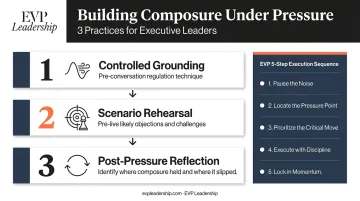
Build it through these three practices:
- Controlled grounding before high-stakes conversations — a brief breathing practice before a difficult meeting isn't soft; it's the same stress-regulation technique used by surgeons, military personnel, and elite athletes to reduce performance degradation under pressure.
- Scenario rehearsal for likely objections — mentally pre-living a challenging conversation before it happens reduces the novelty of pressure when it arrives. EVP Leadership's Execution Layer formalizes this: Pause the Noise → Locate the Pressure Point → Prioritize the Critical Move → Execute with Discipline → Lock in Momentum.
- Post-pressure reflection — after a high-stakes conversation, identify specifically where composure held and where it slipped. Pattern recognition is how you improve the next performance.
The concept of pressure rehearsal matters here: deliberately placing yourself in lower-stakes but genuinely challenging situations builds the muscle memory for composure. Leaders who practice performing under controlled stress develop more reliable responses when real pressure hits.
Develop Self-Awareness and Seek Deliberate Feedback
Research cited by Harvard Business Publishing finds that only about 15% of people are sufficiently self-aware. That gap is wider than most leaders want to believe — and it's the primary reason presence problems persist despite good intentions.
Most feedback leaders receive is useless for development: "great presentation" or "you should be more assertive" tells you nothing about what to change. Meaningful feedback requires specificity:
- Identify 2–3 trusted observers who see you in high-stakes contexts — not just peers who want to be supportive
- Ask targeted behavioral questions — "In that board meeting, when I responded to the challenge about Q3, did my tone stay grounded or did it tighten?" gives actionable data
- Use the CCL's SBI framework: Situation, Behavior, Impact — ask observers to describe the specific situation, the exact behavior they observed, and the impact it had on the room
Treat this data as a leadership development roadmap, not a performance review. Specific behavioral feedback is the fastest way to close the gap between how you think you show up and how you actually do.
Building Influence Without Formal Authority
One of the most common misconceptions about executive presence is that it requires positional power. It doesn't. Influence is built through credibility, consistency, and the ability to help others see a path they couldn't see on their own — no title required.
Two Techniques That Work Immediately
Reciprocity before transactions. Cialdini's first principle of influence is reciprocity: people are more likely to say yes to those they feel they owe. The practical application isn't transactional. Invest in relationships before you need something from them. Leaders who give first — insight, support, access, an introduction — build a trust reserve that translates into real authority when decisions need to be made.
Message framing around the audience. Before any high-stakes conversation, identify three things: What does this person care about? What are they worried about? What does success look like from their seat? Structure your message around those answers, not around what you want to say.
The Strategic Role of Informal Networks
MIT Sloan Management Review research shows that informal networks provide the connective tissue for cross-functional initiatives, alliances, and organizational change that org charts alone can't accomplish. Leaders who invest in these networks gain access to information and influence that formal authority can't buy.
Map your informal relationships honestly: Where do you have trust capital? Where are you unknown or peripheral to conversations that matter? That map is your influence development plan.
Influence Requires Consistency, Not Isolated Performances
That map only pays off if you show up the same way every time. Sustainable influence is built through repeated behavior, not single impressive moments. Showing up consistently in easy situations and hard ones builds the trust that generates authority over time.
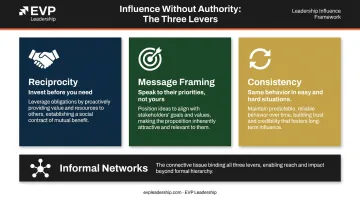
This is what EVP Leadership's conditioning approach develops through the Identity Layer of the PressurePoint System: the habits of consistency, capacity, and character practiced until they become defaults, not performances you reach for when the stakes are high.
Frequently Asked Questions
What are the 5 C's of executive presence?
The 5 C's are Confidence, Credibility, Communication, Connection, and Composure. Because each is an observable behavior, each can be assessed and deliberately developed.
Why is executive presence important in leadership roles?
Executive presence enables leaders to build trust, drive alignment, and influence outcomes — especially in high-stakes situations where positional authority alone isn't enough to move people. It's what converts strategy into execution.
Can executive presence be developed, or is it innate?
Executive presence is a learnable skill set, not a fixed personality trait. It develops through deliberate practice, self-awareness, and consistent application under real-world conditions — which is why conditioning produces results that training alone doesn't.
What is the difference between executive presence and confidence?
Confidence is one component of executive presence. Full presence also requires communication clarity, earned credibility, composure under pressure, and the ability to connect with and influence others — self-assurance alone doesn't account for all of that.
How do you demonstrate executive presence under pressure?
Presence under pressure comes from conditioned responses, not improvisation. Leaders who have rehearsed composure, practiced structured decision-making, and trained their communication discipline don't improvise when stakes are highest. They execute what they've already built.