Gallup research found that managers account for at least 70% of the variance in employee engagement scores across business units. That single statistic reframes coaching and mentoring from soft-skill extras into core business levers.
This guide covers what coaching and mentoring actually mean in a leadership context, how they differ, the skills required to do both well, and how to build these practices into habits that hold under pressure—not as one-time training events.
Key Takeaways
- Coaching targets present performance; mentoring develops long-term career trajectory—strong leaders use both
- Strong leaders master all four coaching styles and shift between them as the situation demands
- Active listening, powerful questions, goal-setting, feedback, and trust are the five core coaching skills every leader needs
- Development investment is directly linked to retention: 94% of employees say they'd stay longer if their company invested in their growth
- Building a coaching culture takes consistent repetition and systems—not one-off training events
Coaching vs. Mentoring: Understanding the Key Difference
These two terms get used interchangeably constantly. They shouldn't be—because they serve fundamentally different purposes, and confusing them leads to applying the wrong intervention at the wrong time.
What Coaching Is
Coaching is a goal-oriented, structured process where a leader works with an individual to improve current performance, close specific skill gaps, or overcome obstacles within their existing role. It's present-focused. The conversation centers on what's happening now, what's getting in the way, and what needs to change in the next 30 to 90 days.
What Mentoring Is
Mentoring is a longer-term, relationship-based process where a more experienced leader shares knowledge, perspective, and career wisdom. The mentee benefits from the mentor's navigation of the organization, perspective on the industry, and insight into paths they haven't walked yet. It's development-focused—thinking beyond the current role toward what comes next.
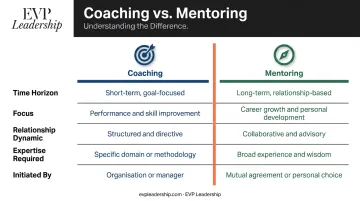
Side-by-Side Comparison
| Dimension | Coaching | Mentoring |
|---|---|---|
| Time horizon | Short-term (weeks to months) | Long-term (months to years) |
| Focus | Performance, skill gaps | Career development, growth |
| Relationship dynamic | Structured, agenda-driven | Organic, relationship-driven |
| Expertise required | Skill-specific knowledge | Broader experience and perspective |
| Initiated by | Often the leader or manager | Often the mentee |
The strongest leaders use both—and use them deliberately. Coaching fixes what's limiting performance today; mentoring shapes where someone is headed next. Reading which one a situation calls for, and adjusting accordingly, is where leadership judgment shows up in practice.
The 4 Types of Coaching Leaders Should Know
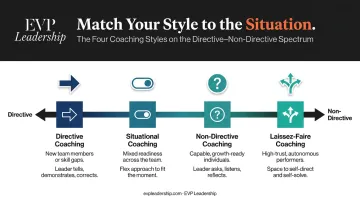
No single coaching style works for every person or situation. According to Harvard Business Review's 2019 analysis, leaders can be mapped along a matrix from highly directive to highly non-directive—and the most effective leader-coaches move fluidly across that spectrum.
The four primary styles:
Directive coaching — The leader provides clear guidance, instruction, and a defined learning path. Most effective for new skills, urgent performance gaps, or when the individual lacks experience in the specific area. The risk: over-reliance on this style suppresses independent thinking.
Non-directive coaching — The coach uses questions to help the individual surface their own answers. Builds ownership, independent problem-solving, and long-term capability. Requires more patience but produces more durable results.
Laissez-faire coaching — Minimal active intervention. Appropriate only for highly skilled, self-motivated individuals who need space more than guidance. Misapplied as a default, it signals disengagement.
Situational coaching — Adapts to the individual's developmental level and the demands of the moment. A leader might be directive with a new hire on a technical skill while being entirely non-directive with a senior team member working through a strategic challenge.
Leaders who default to whichever style feels personally comfortable—usually directive for action-oriented leaders, non-directive for relationship-oriented ones—miss development opportunities their teams actually need. Matching style to the situation, not to personal preference, is what separates adequate coaching from effective leadership.
Core Coaching and Mentoring Skills Every Leader Must Develop
Active Listening
Most leaders listen to respond. Effective coaches listen to understand. That means setting aside your own agenda, resisting the urge to jump to solutions, and paying attention not just to what's being said but to what's underneath it—values, concerns, emotions that the individual may not be naming directly.
The ICF lists active listening as a core coaching competency for a reason: it creates the psychological safety that makes honest dialogue possible. When someone feels genuinely heard, they're far more likely to surface real problems rather than presenting the version of the situation they think you want to hear.
Asking Powerful Questions
The quality of your questions determines the quality of the thinking you produce. Questions beginning with "what" or "how" open reflection and push individuals toward their own answers:
- "What's actually getting in the way here?"
- "How would you approach this differently if you had no constraints?"
- "What are you not saying that might be relevant?"
Compare that to leading questions—"Don't you think you should have handled that differently?"—which create defensiveness and steer the conversation toward a conclusion you've already reached.
Goal-Setting and Accountability
Insight without structure evaporates. Every coaching conversation should end with clear, agreed-upon next steps—specific enough that both parties know what done looks like. Research by Locke and Latham consistently found that specific, challenging goals outperform vague "do your best" goals on performance outcomes.
Accountability in coaching isn't pressure—it's shared commitment. The follow-through check-in at the next conversation is what transforms coaching from a good talk into actual development.
Providing Constructive Feedback
Effective coaching feedback is:
- Specific — tied to observable behaviors, not general impressions
- Timely — delivered close to the event, not months later in a review
- Behavior-focused — about what someone did, not who they are
- Connected to growth goals — linked to what the person is working toward
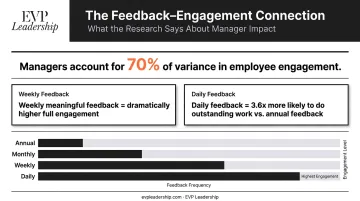
Gallup's research on feedback frequency is striking: employees who receive meaningful feedback weekly are fully engaged at dramatically higher rates, and daily feedback makes employees 3.6x more likely to be motivated to do outstanding work compared to annual feedback.
Building Trust and Psychological Safety
No coaching or mentoring relationship produces lasting results without trust. Leaders demonstrate trustworthiness through consistency (doing what they say), confidentiality (protecting what's shared), and genuine investment (showing up prepared and present).
That foundation is what Teri Evans, Leadership Facilitator at EVP Leadership, built her approach on — work that began in pediatric oncology at Mayo Clinic's Children's Hospital, where creating safety wasn't optional. Her core belief: effective leadership is defined by presence, awareness, and the ability to help others grow — and that holds in a one-on-one coaching conversation as much as it does in a team setting.
Balancing Challenge and Support
Effective coaching is not simply encouragement. It requires asking the uncomfortable question, surfacing the assumption the individual hasn't examined, and pushing beyond the answer that feels safe.
The balance is straightforward: challenge the thinking, support the person — not the other way around.
Why Coaching and Mentoring Drive Business Performance
Retention
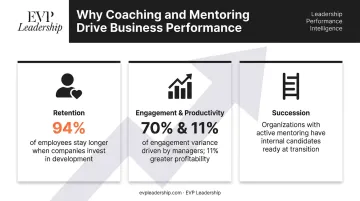
When leaders invest in someone's growth, that person notices. LinkedIn's 2018 Workplace Learning Report found that 94% of employees would stay at a company longer if it invested in their career development. For small and mid-size businesses where replacing a key employee can cost 50-200% of their annual salary, retention is not an abstract metric.
Engagement and Productivity
Gallup's data on manager impact is clear: managers account for at least 70% of the variance in employee engagement across business units. Coaching-capable leaders don't just develop individuals—they lift the entire team's output. Gallup also links strategic investment in employee development to 11% greater profitability and organizations being twice as likely to retain employees.
Succession and Leadership Pipeline
Retention data and engagement scores tell part of the story. The other part plays out when a key person leaves and no one is ready to step up.
Organizations that mentor deliberately—pairing experienced leaders with high-potential individuals over months and years—build an internal pipeline before the vacancy exists. Those that don't treat succession as an afterthought typically discover the gap at the worst possible moment.
Gennifer Baker's executive consulting work at EVP Leadership covers succession planning and exit-readiness with small and mid-size businesses. What she observes across engagements:
- Organizations with active mentoring relationships have internal candidates ready when transitions happen
- Organizations without them spend critical weeks or months in reactive hiring mode
- The difference isn't talent scarcity—it's whether leadership development was treated as ongoing work or a one-time event
How to Build a Coaching and Mentoring Culture That Lasts
Start at the Top
A coaching culture cannot be installed from the middle. If senior leaders aren't modeling coaching behaviors—asking questions instead of issuing directives, holding mentoring relationships, publicly championing development—middle managers won't take it seriously. The message has to be both stated and demonstrated.
Embed Coaching in Everyday Leadership
Formal coaching sessions matter. But the real culture shift happens when leaders apply coaching skills in ordinary moments: the one-on-one that uses powerful questions instead of status updates, the project debrief that focuses on learning rather than blame, the team meeting where someone's idea gets genuine exploration rather than quick dismissal.
Those micro-moments, repeated daily, build culture faster than any scheduled training event.
Design Formal Mentoring with Intention
Formal mentoring programs work when designed well—and underperform when assumed. Key structural elements:
- Purposeful pairing — match based on goals, not seniority alone
- Clear expectations — both parties should know the time commitment and what success looks like
- Mentor training — senior experience doesn't automatically translate to effective mentoring
- Accountability checkpoints — scheduled touch points prevent the relationship from quietly dying
Research from Ragins and Cotton found that informal mentoring relationships often produced stronger protégé outcomes than formal programs—precisely because formal programs don't always reproduce the quality of career guidance and psychosocial support that organic relationships do. Well-designed formal programs can close that gap by deliberately building those same conditions in.
Condition Skills Through Repetition, Not One-Time Events
This is where EVP Leadership's philosophy is directly relevant. Their core argument: under pressure, leaders don't rise to expectations—they fall back on their conditioning. Most leaders have been trained. Far fewer have been conditioned.
The 90-Day PressurePoint System is built on this premise: systematically developing leadership capacity through structured frameworks, real application, and repetition across the full 90-day arc. The same logic applies to coaching and mentoring skills.
A workshop teaches concepts. Repeated practice under actual conditions builds the muscle memory. That distinction matters when a conversation gets uncomfortable or a direct report pushes back.
Learning science supports this directly: spaced practice over time produces more durable skill retention than massed training events. The mechanism matters as much as the content.
Measure Whether It's Taking Root
A coaching culture that isn't measured tends to drift. Track both behavioral and outcome indicators:
Behavioral indicators:
- Are managers having coaching conversations regularly, or reverting to directive communication?
- Are one-on-ones structured around development or just task status?
- Are mentoring relationships active and documented?
Outcome indicators:
- Employee engagement scores
- Internal promotion rates
- Voluntary retention trends
- Upward feedback quality on manager effectiveness
If the behaviors are there but the outcomes aren't moving, the quality of the conversations needs examination. If the outcomes are moving but without the behaviors, it's likely driven by external factors rather than cultural change.
Frequently Asked Questions
What does coaching mean?
Coaching is a structured, goal-oriented process where a leader works with someone to improve performance in a specific area through questioning, feedback, and goal-setting. Unlike advising, the coach helps the individual reach their own answers rather than simply supplying them.
What are the 4 types of coaching?
The four types are directive, non-directive, situational, and laissez-faire. Effective leaders adapt their style based on the individual's skill level and the demands of the situation—rather than defaulting to a single approach regardless of context.
What are the 5 principles of coaching?
The five core principles are active listening, powerful questioning, goal-setting, constructive feedback, and building trust. These work in parallel across every coaching conversation, not as a sequence to follow step by step.
What is the difference between coaching and mentoring in leadership?
Coaching is short-term and performance-focused, targeting specific skill gaps or obstacles within someone's current role. Mentoring is longer-term and relationship-based, focused on career development and growth beyond the current position. Strong leaders use both, depending on what an individual actually needs.
What are the most important coaching skills for a leader?
Active listening, asking powerful questions, and consistent follow-through on accountability are the core three. Each must be practiced under real pressure—not just in comfortable conditions—to hold up when a conversation gets difficult.
How do you know if your coaching and mentoring program is working?
Track both behavioral signals—richer feedback conversations, increased initiative, mentee confidence—and measurable outcomes like retention rates, engagement scores, and internal promotion data. If behaviors are shifting but results aren't, examine conversation quality. Outcomes without behavior change usually signal gains that won't last.