
Key Takeaways
- 65% of high-potential startups fail due to co-founder conflict, not market failure
- Knowing which decision mode to use — consensus, functional ownership, or CEO-final — prevents founder gridlock
- 50/50 equity creates legal deadlock risk — not just symbolic tension
- Role clarity requires documentation and regular review as the company scales
- Decision-making authority requires conditioning — not just a written agreement
Why Co-Founder Authority Breaks Down (Even With Good Intentions)
Most co-founding teams start the same way: two people with shared vision, mutual trust, and a handshake understanding that they'll figure things out together. That works fine when the company is small and decisions are cheap. Then the company grows, decisions become time-sensitive, and "we'll figure it out together" stops being a strategy.
The default fix is consensus. It feels fair. It keeps the peace. But according to Harvard Business School professor Noam Wasserman, 65% of high-potential startups fail due to co-founder conflict — not market failure, not bad products, not bad timing. Co-founder conflict.
The Structural Problem Nobody Talks About
In a two-person founding team, both partners simultaneously occupy all three layers of corporate governance: shareholders, board members, and executive officers. A 50/50 split isn't just philosophically awkward — it's legally precarious.
Under Delaware law, a corporation with two 50% stockholders who cannot agree can face court-ordered dissolution. Either party can petition the Court of Chancery, and if no agreement is reached within three months, the court may dissolve the company entirely.
That's not a hypothetical edge case. It's a documented legal mechanism that exists because founding-team deadlocks are common enough to warrant statutory remedies.
The Two Failure Modes
Authority breakdown in founding teams follows one of two patterns:
- Paralysis by consensus — every decision requires both founders; speed suffers, bottlenecks compound, and resentment builds over sign-offs that shouldn't be required
- Assumed authority without definition — one founder starts making calls in areas the other considered their domain; the other never agreed to that arrangement, and trust erodes until it breaks at the worst possible moment
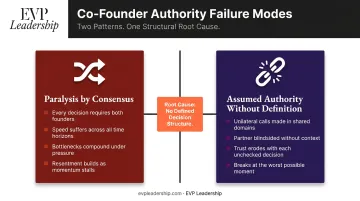
In both cases, the root cause isn't conflict of character — it's the absence of a defined decision-making structure from the start.
The Three Modes of Co-Founder Decision-Making
Effective co-founder teams don't apply one decision-making method to everything. They use three distinct modes, and knowing which mode applies to a given decision is itself a leadership skill.
Consensus-Based Decisions
Consensus is the right call for a specific category of decisions — not for everything. Use it when:
- The company is considering a strategic pivot or mission shift
- A decision materially affects both co-founders' domains equally
- You're making a C-suite hire that changes the power structure of the company
- The long-term direction of the business is genuinely in question
The critical distinction: consensus should be a deliberate choice, not a reflexive default. Teams that use consensus for everything aren't being collaborative — they're avoiding the harder work of defining who owns what.
Before issues arise, co-founders should agree in writing on which decision categories require collective sign-off. That list will be shorter than most founders expect.
Functional Expertise Decisions
As co-founders develop distinct roles — one running product, one running revenue, for example — decisions within each domain should belong to that person. That's the whole point of having distinct roles.
Two errors undermine this arrangement repeatedly:
- Territorial rigidity — a co-founder makes unilateral calls without flagging cross-functional implications, leaving their partner blindsided
- Autonomy erosion — a co-founder constantly second-guesses decisions in their partner's domain, nominally deferring but making the other person feel their judgment isn't trusted
McKinsey research on organizational decision-making found that 80% of organizations struggle with decision-making — and the most common root cause is unclear ownership, not poor judgment. The solution isn't more meetings. It's clearer role definition.
Hierarchical Authority Decisions
Even on the most egalitarian founding team, some decisions require the CEO to make a final call. That's not a failure of partnership — it's functional governance.
The challenge is that co-founders resist this instinctively. The hierarchical distance between a CEO co-founder and a CTO co-founder feels minimal. They're the same age, they talk every day, they own equal stakes. So why should one person's view carry more weight?
Because without a defined tiebreaker, deadlocks become crises.
The CEO must learn to exercise final authority through influence and transparency — explaining the reasoning, hearing the objection, then making the call.
Non-CEO co-founders must genuinely commit to decisions they disagreed with, not just grudgingly comply. That's the harder ask, and it's where most co-founder authority frameworks break down in practice.
How to Define Roles and Leadership Authority Between Co-Founders
Role clarity doesn't mean drawing rigid boxes around who does what. It means documenting who has decision-making authority in each functional area so decisions don't stall waiting for consensus that isn't required.
Common Role Splits and What They Mean for Authority
| Structure | CEO Owns | Co-Founder Owns |
|---|---|---|
| CEO / CTO | Product roadmap priority, go-to-market timing | Technical architecture, engineering hiring, build vs. buy calls |
| CEO / COO | Vision, external relationships, fundraising | Operational execution, team structure, process design |
| Vision / Execution | Strategy, investor narrative, key partnerships | Hiring, budgeting, day-to-day performance management |
These aren't just title differences. Each structure implies a distinct set of decisions that belong to one person without requiring the other's approval.
Mapping Decisions Before Conflict Happens
The most practical exercise any founding team can do is this: list the 20-30 major recurring decisions in the business and categorize each one as:
- Consensus-required — both founders must agree
- Functionally owned — belongs to whichever co-founder owns that domain
- CEO-final — requires a decision, not a negotiation
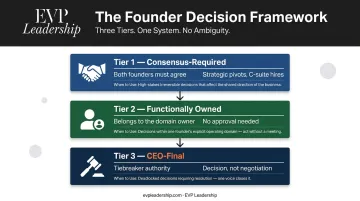
This exercise surfaces hidden assumptions. One co-founder may believe product pricing is consensus-required. The other may assume it's functionally owned by whoever runs revenue. Until it's written down, both assumptions coexist until they collide.
When the First Senior Non-Founder Joins
The real test of a co-founder authority framework comes the moment the first senior non-founder executive joins the company. That person expects genuine autonomy within their domain.
If co-founders can't agree on what authority they're actually delegating — or keep circling back to override decisions they said they were handing off — that executive will either become ineffective or leave.
First Round Review's guidance on executive hiring frames this as "giving away your Legos" — handing over responsibilities every few months as the company grows. Founders who can't do this have an authority problem, not a hiring problem.
Role clarity must also be revisited as the company scales. The structure that works with two founders and five employees won't survive a twenty-person team. This is the kind of structural work EVP Leadership's executive consulting engagements focus on — helping founding teams build leadership frameworks that hold up as headcount and complexity grow.
How Equity Structure Shapes Decision-Making Authority
Equity isn't just a financial arrangement. It's a governance document that determines who has authority when formal agreement breaks down.
The 50/50 Problem
Research from Hellmann and Wasserman analyzing 885 North American startup teams found that approximately 35% of founding teams split equity equally — and that teams who split equity equally and decide quickly experience lower performance, including lower employment growth, compared to teams that negotiate more carefully.
A 50/50 split creates more than symbolic tension. At the shareholder level, it means neither founder has majority authority. At the board level, every contested vote ends in a tie. Delaware law's Section 273 exists specifically because 50/50 corporations deadlock often enough to require a judicial remedy.
Alternatives That Preserve Partnership
Structures like 51/49 or 60/40 accomplish something important: they signal who holds final authority without eliminating the partnership dynamic. A co-founder holding 40% of a company that reaches meaningful scale still has a significant financial outcome. The point isn't control for its own sake — it's governance clarity that prevents a legal impasse from becoming a company-ending event.
Y Combinator recommends that before a significant equity fundraise, only the CEO should sit on the board, to reduce board-level disputes during difficult decisions. That's a structural answer to an authority problem.
Vesting works the same way — just one level down, at the equity itself rather than the boardroom.
Vesting as a Decision-Making Protection Tool
Vesting schedules aren't just about financial fairness if someone leaves early. They're an alignment mechanism — ensuring that authority structures remain connected to active contribution.
The standard Silicon Valley structure is four years with a one-year cliff. Leave at month eight and you walk away with nothing. Leave at month eighteen and you take 25-37% of your stake, depending on the structure.
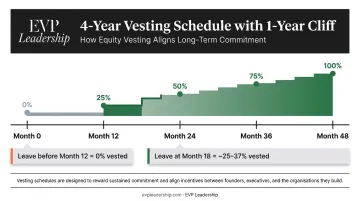
The Facebook/Saverin situation illustrates what happens without this protection. Eduardo Saverin's stake was diluted from approximately 24% to below 10% through share issuance after Facebook incorporated in 2004 — a dispute that ended in litigation. The lesson is direct: unclear equity structures and absent vesting protections create the conditions for authority disputes that can outlast the company itself.
Conditioning Your Co-Founder Team to Decide Confidently Under Pressure
A founding team can document every decision mode, define every role, and structure equity thoughtfully — and still freeze when a high-stakes call arrives under time pressure. That's because defining a structure is not the same as conditioning your team to operate within it.
EVP Leadership's core thesis applies directly here: under pressure, leaders don't rise to expectations. They fall back on their conditioning. Most co-founders have been trained — they've read the books, attended the programs, had the conversations. Very few have been conditioned to execute their authority structure when it's actually hard.
Practices That Build Real Decision-Making Capacity
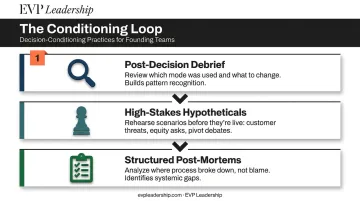
These aren't feel-good exercises. They're the reps that build reflexes:
- After major calls, debrief the process — which decision mode was used, whether it was the right one, and what you'd change; this builds pattern recognition faster than any framework document
- Walk through high-stakes hypotheticals before they're live: a major customer threatens to leave, a key hire wants equity, one founder wants to pivot. The real conversation is calmer when you've already had a version of it
- Run structured post-mortems on bad decisions — not blame sessions, but honest analysis of where the process broke down. This is the step most founding teams skip, and it's the one that would make them significantly better
The Relational Dimension
Google's Project Aristotle research identified psychological safety as the single most important factor in team effectiveness. A 2022 study of over 1,150 leaders across 160 management teams found psychological safety was positively correlated with task performance (r = 0.51) and individual satisfaction (r = 0.70).
Co-founders who maintain their personal relationship — not just their professional one — make better decisions together. Trust reduces the defensive posturing that slows decisions down.
When a CEO co-founder makes a call the other disagrees with, the non-CEO's ability to genuinely commit (rather than quietly undermine) depends almost entirely on whether that relational foundation is intact.
EVP Leadership's Approach to Founder Decision Conditioning
The 90-Day PressurePoint System addresses this gap directly. It doesn't teach co-founders new frameworks — it conditions leaders to execute under real business conditions: time pressure, competing priorities, incomplete information, and the interpersonal friction that comes with high stakes.
Through founder and co-founder pair engagements, EVP Leadership builds two specific capacities the PressurePoint System targets: Decision Integrity — grounding decisions in truth rather than noise and emotion — and Force Alignment, which addresses whether the right people are fully committed and accountable. These aren't abstract concepts. They're the failure points that surface, consistently, when co-founding teams hit real pressure.
Most founding teams need more than instruction. They need preparation — and there's a meaningful difference between the two.
Frequently Asked Questions
Should co-founders be 50/50 equity?
While 50/50 feels intuitively fair, it creates genuine governance deadlock at the shareholder and board level — legally unresolvable without outside intervention in some cases. Structures like 51/49 or 60/40 preserve a meaningful, motivated partnership while providing clarity on who holds final decision-making authority.
What is the role of a co-founder in a startup?
A co-founder is an early, equity-holding partner who shares both ownership and leadership responsibility for building the company. That role typically evolves from a generalist contributor in the early stage to a defined functional leader — CTO, COO, CPO — as the startup scales and the org structure solidifies.
How do co-founders decide who makes the final call?
Decisions within a co-founder's functional domain are theirs to make. Decisions that cut across both domains may warrant consensus. Everything else defaults to the CEO as the designated final authority — a structure agreed upon in advance, not renegotiated every time conflict arises.
What happens when co-founders can't agree on a decision?
Persistent deadlock is usually a symptom of unclear authority structures, not irreconcilable differences. Pre-agreed escalation protocols — including the CEO's explicit tiebreaker role for defined decision categories — prevent disagreements from becoming crises by removing the need to renegotiate authority every time a conflict arises.
How should co-founders divide roles and responsibilities?
The most effective divisions align each co-founder's functional ownership with their strongest skills and clearest contributions, then formalize those in a written document that specifies not just what each person does, but what decisions they own independently — without requiring the other's approval.
Can a startup have two CEOs?
Some early-stage companies try co-CEO structures, but the model creates authority ambiguity and signals unclear governance to investors. Fewer than 100 of 2,200 companies in the S&P 1200 and Russell 1000 used co-CEO arrangements between 1996 and 2020. One CEO with a co-founder in a distinct executive role is the far more sustainable structure.