Introduction
Every relationship a CEO has inside their organization is filtered through power. Direct reports manage up. Boards filter through governance agendas. Peers compete or report to the same authority structure. This isn't a communication problem — it's structural. And it's why even experienced, capable CEOs routinely operate on distorted feedback.
The result: high-stakes decisions made without a real sounding board, blind spots that nobody names, and a growing gap between what the CEO believes is happening and what's actually true on the ground.
CEO leadership coaching exists to address this specific structural reality. Not therapy. Not management training. A structured, confidential partnership designed to help leaders think more clearly, make better decisions, and hold performance steady when the stakes are highest.
This guide covers what CEO leadership coaching is, who needs it, what it addresses, how the process works, and what to look for when choosing the right coach for growth.
Key Takeaways
- CEO coaching addresses structural isolation at the top — every internal relationship is filtered through the CEO's authority, distorting feedback.
- The strongest CEOs seek coaching proactively, not reactively — it's a performance resource, not a remedial one.
- Effective coaching produces measurable outcomes: clearer decisions, stronger teams, better strategy execution, and reduced burnout.
- Conditioning builds automatic responses that hold up under pressure — training alone doesn't get you there.
- Choosing the right coach means evaluating real operating experience, process clarity, and genuine fit — credentials alone aren't enough.
What CEO Leadership Coaching Is (and Why It's Not Just Training)
CEO leadership coaching is accelerated, personalized leadership development built specifically for the structural pressures of the top role — higher stakes, a broken feedback loop, and greater isolation than any other position in the organization.
Training vs. Conditioning
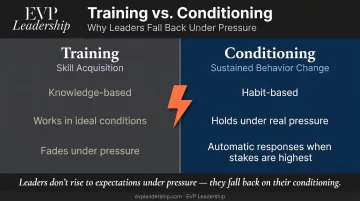
Most leadership development programs deliver training: knowledge and skills designed for ideal conditions. That's useful — until pressure hits.
The distinction that matters is between skill acquisition and sustained behavior change under real conditions. A 2023 peer-reviewed meta-analysis found executive coaching had stronger effects on behavioral outcomes than on attitudes or personal characteristics — meaning the value isn't in what leaders learn, it's in how they behave when it counts.
EVP Leadership frames this directly: "Under pressure, leaders don't rise to expectations — they fall back on their conditioning." Most leaders have been trained, but not conditioned to think clearly, stay focused in complexity, or execute with discipline under real pressure.
Conditioning builds the automatic responses and mental habits that hold up when pressure, complexity, and uncertainty are highest. Training builds knowledge. Conditioning builds the responses that actually show up under fire.
Not Remedial — Competitive
There's a persistent misconception that coaching is for struggling leaders. Harvard Business Review now frames it differently: you cannot sell "remedial coaching" to a powerful executive — it should be positioned as a hallmark of elite performance. A 2025 survey by the Hoover Institution, Stanford CGRI, and The Miles Group found 95% of CEOs rely on professional coaches or informal advisor networks, and 58% use a professional coach.
CEO coaching is now mainstream performance infrastructure — not a signal of weakness.
Why CEO Coaching Is Different
At the CEO level, the feedback infrastructure that exists everywhere else simply isn't there:
- No boss providing direct performance feedback
- No natural peer group creating useful friction
- No bounded role with built-in accountability mirrors
- Every stakeholder filtered through the lens of the CEO's authority
The coaching dynamic must account for a level of information distortion that doesn't exist anywhere else in the organization. That's what makes CEO coaching structurally different from general executive coaching — and why generic programs don't reach the real problem.
Signs You're Ready for CEO Leadership Coaching
The leaders who get the most from coaching aren't in crisis. They're the ones who spot the structural gap early — before a missed decision or a disengaged team forces the conversation.
Behavioral and Situational Signals
A CEO or small business owner would benefit from coaching now when:
- High-stakes decisions are being made in an echo chamber or deferred out of uncertainty
- Reactive patterns are replacing deliberate leadership — decision fatigue has taken hold
- The team isn't performing to its potential, and it's unclear whether the problem is the team or the leadership
- Day-to-day operations are crowding out long-term strategy; the CEO is in the weeds, not above them
- Feedback is getting thinner — people are agreeing more and challenging less
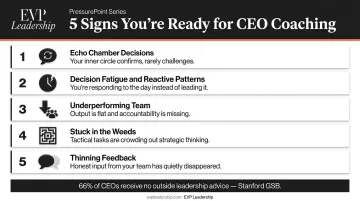
The right time to start coaching is before a crisis reveals the cracks, not after. Stanford GSB's research found that nearly 66% of CEOs did not receive outside leadership advice, while 100% were open to making changes based on feedback. Most CEOs want an outside perspective — few have one structured around their actual role.
The Coachability Factor
Coaching only produces results when the leader is open to challenge, not seeking validation. Before entering a coaching relationship, ask honestly:
- Do I want to be challenged, or do I want to be agreed with?
- Am I willing to examine my own patterns, not just external circumstances?
- When the conversation gets uncomfortable, do I lean in or look for the exit?
A CEO who enters coaching looking for confirmation will leave with their blind spots intact. The ones who come in willing to be wrong — about their habits, their assumptions, their role in the problems — are the ones who leave with something that actually sticks.
Five Areas CEO Leadership Coaching Addresses for Growth
Decision-Making Under Pressure and Uncertainty
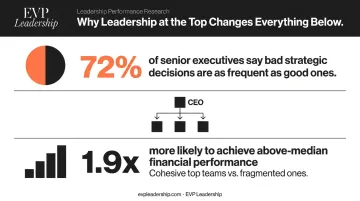
CEOs make high-stakes calls with incomplete data, competing priorities, and no internal peer to pressure-test their thinking. McKinsey research found 72% of senior executives said bad strategic decisions were as frequent as good ones — and recommended making big-bet decisions with roughly 80% of the required information while sharpening the quality of debate, not waiting for certainty.
That gap between available information and required confidence is where most CEO decisions go wrong.
CEO coaching builds the capacity to evaluate choices clearly, test assumptions before they become commitments, and recover fast when outcomes don't land as planned. In EVP Leadership's PressurePoint System, Decision Integrity — grounding decisions in truth rather than noise and emotion — and Problem Intelligence — identifying the real problem fast — are two of the core diagnostic components applied in 1:1 CEO coaching work.
Blind Spots and Self-Awareness Gaps
Every leader has blind spots. The CEO's authority ensures fewer people are positioned to name them honestly. A Korn Ferry study analyzing 6,977 self-assessments across 486 public companies found professionals at poorly performing companies had 20% more blind spots and were 79% more likely to have low self-awareness.
CEO coaching surfaces the decision-making patterns and behavioral tendencies that are invisible from inside the system you lead. Tools like 360-degree feedback and behavioral assessments are particularly useful at this level — and the design of a 360 is itself a strategic decision, since every stakeholder brings a politically filtered perspective.
Leadership Team Calibration and Accountability
The leadership team mirrors what the CEO tolerates. If the CEO avoids difficult conversations, the team learns avoidance is acceptable. McKinsey's CEO research — drawn from 7,800 CEOs and 3,500 public companies — found cohesive top teams were 1.9x more likely to achieve above-median financial performance.
EVP Leadership's approach to this area includes structured accountability systems: clear delegation protocols, defined operating rhythms, 1:1 cadences, and performance conversations. The goal is an operating structure that holds regardless of who's in the room.
Strategic Clarity and Long-Term Focus
Operational demands pull CEOs away from big-picture thinking. Coaching creates a structured rhythm for stepping back, reassessing priorities, and staying focused on what actually moves the business forward — not just what's urgent today.
Within the PressurePoint System, two diagnostic components address this directly:
- Mission Clarity — knowing exactly what must be achieved and why it matters now
- Momentum Control — making measurable progress on what actually matters
Burnout Prevention and Sustainable Performance
Nearly 70% of the C-suite have seriously considered leaving for a role that better supports their well-being, according to Deloitte and Workplace Intelligence research.
Leading without a true peer — carrying the weight of decisions, people, and performance at the top — accelerates burnout when the underlying structure isn't addressed.
EVP Leadership's Executive Burnout Recovery work targets the root causes directly:
- Over-scope and unclear role boundaries
- Weak operating rhythm with no recovery cadence
- Poor delegation and accountability gaps
- Identity fused to the business rather than grounded in the leader
The outcome isn't just relief. It's a redesigned operating structure that protects performance over the long term.
The CEO Leadership Coaching Process: What to Expect
Assessment and Intake
Effective coaching begins before the first session. Behavioral assessments, emotional intelligence measurement, and 360-degree feedback establish an honest baseline: not just where the CEO wants to grow, but where the gaps actually are. At the CEO level, even the design of the assessment process is a strategic decision, since every stakeholder (board members, direct reports, external partners) brings a politically filtered perspective.
EVP Leadership begins each engagement with a complimentary scoping conversation to understand the specific leadership context, business stage, and pressure points before proposing an engagement structure.
Goal-Setting and Focus Areas
Early sessions establish three to five measurable behavioral focus areas tied to observable behavior, not general aspiration. Generic goals produce generic results. The most effective focus areas are concrete:
- How the CEO runs the leadership team and drives accountability
- How they handle performance conversations with direct reports
- How they communicate with the board under scrutiny
- How they make decisions when the pressure is highest
Regular Sessions and Pattern Recognition
Typical cadence runs biweekly or monthly, with 60- to 90-minute sessions where the CEO sets the agenda. The coach's role is to hold pattern recognition across sessions, surfacing habits and dynamics that are difficult to spot from inside day-to-day operations.
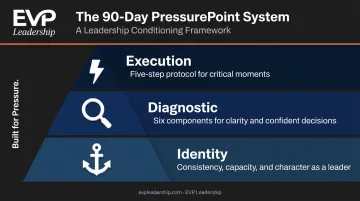
EVP Leadership's 90-Day PressurePoint System is a structured, time-bound example of this approach. It builds leadership capacity through three layers:
- Identity — consistency, capacity, and character as a leader
- Diagnostic — six components for seeing clearly and deciding with confidence
- Execution — a five-step protocol for navigating critical moments
Practical Application and Accountability
Coaching only sticks when it moves off the page. Between sessions, the CEO applies what they've worked through — restructuring a leadership meeting, preparing for a high-stakes conversation, or shifting how they handle recurring pressure points.
Progress is reviewed periodically, and the real measure of success is behavioral change that others can observe. Self-reporting is easy. The benchmark is whether the people around the CEO notice the difference.
What to Look for When Choosing a CEO Leadership Coach
Not every coach is built for the CEO seat. The right one combines real operating credibility, a structured methodology, and a relationship dynamic that pushes without destabilizing. Here's what to evaluate before committing.
Real Operating Experience in Leadership Roles
A coach who has navigated actual executive authority brings a sharper, more grounded perspective than one with only academic or training credentials.
Look for coaches whose background shows they understand the structural pressures of the role — not just its surface demands. Relevant experience includes board dynamics, leading teams through uncertainty, and scaling organizations. Gennifer Baker, founder of EVP Leadership, is one benchmark: 30+ years of executive consulting with founders, CEOs, and C-suite teams across strategic planning, leadership capacity, and scale-up readiness.
Methodology Transparency and a Conditioning Orientation
Ask any prospective coach to describe their assessment tools, session structure, and how they measure results. The best coaches can name their frameworks clearly.
Prioritize coaches whose approach builds lasting conditioning — habits and responses that hold under pressure — rather than temporary skill transfers that fade when stress increases. EVP Leadership's conditioning-first philosophy, built into the PressurePoint System, is a useful benchmark: methodology should be specific, structured, and designed for durability.
When vetting coaches, ask directly:
- What frameworks or tools do you use, and how were they developed?
- How do you measure progress — and over what timeframe?
- What does a typical 90-day engagement look like?
- How do you work with clients who are under active operational pressure?
Confidentiality Architecture and Fit
At the CEO level, who is the client is a non-trivial question — especially when an engagement is funded by a board or investor. Confirm upfront how information flows and what remains confidential. EVP Leadership structures its 1:1 engagements as confidential by design.
Beyond structure, the relationship itself must be one where the CEO feels challenged, not judged, and supported without being coddled. Fit determines whether coaching becomes transformation or transaction.
The Real Outcomes of CEO Leadership Coaching for Growth
Individual and Organizational Outcomes
Well-executed CEO coaching produces measurable results across both dimensions:
- Faster, more confident decision-making with reduced reactive patterns
- Stronger leadership team alignment — clearer accountability, better operating rhythm
- Reduced burnout and emotional reactivity — sustainable performance rather than short bursts
- Clearer strategic direction — the CEO operating above the operational noise
- Improved relationships with boards, investors, and key stakeholders
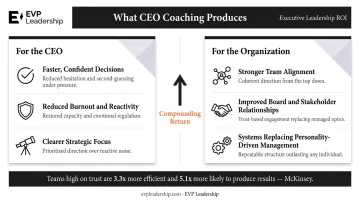
McKinsey research found teams above average on trust were 3.3x more efficient and 5.1x more likely to produce results. When CEO coaching improves how the top leader operates, the effect moves through the entire team.
The Compounding Return
CEO leadership development compounds. Each growth cycle in the CEO's capacity unlocks a new level of organizational performance — one that wouldn't have been accessible otherwise.
A stronger leadership foundation translates to:
- Better hiring decisions (the CEO attracts leaders who can challenge them)
- Healthier culture (tolerance patterns shift when the CEO's standards shift)
- More resilient operations (systems replace personality-driven management)
- A business that can scale without repeatedly hitting the same ceiling
Most growth ceilings aren't market problems or capital problems — they're leadership capacity problems. That's what conditioning addresses.
Frequently Asked Questions
How much does CEO coaching cost?
CEO-level coaching investment varies based on engagement length, coach experience, program structure, and assessment depth. EVP Leadership uses custom pricing, determined through a complimentary scoping conversation, because the right engagement structure should match the specific situation rather than a standard rate card.
What is the difference between a CEO coach and a business consultant?
A consultant typically diagnoses problems and delivers solutions. A CEO coach partners with the leader to develop the thinking, habits, and decision-making capacity to solve problems themselves — building lasting capability rather than a one-time deliverable. EVP Leadership works at the intersection of both, conditioning the leader while aligning strategy to execution.
How long does it take to see results from CEO leadership coaching?
Meaningful behavioral change typically becomes visible within 60 to 90 days for the CEO. Stakeholders and team members often notice shifts within the same window — different decision-making patterns, different conversations, different tolerance for underperformance. Deeper organizational impact compounds over a 6-to-12-month horizon.
Is CEO coaching worth it for small business owners and entrepreneurs?
The value is especially high for small business owners, who face the same decision-making pressure and structural isolation as corporate CEOs but with fewer resources around them. EVP Leadership's work is built specifically for founders and owner-operators, not adapted from Fortune 500 frameworks.
What is the difference between leadership training and leadership conditioning?
Training delivers skills designed for ideal conditions. Conditioning builds the automatic responses and habits that hold under real pressure. EVP Leadership's view: leaders don't rise to expectations under pressure — they fall back on their conditioning. Lasting growth requires conditioning, not just instruction.
When should a CEO stop working with a coach?
Coaching relationships naturally evolve. Some CEOs retain a coach long-term as a strategic thinking partner. Others complete a structured engagement, like EVP Leadership's 90-Day PressurePoint System, and return only at major inflection points — scaling, succession, or significant leadership transitions.