The question worth sitting with: what separates leaders who build lasting companies from those who build impressive-looking ones that collapse under scrutiny?
For small and mid-size business leaders, the stakes are immediate. There's no PR department to buffer a credibility gap, no organizational layer between the CEO's behavior and the employee experiencing it. Every decision either deposits into or withdraws from the culture's trust account.
This article covers why integrity is a CEO's highest-leverage asset, the five pillars that define it in practice, and why sustainable integrity requires conditioning — not occasional good intentions.
Key Takeaways
- Integrity is a pattern of behavior demonstrated consistently under pressure — not a values-statement exercise.
- The five pillars of integrity-led leadership compound over time — building the kind of trust and credibility that outlasts any single decision.
- Trust must be actively built before a crisis; CEOs who wait until they need it are already behind.
- Integrity-based leadership directly shapes employee retention, stakeholder confidence, and long-term sustainability.
- Like physical conditioning, leadership integrity strengthens with repetition — and erodes the moment you stop practicing it.
Why Integrity Is the CEO's Most Valuable Asset
Revenue growth, market share, operational efficiency — these are output metrics. They measure what a company produces, not whether that production is sustainable. Integrity is the upstream variable that determines whether strong outputs hold over time.
A company can be profitable and still be fragile. The mechanism is straightforward: employees who trust their organization's leaders are three times as likely to be engaged, according to Gallup's 2023 research. Disengagement is expensive — and it almost always traces back to a leadership credibility problem, not a compensation problem.
The Optics Trap
Leaders who optimize for appearance — managing perception, deflecting blame, claiming credit for team wins — can accumulate impressive short-term results. But they build organizations that cannot survive scrutiny.
Enron's collapse in December 2001 came after years of manipulated earnings and sham accounting that executives tolerated whenever profits resulted. Theranos raised more than $700 million from investors before the SEC charged the company and its founder with fraud in 2018, and Elizabeth Holmes was ultimately convicted of investor fraud. Both companies looked like high-growth successes until integrity failure made them unsustainable.
The Small Business Multiplier
For small and mid-size business CEOs, integrity carries an even greater multiplier effect. There's no buffer between the CEO's behavior and the team experiencing it. When a CEO cuts corners on a vendor agreement, the ops manager notices. When a CEO avoids a hard conversation with a poor performer, the high performer draws conclusions.
That pattern — behavior shaping culture without a single formal announcement — is exactly the pressure point EVP Leadership's work addresses. The firm's PressurePoint System grounds its Identity Layer in character: specifically, how a leader's consistency and capacity show up when no one is watching. The core premise is direct: who you are at your core determines the health of your leadership.
The Five Pillars of Integrity-Led Leadership
Integrity isn't one thing. It's a cluster of practiced behaviors that reinforce each other. These five pillars form the CEO's operational blueprint — concrete standards that show up in daily decisions, not just mission statements.
Ethical Decision-Making: Doing the Right Thing When It Costs You
Ethical leadership means establishing a moral compass that guides decisions even when the profitable or politically easy choice runs counter to it. What a CEO permits, they effectively promote — and the team is always watching.
A concrete example: a CEO facing margin pressure chooses to absorb a short-term hit and honor the terms of a vendor commitment rather than renegotiating under duress. The vendor remembers. So does the internal team watching how the CEO behaves when it's inconvenient.
Brown, Treviño, and Harrison's foundational 2005 research on ethical leadership frames this precisely — ethical leadership is demonstrated through personal actions, relationships, two-way communication, reinforcement, and decision-making. It is observable conduct, not stated intention.
Cultivating Trust With Every Stakeholder Group
Trust is not a byproduct of success. It's built through consistent honesty, transparency, and follow-through — across employees, customers, investors, and partners. And it's asymmetric: it accumulates slowly and can be destroyed in a single interaction.
High-trust companies on the Fortune 100 Best list produced a 3,175% cumulative return over 27 years versus 907% for the Russell 3000, according to Great Place To Work's 2026 benchmark. The same data shows two-thirds less turnover than the Bureau of Labor Statistics average.
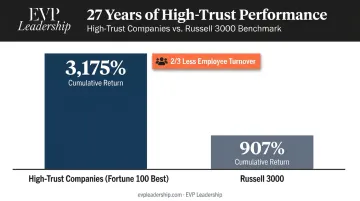
Reduced turnover, stronger partnerships, faster recovery when things go wrong — that's the return on a trust-first leadership approach.
Driving Culture Through Personal Example
Values written on walls don't shape culture. What leadership tolerates, rewards, and models in daily behavior does.
When a CEO's actions match stated values, employees experience psychological safety — they're more likely to raise concerns, take initiative, and contribute fully. When there's a gap, employees read it immediately and adjust their own behavior accordingly.
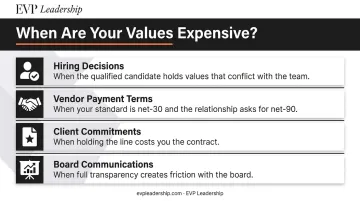
The real audit question is: when are your values expensive? The answer shows up in moments like these:
- Hiring decisions — do you pass on the high-performer with the wrong character?
- Vendor payment terms — do you honor commitments when margins are tight?
- Client commitments — do you deliver what you promised even when it costs you?
- Board communications — do you report the full picture, not just the good news?
Those are the moments that reveal whether stated values are real.
Owning Accountability Up and Down the Organization
Integrity-led CEOs claim accountability for difficult outcomes rather than deflecting blame onto market conditions, staff performance, or external circumstances. They celebrate contributions from others during wins and step forward during failures.
Publicly modeling accountability doesn't signal weakness. It signals security — and it creates a permission structure for the broader organization to operate with the same honesty. When a CEO exempts themselves from accountability, they guarantee that the team will too.
Leading With Integrity in Crisis
Crisis is the integrity stress test. When results are down, talent is leaving, or the business faces genuine threat, a CEO's credibility rests entirely on the trust reserve they've built before the crisis arrived.
Two types of crisis response:
- Transparent, accountable posture: Acknowledge what's true, own the leadership dimension of what went wrong, communicate clearly, and focus the team on what's next. This approach holds credibility because it's consistent with pre-crisis behavior.
- Spin-and-minimize posture: Manage the narrative, deflect, obscure. This approach signals that the CEO's pre-crisis transparency was conditional — and the team will remember.
Consistency before the crisis is the only thing that preserves credibility during it. Without that track record, a CEO loses their audience precisely when they need it most.
Integrity Under Pressure: Where Most CEOs Fall Short
Most CEOs intend to lead with integrity. Intention erodes under pressure. Quarterly targets, board expectations, competitive threats, and personal ego all pull leaders toward compromise — and rarely all at once. The drift is gradual.
The Gray Zone
The real integrity risk isn't fraud. It's the accumulation of small compromises:
- Taking credit for a team's work in a board presentation
- Avoiding a difficult performance conversation that should happen now
- Overpromising a client to close a deal
- Minimizing a known risk in a report to avoid uncomfortable questions
These micro-betrayals define leadership character as much as the visible big decisions. They also create organizational permission — what the CEO does quietly becomes the team's behavioral reference point.

The Institute of Business Ethics reported in 2018 that 16% of European employees felt pressure to compromise their organization's ethical standards. The U.S. National Business Ethics Survey found similar patterns, with pressure to compromise standards identified as a leading indicator of future misconduct.
Pressure-Revealed Character
Those micro-compromise patterns don't emerge from bad intentions — they emerge from leaders who haven't conditioned a different response. Under stress, character gaps become visible. Who a leader is under pressure is who they actually are.
The critical mistake is relying on willpower to "choose integrity" in high-stakes moments. Willpower is finite. Leaders who consistently perform with integrity under pressure haven't made a better choice in the moment: they've conditioned that response over time through repeated practice.
EVP Leadership's Execution Layer speaks directly to this. The framework's first step is Pause the Noise — creating space before the moment controls you. That pause only exists if it's been practiced. Without conditioning, pressure collapses the gap between stimulus and reaction.
Building a Culture of Trust and Accountability
A CEO cannot be solely responsible for an organization's integrity. The goal is to build systems and culture where integrity is the expected default at every level.
Practical mechanisms that work:
- Communicate honestly and regularly — teams can handle difficult truths, but not discovering the CEO withheld them
- Build structures that reward raising concerns; Amy Edmondson's 1999 research on psychological safety shows punitive leaders kill the honest communication organizations depend on
- Measure how results are achieved, not just whether they are — outcomes built on misalignment cost more than missed targets
These mechanisms don't function on goodwill alone — they require structure. EVP Leadership's Delegation, Accountability & Operating Discipline engagements build exactly that: a clean delegation protocol, an accountability operating rhythm with scorecards and performance conversations, and an execution-discipline framework that makes accountability a designed feature, not an assumed one.
One principle runs through all of it: the CEO who holds their team to high standards must hold themselves to those same standards, publicly. The moment a CEO exempts themselves from the norms they expect of others, the culture fractures.
Integrity as Conditioned Behavior, Not Just Character
The common belief that integrity is a fixed character trait — something you either have or don't — doesn't hold up. Integrity is a practiced skill, built through repeated consistent behavior over time — and it degrades without practice.
Behavioral science supports this directly. Research on habit formation by Gardner, Lally, and Wardle (2012) explains that automaticity develops when behavior is repeated consistently in context — the context-behavior association strengthens with repetition. The same mechanism applies to leadership decision-making.
The most effective leaders don't rely on making the right choice under fire. They've rehearsed those choices so many times through daily habits, routines, and decision frameworks that integrity becomes their automatic response — not their deliberate override.
This is the foundation of EVP Leadership's conditioning philosophy. The firm's core thesis is direct: under pressure, leaders don't rise to expectations — they fall back on their conditioning. Most leaders have been trained, but not conditioned for real pressure.
The 90-Day PressurePoint System is built around this premise. Each layer targets a specific dimension of conditioned integrity:
- Identity Layer builds consistency (values alignment), capacity (handling pressure and growth), and character (the moral anchor governing both)
- Decision Integrity diagnostic asks whether decisions are grounded in truth or distorted by noise and emotion
- Execution Discipline ensures that once integrity-based decisions are made, they're followed through with clean action
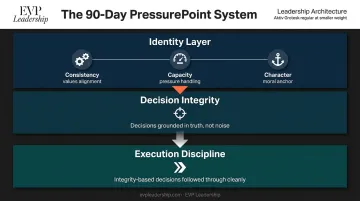
The conditioning isn't theoretical. It builds the habituated behaviors and decision reflexes that hold when pressure is highest — so integrity isn't something leaders reach for, it's something they default to.
The Long-Term Payoff: Legacy and Sustainable Success
Integrity-led leadership compounds over time into something most leaders underestimate: a business that can survive leadership transitions, attract top talent, weather downturns, and hold stakeholder trust without constant maintenance.
This is the architecture of sustainable success — not a single ethical decision, but the cumulative effect of thousands of them. The organization that exists after a decade of integrity-based leadership is structurally different from one built on performance optics. The trust is real. The culture is self-reinforcing. The people who stayed, stayed for reasons that persist.
A CEO's most lasting contribution is not a quarter of record earnings. It's the standard they set and the culture they leave behind. Every person who works in that organization long after the current CEO is gone will either benefit from — or bear the cost of — choices made under pressure, long before anyone was watching.
That's the compounding return on integrity: a leadership standard that outlasts the leader who built it.
Frequently Asked Questions
What are the C's of executive presence?
Common frameworks describe executive presence through components like confidence, composure, credibility, and communication — though the Center for Talent Innovation model centers on gravitas, communication, and appearance. A leader whose behavior consistently matches their stated standards projects natural authority without performance.
How does leading with integrity affect company culture?
A CEO who leads with integrity models the behavioral standards for the entire organization. Over time, this creates a culture of accountability, openness, and trust — where employees raise concerns rather than hide them, and performance standards are real rather than aspirational.
What is the difference between ethical leadership and integrity-based leadership?
Ethical leadership refers to following moral principles in decision-making. Integrity-based leadership emphasizes consistent alignment between a leader's stated values and actual behavior — especially under pressure. Integrity-based leadership is ethical leadership made durable through conditioning, not just intention.
How can a CEO rebuild trust after a leadership failure?
Rebuilding trust requires transparent acknowledgment of the failure, clear accountability for what went wrong, and sustained behavioral change over time. Apologies alone are insufficient if the systems, incentives, or CEO behaviors that allowed the failure remain unchanged.
What happens to organizations when CEOs lack integrity?
The effects cascade: employee trust erodes, cultural dysfunction spreads, high performers leave first, reputational damage accumulates, and operational instability follows — even when short-term financial metrics appear strong.
Can integrity be developed, or is it fixed?
Integrity is a practice that can be deliberately developed through consistent habits and conditioned decision-making — not a fixed character trait. Leaders who invest in structured conditioning build more reliable integrity under pressure than those who rely on good intentions alone. EVP Leadership's positioning is direct on this: leaders fall back on their conditioning when pressure rises, so conditioning integrity is the work.