Introduction
Many small business owners build teams that perform well when conditions are stable—and then watch things unravel the moment pressure increases, growth demands more, or priorities shift. The problem usually isn't strategy. It's leadership structure.
Sustainable leadership is an operational concept. It shows up in how consistently a business performs, how long employees stay, and how well an organization holds its shape when conditions change.
According to Gallup's meta-analysis of 112,312 business units, top-quartile teams deliver 23% higher profitability, 18% higher sales productivity, and 41% fewer quality defects than their bottom-quartile counterparts. That gap comes down to one thing: how consistently leaders lead.
What follows covers the measurable benefits of sustainable leadership for small and mid-size businesses — and why the consistency gap in that Gallup data is exactly where leadership development work pays off.
TL;DR
- Sustainable leadership prioritizes consistent performance and systems built to last—not just short-term wins
- It directly improves team performance, employee retention, and the business's ability to adapt under pressure
- Without it, businesses stagnate, decisions bottleneck at the top, and growth stalls at whatever the leader can personally handle
- Businesses that build these practices early develop structural advantages competitors can't easily copy
- For small business owners, it's the difference between a business that runs with you—and one that runs without you
What Is Sustainable Leadership?
Sustainable leadership is a leadership approach focused on building the capacity, systems, and culture that allow a business to perform consistently over time—through growth, pressure, and change—rather than optimizing only for short-term results.
For small and mid-size business leaders, the concept has nothing to do with environmental policy. It's about how you make decisions, develop your team, and build operations that hold up as the business scales.
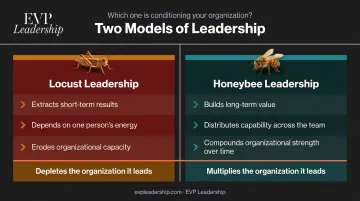
Avery and Bergsteiner's foundational framework, published in Strategy & Leadership, draws a clear contrast between two leadership models. Sustainable "honeybee" leadership builds long-term value through staff engagement, quality, and resilience. "Locust" leadership extracts results without building capacity. One model produces businesses that compound in strength; the other produces businesses that depend entirely on one person's energy and presence.
The outcome sustainable leadership makes possible:
- Leading consistently without constant crisis management
- Delegating confidently because systems and standards exist
- Keeping an organization moving forward even when conditions shift
For founders and executives running businesses that are growing, these outcomes aren't aspirational—they're operational necessities.
Key Benefits of Sustainable Leadership
The benefits outlined here are not theoretical. They represent operational improvements visible in how teams function, how decisions get made, and how organizations weather change. Each connects to outcomes most leaders already track: team performance, cost efficiency, talent retention, and long-term growth.
Benefit 1: Consistent Organizational Performance
Sustainable leadership creates repeatable systems for decision-making, communication, and execution—so results don't depend entirely on one person's energy or presence on a given day. Sustainable leaders establish clear expectations, align teams around long-term goals, and build processes that reduce reactive firefighting.
Why this matters: When a leader's behavior, priorities, or communication style shifts under pressure, teams lose direction. Research published in the Journal of Business Ethics defines inconsistent leader behavior as erratic and unpredictable—and argues it directly violates fairness and trust, harming both individuals and organizational performance. That erosion has a cost: rework, missed opportunities, and operational friction that compounds over time.
EVP Leadership's 90-Day PressurePoint System is built around this exact problem. The system's Identity Layer conditions leaders to act in alignment with their values and expectations consistently—not just when conditions are comfortable. The Diagnostic Layer adds structure through Mission Clarity, Execution Discipline, and Decision Integrity, turning leadership from personality-dependent into process-driven.
KPIs this benefit influences:
- Revenue consistency
- Team productivity
- Decision-making speed
- Error and rework rates
- Goal attainment rates
When this matters most: Scaling phases, leadership transitions, and high-pressure environments where team clarity becomes critical to maintaining execution quality.
Benefit 2: Stronger Talent Retention and Employee Engagement
Sustainable leaders invest in the long-term development of their people—creating environments where employees feel valued, have clear paths for growth, and are motivated by more than their next paycheck. Transparent communication, psychological safety, and consistent recognition aren't soft perks. They're retention tools.
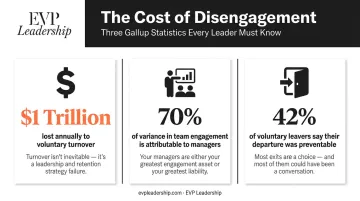
Gallup estimates voluntary turnover costs U.S. businesses $1 trillion annually, with replacement costs running one-half to two times an employee's annual salary—and up to 200% for managers and leaders. In a small business, replacing one manager or key technical employee isn't an HR problem. It's a financial event.
The manager relationship sits at the center of this. Gallup finds managers account for 70% of variance in team engagement—and that 42% of voluntary leavers said their manager or organization could have prevented their departure. Just one meaningful conversation per week with a direct report makes employees four times more likely to be highly engaged.
Why this matters for small businesses specifically: When employees leave, institutional knowledge leaves with them. Small businesses don't have the redundancy of large organizations—every departure carries compounding cost. Sustainable leaders reduce this risk by building cultures where people have a reason to stay.
Teri Evans, Leadership Facilitator at EVP Leadership, structures facilitation work explicitly around psychological safety, trust, and communication—the foundational conditions that determine whether high performers stay or start looking elsewhere.
KPIs this benefit influences:
- Employee retention rates
- Engagement scores
- Time-to-productivity for new hires
- Internal promotion rates
- Absenteeism
When this matters most: Competitive hiring markets, rapid growth phases where team stability is non-negotiable, and businesses where relationships and institutional knowledge drive results.
Benefit 3: Long-Term Resilience and Competitive Advantage
Sustainable leadership prepares organizations to adapt, navigate disruption, and continue performing when conditions shift—rather than relying on heroic interventions from the founder or key executive. That preparation comes from distributing decision-making capability, investing in systems and processes, and developing a team that can think and act strategically without being micromanaged.
The succession data tells a clear story about how few businesses actually build this capacity. PwC's US Family Business Survey found only 34% of family businesses had a robust, documented succession plan in 2021. That gap represents concentrated risk—businesses that cannot function when leadership is unavailable, distracted, or transitioning.
Research on SME resilience frames it as a strategic capability—one that enables small and mid-size businesses to sustain performance and competitiveness during disruption. Resilience is built before crisis arrives, not in response to it.
EVP Leadership's PressurePoint System addresses this directly. The Diagnostic Layer develops leaders across six components—Mission Clarity, Force Alignment, Problem Intelligence, Decision Integrity, Execution Discipline, and Momentum Control.
That scope is deliberate. When capability is distributed across a leadership team rather than concentrated at the top, the business can operate without constant executive involvement—even through transitions, disruptions, or periods of rapid growth.
KPIs this benefit influences:
- Business continuity during disruption
- Leadership pipeline depth
- Revenue stability through transitions
- Customer retention across leadership changes
- Scalability indicators
When this matters most: Leadership transitions, rapid scaling, economic uncertainty, and any situation where the business needs to operate with less direct involvement from its founder or primary executive.
What Happens When Sustainable Leadership Is Missing
The operational reality of organizations without sustainable leadership is consistent and recognizable: decisions bottleneck at the top, teams become reactive, and the leader becomes indispensable in ways that prevent growth rather than enable it.
Capital One's 2022 survey of 1,295 small business owners found 48% experienced burnout in the past month, with 72% reporting mental exhaustion and 69% reporting physical exhaustion. That's not a wellness problem—it's a structural one.
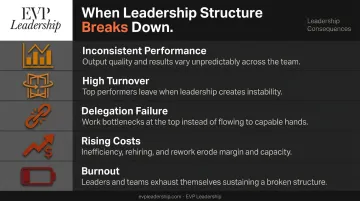
The compounding consequences of unsustainable leadership typically include:
- Inconsistent team performance that fluctuates with the leader's mood, bandwidth, or physical presence
- High turnover driven by unclear expectations, lack of development, and a culture that rewards urgency over intention
- Delegation failure because systems and standards haven't been built to outlast direct involvement
- Rising costs from reactive decisions, repeated mistakes, and rebuilding rather than building forward
- Burnout—for the leader and the team—as the gap between what the business demands and what the leadership structure can deliver continues to widen
These patterns don't emerge from a lack of effort or ambition. Gennifer Baker, Founder of EVP Leadership and a C-level executive consultant with more than 30 years in business strategy, has observed this across thousands of engagements: the businesses that stagnate have strategy. What they're missing is the leadership structure to carry it out.
How to Get the Most Value from Sustainable Leadership
Sustainable leadership works best when treated as an ongoing practice—not a mindset shift that happens once. Real results come from habits and systems that get reinforced over time, not from workshops or one-time training events.
Leaders get the most value when they:
- Apply it consistently across decisions large and small—not just when things are calm, but especially when pressure increases and short-term thinking becomes tempting
- Build clear structures for accountability, communication, and performance review so sustainable behaviors become embedded in how the organization operates—not just how the leader personally shows up
- Seek structured support to accelerate the conditioning process—executive coaching and leadership development systems deliver durable capacity faster than self-directed learning
EVP Leadership's 90-Day PressurePoint System is designed for this purpose. It conditions leaders rather than simply training them, building the internal capacity needed to perform consistently under pressure through practice structured across three layers: Identity, Diagnostic, and Execution.
The goal, as EVP Leadership frames it: leaders don't rise to expectations under pressure—they fall back on their conditioning. The system builds conditioning that holds.
Conclusion
The value of sustainable leadership isn't abstract. It shows up in revenue consistency, employee retention rates, and the organization's ability to keep moving when conditions change.
These gains build on each other. Teams become more capable. Systems become more reliable. Leaders perform with less friction — not because conditions got easier, but because the habits were built and held consistently, not treated as a one-time initiative.
For small business owners and executives, sustainable leadership isn't a long-term aspiration to work toward eventually. It's the operating structure that determines how well everything else in the business actually functions — decision-making, team performance, and capacity under pressure included. The earlier leaders start conditioning those habits, the more compounding that return becomes.
Frequently Asked Questions
What is meant by sustainable leadership?
Sustainable leadership is a leadership approach focused on building the systems, habits, and culture that allow an organization to perform consistently over time—through pressure, growth, and change—rather than optimizing only for short-term wins. It prioritizes durable organizational capacity over immediate results.
What are the 5 C's of leadership?
Common variations include character, competence, communication, consistency, and commitment. Each anchors leader behavior in repeatable, trustworthy patterns rather than reactive or situational responses.
What is the difference between sustainable leadership and traditional leadership?
Traditional leadership often prioritizes immediate results and individual performance. Sustainable leadership focuses on building lasting organizational capacity—distributing decision-making, developing people, and creating systems that outlast any single leader's direct involvement.
What are the key benefits of sustainable leadership for small businesses?
Small businesses benefit most from consistent team performance, reduced employee turnover, and the ability to scale without the founder becoming the bottleneck. As the business grows, these advantages build on each other in ways that are genuinely hard to reverse-engineer.
Can sustainable leadership be learned or developed over time?
Sustainable leadership is a learned and conditioned set of practices—not an innate personality trait. Leaders who invest consistently in developing their capacity see measurable improvement in both their own performance and their organization's results over time.
How does sustainable leadership affect employee retention and team performance?
Sustainable leaders create environments of clarity, growth, and psychological safety that give employees genuine reasons to stay and perform. That stability reduces costly turnover and builds the team consistency that long-term business performance depends on.