Introduction
There's a pattern EVP Leadership sees consistently after more than 35 years of working with executives, founders, and small business owners: a leader who is visionary, capable, and deeply committed — yet whose organization stalls the moment they step back.
Decisions pile up on their desk. The team won't move without approval. Growth has an invisible ceiling, and that ceiling is the leader themselves.
This is the founder-bottleneck pattern, and it's more common than most leaders acknowledge.
Sustainable leadership — in a business context, not an environmental one — is the ability to lead in a way that produces consistent results, develops your people, and keeps the organization moving even when you're not in the room. It's built on systems, conditioned habits, and distributed capacity.
This guide outlines 7 principles that small business owners, entrepreneurs, and executives can use to build leadership that holds under pressure, scales without bottlenecks, and keeps producing results — with or without you in the room.
Key Takeaways
- Sustainable leadership is a system, not a personality — it's built through structure and conditioning, not talent alone
- All 7 principles reinforce each other — skip one and the others weaken
- Over-centralized decision-making is the most common and most costly leadership failure in small businesses
- Resilience under pressure is a conditioned capability — it can be deliberately built
- Lasting change comes from small habits practiced consistently over time — not one-off training events
What Is Sustainable Leadership in Business?
Sustainable leadership means building an organization that performs consistently, develops its people, and doesn't collapse under the weight of a single person's departure, distraction, or burnout.
Traditional leadership models reward individual performance and short-term results. The structure itself is the problem: when everything flows through one person, that person becomes a single point of failure — and the organization has no way to absorb the shock when that person steps back, burns out, or leaves.
The numbers reflect this risk. According to Nationwide citing a National Association of Insurance Commissioners survey, 71% of small businesses depend on one or two key people for success. Separately, Project Equity's 2025 research reports that 73% of privately held companies intend to transition ownership within 10 years — yet 78% of those owners lack a formal transition team.
Both data points describe the same structural fragility: organizations built around a person rather than a system.
Sustainable leadership shifts the foundation:
- From individual heroics to repeatable processes
- From reactive decision-making to intentional operating rhythms
- From leader-as-bottleneck to distributed capacity and accountability
- From short-term wins to compounding long-term performance
The goal isn't to remove the leader from the equation. It's to build an organization that carries the leader's standards forward — even under pressure, through transitions, and across organizational layers.
Why Most Leadership Approaches Don't Last
Most leaders are trained to perform. Very few are conditioned to build.
The distinction matters. Performance training teaches leaders how to handle the moment in front of them. Conditioning builds the habits, systems, and team capacity that make leadership durable across hundreds of moments over time.
The Real Cost of Unsustainable Leadership
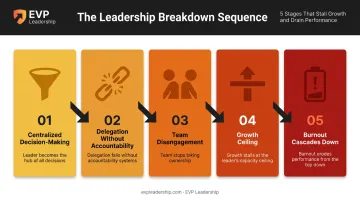
EVP Leadership has observed the same structural breakdown pattern across decades of working with C-suite executives and small business owners. It typically follows this sequence:
- The leader becomes the hub of all decisions
- Delegation fails because accountability systems don't exist
- The team stops taking ownership
- Growth stalls as everything slows to the speed of the leader's capacity
- Burnout sets in, and performance erodes from the top down
The data confirms this pattern. McKinsey research found that executives spend nearly 40% of their time on decisions, yet only 57% of organizations consistently make high-quality ones. Gallup adds that managers account for 70% of the variance in team engagement — meaning leadership quality directly determines whether teams stay energized or disengage entirely.
Leaders who burn out are often the hardest-working people in the building. The problem isn't work ethic. It's the model — reactive, centralized, and fragile by design.
The 7 Principles of Sustainable Leadership
Principle 1: Long-Term Vision Aligned with Daily Decisions
Sustainable leaders don't just have a vision. They connect it to what happens on Monday morning.
Without this connection, daily decisions accumulate in conflicting directions — each one defensible in isolation, but collectively pulling the organization away from its strategic goals. The organization stays busy without moving forward.
Within EVP Leadership's PressurePoint System, two components address this directly:
- Mission Clarity — Do we know exactly what must be achieved, and why it matters now?
- Execution Discipline — ensuring the work being done actually reflects those priorities, consistently.
In practice, this means leaders must regularly revisit strategic priorities and assess whether today's decisions are accumulating toward the future they intend — or gradually undermining it.
Principle 2: Systems That Outlast Any Individual
If your organization runs smoothly because of your presence — and struggles the moment you're unavailable — you haven't built a business. You've built a dependency.
Breaking that pattern requires deliberate infrastructure: documented processes, decision frameworks, delegation protocols, and accountability rhythms that carry the organization forward regardless of who is in a particular role.
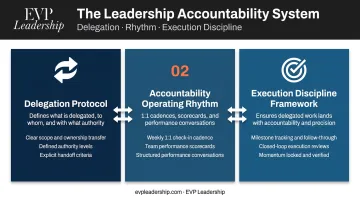
EVP Leadership addresses this through its Delegation, Accountability & Operating Discipline service, treating these three elements as a connected operating system rather than isolated skills. The work typically includes:
- A structured delegation protocol defining what gets delegated, to whom, with what authority
- An accountability operating rhythm: 1:1 cadences, team scorecards, performance conversations
- An execution-discipline framework ensuring delegated work actually lands
The result: leaders get time back, teams own more, and decisions move down the organization where they belong.
Principle 3: Distributed Leadership Capacity
Delegation is a tactic. Distributed leadership capacity is a strategy.
The difference: delegation transfers tasks. Distributed capacity builds the actual ability of people throughout the organization to think, decide, and execute independently — without constant escalation to the top.
This requires intentional development at multiple organizational layers. EVP Leadership's programs serve audiences from owners building their first leadership team to scaling mid-size businesses developing their next tier of leaders. Formats include:
- Multi-month cohorts
- Intact-team training
- Manager and director programs
- High-potential pipeline development
The curriculum covers decision-making, accountability, strategic thinking, delegation, and operating-rhythm design — the competencies that allow leadership capacity to spread across an organization rather than concentrate at the top.
Principle 4: Resilience and Performance Under Pressure
Sustainable leadership requires more than performing well when conditions are favorable. It requires performing consistently — particularly when things get hard.
EVP Leadership's core thesis is direct: under pressure, leaders don't rise to expectations — they fall back on their conditioning. Resilience isn't a personality trait. It's a trained capability, built through structured practice over time. Research supports this — a 2025 randomized controlled trial protocol on psychological resilience training for leaders treats resilience explicitly as an intervention target, not a fixed characteristic.
The PressurePoint System builds this capability through two layers:
The Identity Layer conditions three elements:
- Consistency — acting in alignment with values over time
- Capacity — the ability to handle complexity, pressure, and growth
- Character — how consistency and capacity are applied
The Execution Layer provides a repeatable protocol for high-pressure moments: Pause the Noise → Locate the Pressure Point → Prioritize the Critical Move → Execute with Discipline → Lock in Momentum.
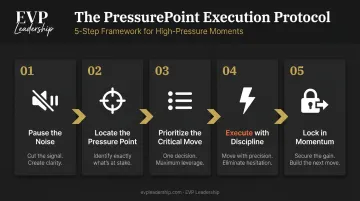
These aren't concepts to memorize. They're responses to condition — practiced until they become the leader's default under pressure.
Principle 5: Ethical Accountability and Transparency
Trust is organizational infrastructure. Without it, communication distorts, performance fluctuates, and people leave.
Sustainable leadership builds trust through consistency between stated values and daily behavior. Not through mission statements — through the hundreds of small decisions leaders make each week. How they handle bad news. Whether they own outcomes or deflect them. Whether honest conversations happen at every level, or only when things are going well.
The PressurePoint System's Decision Integrity component addresses this directly: are decisions grounded in truth, or distorted by noise and emotion? Force Alignment assesses whether the right people are accountable for the right outcomes.
Leaders who hold themselves to the same standards they expect from others signal something the org chart cannot: that accountability runs in both directions. That consistency is what retains people and sustains performance when conditions get hard.
Principle 6: Stakeholder and Team Investment
An organization grows at the rate its people grow. That's a structural reality, not a motivational slogan.
Leaders who concentrate knowledge, decision-making authority, and capability at the top create organizations that scale only as fast as one person can scale. Leaders who invest consistently in developing the people around them multiply their own capacity.
The data is clear on what happens when organizations underinvest here. Only 36% of organizations qualify as career development champions with robust learning programs tied to career development, according to LinkedIn's 2025 Workplace Learning Report. The cost of that gap shows up in retention: Gallup's 2024 analysis found that 42% of voluntary exits were preventable — situations where the manager or organization could have done something to keep the person.
Investing in people is a retention and performance strategy with measurable returns — not a line item on a benefits summary.
Principle 7: Continuous Self-Leadership
Every other principle on this list depends on this one.
A leader who is running on empty, operating without clarity, or disconnected from their own values cannot sustain the standards they set for others. They cannot build systems with discipline they don't have. They cannot develop people with patience they've depleted.
EVP Leadership's Executive Burnout Recovery & Resilience Building work targets this directly — addressing the chronic overload, decision fatigue, declining capacity, and eroded operating rhythm that precede a full leadership breakdown. The outcomes include restored decision-making clarity, rebuilt emotional resilience, and a redesigned operating rhythm that protects recovery time.
The PressurePoint Identity Layer frames this through capacity: the ability to handle responsibility, complexity, pressure, and growth. And through the organization's foundational belief: who you are at your core determines the health of your leadership.
Self-leadership isn't a wellness program. It's the engine that makes every other principle run.
How to Put These Principles Into Practice
These principles don't function independently — they work as a reinforcing system. Strengthening one creates headroom for others. Neglecting one will eventually undermine the rest.
Start With an Honest Audit
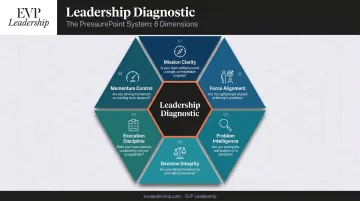
The most productive starting point is an honest assessment of where your leadership is creating dependency rather than capacity. EVP Leadership's Diagnostic Layer provides a structured framework for this, evaluating six dimensions:
- Mission Clarity — Does your team know what must be achieved and why it matters now?
- Force Alignment — Are the right people fully aligned and accountable?
- Problem Intelligence — Are you identifying and attacking the real problem quickly?
- Decision Integrity — Are decisions grounded in truth, or distorted by pressure and noise?
- Execution Discipline — Is execution clean, consistent, and without unnecessary complexity?
- Momentum Control — Is measurable progress happening on what actually matters?
Build One Habit at a Time
Once you've identified your weakest area, resist the temptation to fix everything at once. UCL research on habit formation found that automaticity — the point where a behavior becomes reliably automatic — takes an average of 66 days of consistent practice.
Pick one or two principles where your leadership is most fragile and build a focused 90-day improvement habit around them. Small, consistent actions practiced deliberately compound into lasting change.
That's the conditioning philosophy behind EVP Leadership's 90-Day PressurePoint System — not a training event, but a structured engagement that builds the habits and operating systems leaders need to hold up when pressure peaks.
Leaders who condition these principles consistently don't just survive hard seasons. They build organizations that stay sharp through them.
Frequently Asked Questions
What are the principles of sustainable leadership?
The 7 principles covered in this guide are: long-term vision aligned with daily decisions, systems that outlast any individual, distributed leadership capacity, resilience under pressure, ethical accountability and transparency, stakeholder and team investment, and continuous self-leadership. These principles address leadership durability in business contexts, not environmental or ESG sustainability.
What is sustainable leadership in a business context?
Sustainable business leadership is the ability to lead consistently over time and build systems that don't collapse without you. It means developing the people and processes that allow an organization to grow and adapt, regardless of who holds a particular role.
How is sustainable leadership different from traditional leadership?
Traditional leadership often centers on individual performance and short-term results. Sustainable leadership prioritizes building systems, distributed capacity, and cultures that produce consistent outcomes across time and leadership transitions — not just when the right person is in the room.
What causes leadership to become unsustainable in small businesses?
The most common culprits are over-centralized decision-making, lack of documented systems, neglect of team development, and leader burnout. These patterns reinforce each other, and all of them are addressable through deliberate conditioning rather than one-off training.
How long does it take to build sustainable leadership habits?
Meaningful change typically begins within 90 days of consistent, deliberate practice. Research on habit formation suggests it takes an average of 66 days for behaviors to become second nature. The key is consistency over speed — small habits practiced deliberately compound into lasting capability.