
This isn't a motivation problem. Most owners who plateau between six and seven figures are working harder than anyone around them. The problem is that hustle, personal involvement, and wearing every hat — the exact behaviors that generated early revenue — become the ceiling that prevents the next level of growth. According to a 2022 Forbes report, 42% of small business owners experienced burnout in the past month, and 24% were currently experiencing it. Burnout at the top isn't just a personal problem. It's an operational one.
Crossing seven figures requires a different operating model — one built on strategy, systems, and leadership capacity rather than individual effort.
This guide covers the fundamental mindset shift required, four proven growth strategies, the systems that eliminate owner bottlenecks, and the leadership development most owners skip entirely.
Key Takeaways
- The six-to-seven-figure leap demands a structural shift from operator to strategist — not more effort
- The Ansoff Matrix maps four distinct growth paths — choose based on risk tolerance and where your business actually stands today
- Well-built operating systems remove the owner from daily decision flow and let the business run without them present
- Hiring specialists over generalists reduces execution risk, raises output quality, and often costs less than owners expect
- Strategic knowledge gets you to seven figures. Whether you stay there depends on how well you perform under pressure — and that's conditioned, not innate.
Why the 6-to-7-Figure Leap Requires a Different Playbook
The Hustle Ceiling
There's a predictable pattern in six-figure businesses: the owner is everywhere. They close deals, handle client issues, manage the team, review financials, and make every meaningful decision. This works — until it doesn't.
As complexity scales, this reactive, do-everything-yourself approach stops generating returns and starts creating drag. The owner becomes the constraint. Every process that requires their personal involvement is a process that can't run faster than they can move.
Research on growing SMEs consistently shows that owner-managers struggle to delegate decision-making, broaden their leadership platform, and formalize management structures as their firms expand. It's a structural problem, and it requires a structural solution.
The Operator-to-Strategist Shift
The transition that unlocks seven figures is a role change — not a tactic.
At six figures, the owner is the business. At seven figures, the owner leads the business. That distinction changes everything about how a day is spent, how decisions get made, and what the owner's attention is reserved for.
In practice, this shift looks like:
- Designing the systems that do the work, rather than doing the work yourself
- Moving from making every decision to building teams that make most decisions
- Moving from reactive problem-solving to proactive strategic planning
- Reserving personal capacity for high-leverage choices, not operational execution
Six-Figure vs. Seven-Figure Operations
| Dimension | Six-Figure Business | Seven-Figure Business |
|---|---|---|
| Revenue sources | Typically 1-2 | Diversified across products/markets |
| Decision-making | Owner-centric | Distributed across documented processes |
| Processes | Implicit, in the owner's head | Documented, repeatable, delegable |
| Team structure | Generalists who assist the owner | Specialists who own domains |
| Owner's primary role | Operator and executor | Strategist and leader |
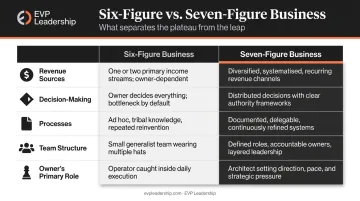
Closing that gap requires building different structures — not logging more hours.
The 4 Business Growth Strategies Every Owner Should Know
The Ansoff Matrix as a Strategic Framework
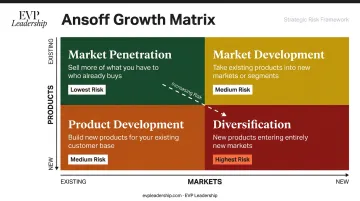
Igor Ansoff introduced his growth matrix in a 1957 Harvard Business Review article — and it remains one of the most referenced strategy tools in business. The framework maps four growth paths based on two variables: existing vs. new products, and existing vs. new markets.
The right strategy depends on where you are now and how much risk you can absorb.
Market Penetration — Start Here
Existing product, existing market. This is the lowest-risk path and the one most seven-figure aspirants should exhaust first.
The logic is straightforward: Bain research cited by HBR found that acquiring a new customer can cost 5 to 25 times more than retaining an existing one — and that a 5% increase in retention can raise profits by 25% to 95%. Your existing customers already trust you. Generating more revenue from them costs a fraction of what it takes to find new ones.
Tactics include:
- Increasing purchase frequency through follow-up sequences and loyalty offers
- Improving customer retention through proactive service and check-ins
- Capturing more market share by competing more aggressively on value in your existing niche
- Upselling or cross-selling adjacent offerings to active customers
Most owners move on too quickly. Penetration is worth a serious, sustained effort before anything else.
Market Development — Take What Works Somewhere New
Existing product, new market. Market development asks a simple question: who else needs what you already sell?
This could mean expanding geographically, targeting a different customer segment, or entering an adjacent channel. The product stays the same; the audience changes.
Before committing resources, evaluate:
- Is there documented demand in the target market?
- Can your current delivery model transfer without major modification?
- What's the realistic customer acquisition cost in the new market?
Product Development — Deepen Existing Relationships
New product, existing customers. Your existing customer base is your most valuable asset. They've already bought from you — trust is established and acquisition cost is near zero.
Adding complementary products or services leverages that trust. The catch: this strategy requires genuine knowledge of what customers need next, not what you assume they want.
Before building anything, go to the source:
- Run direct conversations with 5-10 of your best customers
- Ask what problems remain unsolved after working with you
- Look for patterns in support requests, renewals, or referral language
Diversification — High Risk, Specific Conditions
New product, new market. This is the highest-risk quadrant. You're operating without an established customer base or a proven product in a known market — two unknowns at once.
Research on SME diversification consistently shows that unrelated expansion can impair performance, particularly when core markets haven't been fully developed. For most owners approaching seven figures, diversification is worth exploring only after the other three strategies have been genuinely maximized — not as a default when other options feel exhausted.
Building Scalable Systems and Operations
Why Systems Beat Effort
A 2025 Productivity Institute study found that a 10% improvement in structured management-practice scores was associated with a 5.2% increase in labor productivity. The mechanism matters: structured management removes guesswork, reduces owner-dependency, and creates repeatable outputs regardless of who executes them.
At seven figures, effort isn't the scarce resource — structure is.
The Three Core Systems
Every seven-figure business needs these three systems documented and running without constant owner involvement:
- Client Acquisition and Delivery — Covers how leads enter, convert, get served, and stay. Any step requiring the owner's personal involvement is a bottleneck.
- Financial Monitoring and Forecasting — Tracks CAC, LTV, gross margin, and cash flow. Reviewed weekly, not quarterly.
- Team Management and Accountability — Defines 1:1 rhythms, performance scorecards, role expectations, and decision rights. Lets the team operate consistently without the owner resolving every conflict.
The Owner-Dependency Audit
Run through this honestly. For each core process in your business, ask:
- Does this require my personal involvement to happen correctly?
- Would this break or slow significantly if I were unavailable for a week?
- Is this something only I can do, or is it something only I currently do?
Every process that lives in the second category is a system waiting to be built. These are your primary seven-figure bottlenecks.
KPIs as Decision-Making Tools
Once you've identified bottlenecks, data tells you which ones to fix first. Seven-figure owners track numbers, not instincts.
The metrics worth monitoring regularly:
- CAC: what it costs to acquire each new customer
- LTV: total value a customer generates over the relationship
- Gross margin: revenue retained after direct costs
- Team productivity ratios: output per person relative to compensation
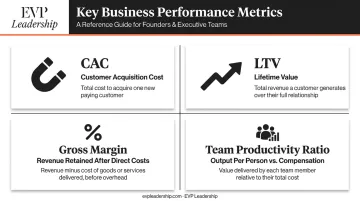
Together, these indicators surface problems early — before they show up in your bank account.
Strategic Team Building and Outsourcing
Drop the Unicorn Hire Mindset
Many owners try to solve their capacity problem by hiring one person to do everything — operations, marketing, client support, and reporting. This rarely works. Expecting one full-time employee to cover multiple specialized functions usually produces mediocre output across all of them, not excellence in any.
The smarter path is a lean team of specialists, each excellent in their domain. According to Clutch research, 52% of small businesses planned to outsource in 2019, with accounting (21%), IT (20%), and digital marketing (20%) among the most common functions. By 2021, that number had climbed to 80%, with time savings, business growth, and expert access cited as the primary reasons.
That infrastructure already exists. The question is whether you're using it.
What to Outsource First
Start with tasks that are:
- Time-intensive for you
- Not tied to your unique expertise or judgment
- Not directly connected to revenue generation
Common first candidates: scheduling and calendar management, bookkeeping and basic financial reporting, inbox management, and social media execution. These tasks drain owner capacity without requiring owner judgment.
Revenue-generating and relationship-dependent work stays with you longer. Hand off operational volume first.
What Good Contractor Management Looks Like
Outsourcing fails more often from poor management than poor hiring. When the relationship breaks down, it's usually a leadership gap — not a talent gap. Get these right from day one:
- Clear onboarding — documented expectations, tools, and processes before the first task
- Defined success criteria — what "done correctly" looks like, not just what the task is
- Shared tools — project management and communication systems the contractor can access independently
- Regular check-ins — structured, not reactive
- Early feedback — address gaps in week one, not week eight
Leadership quality determines whether outsourcing produces results. The hire is just the start.
Leadership Conditioning: The Growth Lever Most Owners Ignore
The Leadership Capacity Ceiling
At seven figures, the owner's leadership patterns become the primary growth constraint. Market conditions, product quality, and team size all matter — but the owner's habits set the ceiling on how far any of those factors can take the business.
Gallup's Q12 meta-analysis — covering 736 studies, 347 organizations, 53 industries, and 3.3 million employees — found that top-quartile engagement units had 23% higher profitability and 18% higher sales productivity than bottom-quartile units. And Gallup separately estimates that managers account for at least 70% of variance in employee engagement scores. The owner-leader's patterns ripple through the entire organization.
Conditioning vs. Training — A Critical Difference
Most leadership development delivers information. Leadership conditioning builds performance.
The distinction matters under pressure. A leader can know exactly what good delegation looks like and still revert to micromanagement when a deadline compresses and stakes feel high. Knowledge doesn't override ingrained habit. Repetition does.
EVP Leadership articulates this directly: "Under pressure, leaders don't rise to expectations — they fall back on their conditioning." The goal isn't to understand what good leadership requires. The goal is to perform it reliably when the pressure is real.
This parallels athletic conditioning. An athlete doesn't read about technique during competition — they execute what they've drilled. Leadership at seven figures works the same way.
The Capabilities That Matter Most at This Level
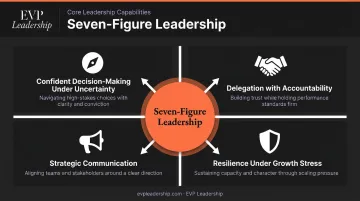
Four leadership capabilities separate owners who sustain seven-figure growth from those who stall:
- Confident decision-making under uncertainty — acting on incomplete information without paralysis or recklessness
- Delegation with accountability — not just assigning tasks, but building systems where team members own outcomes
- Strategic communication — aligning the team to priorities clearly enough that they can execute without constant owner involvement
- Resilience under growth-related stress — maintaining performance quality as complexity, team size, and pressure increase simultaneously
How Misaligned Habits Create Operational Drag
When owners second-guess their team after delegating, the team stops taking ownership. When reactive decisions replace structured ones, the team stops trusting the process. When difficult conversations get avoided, performance problems compound silently.
The costs are concrete: lost productivity, team disengagement, and strategic drift. The business doesn't stall because of a bad market — it stalls because the leader's habits haven't scaled with the business.
EVP Leadership's 90-Day PressurePoint System
EVP Leadership built the PressurePoint System specifically for small and mid-size business owners and executives who need to perform consistently — not just understand strategy.
The 90-day engagement works through three integrated layers:
- Identity Layer — builds leadership anchored in consistency, capacity, and character as operational commitments, not abstract values
- Diagnostic Layer — develops six performance dimensions: Mission Clarity, Force Alignment, Problem Intelligence, Decision Integrity, Execution Discipline, and Momentum Control
- Execution Layer — a five-step protocol for high-stakes moments: Pause the Noise → Locate the Pressure Point → Prioritize the Critical Move → Execute with Discipline → Lock in Momentum
Owners who complete the system don't just know what good leadership looks like — their decision-making, communication, and resilience hold up when growth gets hard.
Frequently Asked Questions
What are the 4 growth strategies in business?
The four strategies come from the Ansoff Matrix: market penetration (more sales to existing customers in existing markets), market development (existing products in new markets), product development (new products for existing customers), and diversification (new products in new markets). Each carries a different risk level, with penetration lowest and diversification highest.
What is the 3-3-3 rule in sales?
The 3-3-3 rule is a sales follow-up framework: reach out to 3 prospects in 3 different ways over 3 days. It's designed to improve contact consistency and increase conversion rates without overwhelming prospects through excessive outreach.
What is the biggest challenge when scaling a business to 7 figures?
The most common challenge is the owner's failure to transition from operator to strategic leader — holding onto execution tasks, underbuilding systems, and not developing the team structure needed to remove themselves as the daily bottleneck. Strategy is rarely the issue; leadership habits are.
How long does it typically take to scale a business to 7 figures?
Most owners reach seven figures within 3–7 years, though service-based businesses with strong systems and clear positioning often move faster. The primary variable isn't market conditions — it's how quickly the owner builds team capacity and removes themselves as the operational bottleneck.
What systems should a 7-figure business owner have in place?
Three core categories: a repeatable client acquisition and delivery system, a financial tracking and forecasting system, and a team management and accountability system — all documented well enough to operate without constant owner involvement.
How does leadership development impact business growth?
Leadership capacity directly determines how much complexity, team size, and revenue volume an owner can effectively manage. Owners who develop their decision-making, communication, and resilience under pressure outperform those who focus only on external strategy while leaving their own leadership habits unchanged.