
Introduction
The skills that close deals often undermine the skills that build teams. Real estate entrepreneurs who hustle their way to top producer status frequently hit a wall the moment they step into a leadership role — because closing instincts and commission-driven intensity don't translate directly into running a brokerage or managing a team of agents.
The pressure doesn't go away. It changes shape. Rate shifts, inventory crunches, agent departures, and recruiting battles all demand decisions that no transaction history can prepare you for.
Leadership coaching addresses this gap — but its value in real estate isn't abstract. It shows up in agent retention rates, decision quality under market pressure, team GCI consistency, and an owner's ability to grow without becoming the operational ceiling of their own business.
What follows covers the specific benefits — each one tied to the operational demands real estate entrepreneurs face when the business outgrows what hustle alone can hold together.
Key Takeaways
- Leadership coaching moves real estate entrepreneurs from top individual producers to business leaders who build and scale teams.
- The highest-ROI outcomes are sharper decision-making under pressure, stronger agent retention, and breaking the owner-as-bottleneck pattern.
- Leadership gaps — not market conditions — are what stall growth in most real estate businesses.
- Conditioning beats training: habits built under realistic pressure hold up when markets shift; insights gained in a seminar often don't.
- Structured 90-day programs produce faster, more concrete progress than open-ended or crisis-driven coaching.
What Is Leadership Coaching for Real Estate Entrepreneurs?
Leadership coaching is a structured, personalized process that helps business owners develop the mindset, skills, and systems needed to lead people and organizations — not just produce results themselves. It's distinct from sales training (which focuses on closing technique) and business consulting (which focuses on strategy and systems) — it focuses on the person running the business.
In a real estate context, this applies across three common transitions:
- Solo agents scaling to team leads — learning to lead others rather than simply outwork them
- Team leaders growing into brokerage owners — building culture, systems, and delegation capacity
- Broker-owners who are operationally strong but struggling to inspire, delegate, or retain agents long-term
Conditioning vs. Training
The key distinction is between leadership training and leadership conditioning. Training delivers knowledge in a structured setting. Conditioning builds repeatable habits through consistent practice under realistic pressure — so that leadership behaviors hold up when a market correction hits, a top agent walks out, or a high-stakes recruiting conversation goes sideways.
EVP Leadership's approach is built on this distinction. Their PressurePoint System is a 90-day leadership conditioning program structured around three layers:
EVP Leadership's approach is built on this distinction. Their PressurePoint System is a 90-day leadership conditioning program structured around three layers:
- Identity — consistency, capacity, and character as a foundation
- Diagnostics — clarity tools including Mission Clarity, Decision Integrity, and Force Alignment
- Execution — a five-step protocol for performing through high-pressure moments
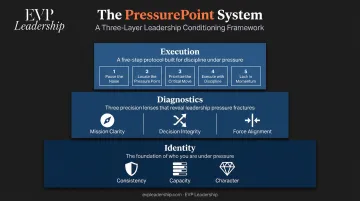
The goal is consistent leadership performance under pressure — built through habit, not theory.
Key Benefits of Leadership Coaching for Real Estate Entrepreneurs
The benefits below connect to metrics real estate entrepreneurs actually track: agent retention, GCI per agent, deal conversion, owner time allocation, and team revenue independent of the owner's personal production. These aren't soft improvements — they directly influence how a business grows and sustains itself.
Benefit 1: Sharper Decision-Making When the Market Doesn't Give You Time to Think
Real estate operates in cycles of urgency. Rate changes, inventory swings, and buyer demand shifts create narrow decision windows, and the entrepreneurs who move with clarity in those windows consistently outperform those who hesitate or default to old habits.
The problem is that stress actively degrades decision quality. Research published in Brain, Behavior, & Immunity - Health confirms that stress impairs cognitive processes, particularly decision-making. The moments that demand the best leadership judgment are the same moments that make it hardest to think clearly.
Leadership coaching addresses this directly. Through structured reflection, scenario work, and feedback cycles, entrepreneurs identify their specific patterns under pressure: where they overcorrect, where they freeze, and where they default to control instead of strategy. Over time, this builds the mental conditioning needed to lead confidently when stakes are high.
McKinsey's research on decision-making found that only 20% of organizations excel at decision-making, and that fast decision makers are twice as likely to make high-quality decisions as slow ones.
In a commission-based environment, slow or reactive decisions carry direct financial consequences: lost recruits, botched negotiations, missed market timing. That makes decision-making one of the highest-ROI outcomes coaching delivers to real estate entrepreneurs.
EVP Leadership's Execution Layer directly targets this: the five-step protocol (Pause the Noise → Locate the Pressure Point → Prioritize the Critical Move → Execute with Discipline → Lock in Momentum) gives leaders a repeatable process for high-stakes moments rather than relying on instinct alone.
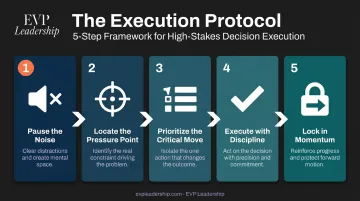
KPIs this benefit influences:
- Deal conversion rate
- Time-to-decision on operational pivots
- Owner hours spent in reactive firefighting vs. strategic planning
- Agent satisfaction with leadership responsiveness
When this matters most: Market corrections, rapid team expansion, competitive recruiting windows, or when a team is transitioning from a team model to a full brokerage.
Benefit 2: Building Agent Teams That Stay, Produce, and Trust Leadership
Agent churn is one of the most expensive and underaddressed problems in real estate entrepreneurship. RealTrends data shows that nearly 20% of all real estate licensees exit the business every year, with 20–30% leaving before their third anniversary.
Agents who departed had median annual production of $434,500, compared to $1,646,500 for agents who stayed. That's not just a people problem. It's a revenue problem.
Leadership coaching develops the communication, influence, and culture-building capacity that changes this dynamic. When broker-owners and team leaders learn to lead with clarity, the team dynamic shifts from transactional to relational:
- Setting clear expectations so agents know exactly where they stand
- Recognizing contributions before agents start questioning their fit
- Handling conflict directly rather than letting it erode trust
- Creating psychological safety that makes people want to stay
The difference matters. Agents who trust leadership close more deals, refer recruits, and maintain consistent production levels. Agents who don't treat the brokerage as a platform — interchangeable, dispensable, always one better split away from leaving.
Gallup estimates that managers account for at least 70% of the variance in employee engagement scores. In a commission-based, independent-contractor environment where 87% of NAR members are classified as independent contractors, this influence dynamic is even more critical. You can't mandate loyalty. You have to earn it through how you lead.
The PressurePoint System's Diagnostic Layer includes two components directly relevant here: Force Alignment (whether the right people are fully aligned and accountable) and Mission Clarity (whether agents understand what must be achieved and why it matters). When these are operating, agents feel invested in something larger than their individual commission — and that's what retention is built on.
KPIs this benefit influences:
- Agent retention rate and average tenure
- Team GCI per agent
- Manager-to-agent communication frequency
- Internal referral and recruitment rate
When this matters most: During rapid team scaling, post-split from a larger brokerage, or when an owner has experienced multiple consecutive agent departures.
Benefit 3: Making the Shift from Producer to Business Owner — and Staying There
A high-producing agent becomes a team leader or broker-owner, and keeps operating like a solo producer. They take listings personally, manage every agent problem directly, and become the business rather than running it. It's the most common growth trap in real estate entrepreneurship.
This isn't a discipline problem. It's an identity and habit problem, and it's extraordinarily common. SCORE reports that 70% of small business owners prefer to do everything themselves rather than delegate, citing three consistent reasons: they believe they're the most capable option, they doubt their team's skills, and they're simply in a hurry.
Harvard Business Review notes that poor delegation prevents organizations from maximizing their people, denies team members growth opportunities, and leaves leaders with no time for strategic work. For a real estate entrepreneur, this translates directly: every hour spent taking listings or personally handling agent escalations is an hour not spent building systems, recruiting, or leading strategically.
Leadership coaching surfaces the specific habits and beliefs that keep entrepreneurs stuck in production mode. EVP Leadership's Founder Leadership Coaching and Delegation, Accountability & Operating Discipline work address this directly — not through motivational reframing, but through structured delegation protocols, accountability operating rhythms, and an identity-level shift in how the owner understands their role.
A business that depends entirely on the owner's personal production isn't a scalable asset. It's a self-employment trap. The shift from producer to business owner — building systems, delegating with clarity, and leading rather than doing — is what makes a real estate business worth owning long-term.
When this matters most: When a team reaches 3–5 agents and growth plateaus, when burnout symptoms emerge, or when the business is preparing for expansion or a future exit.
KPIs this benefit influences:
- Percentage of revenue dependent on owner's personal production
- Owner hours in management vs. billable activities
- Team revenue growth independent of owner deals
- Operational consistency during owner absence
What Happens When Leadership Coaching Is Missing
Without deliberate leadership development, most real estate entrepreneurs stall — not because the market fails them, but because leadership gaps compound over time:
- Chronic recruiting cycles replace agent retention — draining momentum and revenue
- Reactive decisions in volatile market windows cost deals, agents, or credibility
- Owner burnout from being the solution to every operational problem and client escalation
- Growth ceilings that feel like market limitations but are actually leadership limitations
- Full revenue dependency on the owner's personal production — fragile, exhausting, and unscalable
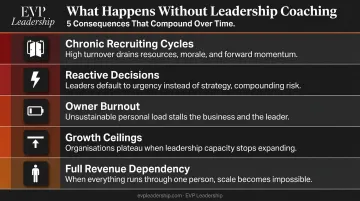
Those last two items on that list tend to hit hardest — and the data on burnout backs it up. Capital One's research found that 48% of small business owners experienced burnout in the past month, with 72% reporting mental exhaustion. In real estate — where the market never fully stops and agent management never pauses — those numbers likely run higher.
The underlying pattern is predictable. Leaders who haven't been conditioned to perform under pressure revert to their strongest individual-contributor habits when pressure peaks. They do more. They lead less. The organization stops growing because it's still depending on one person to hold it together.
How to Get the Most Value from Leadership Coaching
Leadership coaching delivers stronger, more lasting results when treated as a consistent practice, not a crisis resource. What separates engagements that drive behavior change from ones that produce only awareness:
- Tie coaching to specific business outcomes — agent retention targets, revenue goals, owner time allocation — not just personal development goals
- Apply insights in real operational situations between sessions, not just during them
- Use a defined engagement window with accountability checkpoints rather than open-ended, ad-hoc sessions
- Review progress regularly so insights translate into changed behavior, not just changed thinking
Structured programs outperform open-ended coaching for one reason: accountability within a clear timeframe creates momentum. That's the logic behind EVP Leadership's 90-Day PressurePoint System. It maps a direct path from identified leadership gaps to pressure-tested habits, in a window short enough to maintain urgency and long enough to drive real conditioning.
Ninety days is the conditioning threshold. That's how long it takes for new leadership behaviors — decision-making frameworks, delegation habits, communication patterns — to become reliable under pressure, rather than requiring conscious effort every time.
Conclusion
Real estate entrepreneurs who invest in leadership coaching aren't developing soft skills. They're building the operational capacity to make better decisions, lead stronger teams, and grow beyond their personal production ceiling.
The measurable outcomes — agent retention, team revenue, decision speed, owner capacity — are what distinguish sustainable brokerages from stalled ones. And each of those outcomes connects directly to how the person at the top leads when pressure is highest.
The real estate market will always be volatile. Brokerages that scale through it aren't led by people with better instincts — they're led by people who have been systematically conditioned to make clear decisions under pressure. That conditioning doesn't happen once. It compounds over time.
If you're ready to build that capacity, EVP Leadership offers a complimentary scoping conversation to identify where the work starts.
Frequently Asked Questions
What are the benefits of leadership coaching?
Leadership coaching improves decision-making quality, strengthens team communication, and builds the self-awareness needed to lead consistently under pressure. For real estate entrepreneurs specifically, these translate into higher agent retention, fewer reactive management patterns, and a business that can grow without depending entirely on the owner's personal production.
What are the 5 C's of coaching?
One widely referenced framework — attributed to executive coach Henna Inam — identifies the Five C's as Clarity, Compassion, Curiosity, Confirmation, and Commitment. This is not an ICF standard; the International Coaching Federation uses an 8 Core Competency model. For real estate entrepreneurs, the most operationally relevant C's are clarity in direction-setting, curiosity in diagnosing team problems, and commitment to following through on difficult decisions.
How is leadership coaching different from business coaching for real estate entrepreneurs?
Business coaching typically focuses on strategy, revenue tactics, and systems — the what of the business. Leadership coaching focuses on the person running it — their decision-making patterns, communication style, and capacity to lead people consistently under pressure. Both have value; leadership coaching tends to have the higher leverage when the owner is the bottleneck.
How long does it take to see results from leadership coaching?
Meaningful leadership changes typically emerge within 60–90 days when tied to structured programs with defined goals and accountability checkpoints. Open-ended or infrequent sessions tend to produce awareness without the behavioral conditioning needed for results to hold under real pressure.
Can leadership coaching help real estate entrepreneurs with agent recruitment and retention?
Leadership coaching builds the communication, influence, and culture-building capacity that drives agent loyalty and referral recruiting. Since managers account for the majority of variance in team engagement, improving how a broker-owner leads often has more impact on retention than adjusting commission splits or marketing budgets.
What is the difference between leadership training and leadership conditioning?
Training delivers knowledge and frameworks in a structured setting. Conditioning builds repeatable habits through consistent practice under realistic pressure — so those behaviors hold up when a market correction hits or a key agent walks out. EVP Leadership's PressurePoint System is built on this distinction: training tells you what to do; conditioning ensures you can execute it when it counts.