Introduction
You know exactly what needs to happen. The strategy is clear, the priorities are identified — and yet weeks pass with the same items sitting untouched while urgent fires consume every available hour.
That gap between knowing what to do and consistently doing it is where entrepreneurial momentum stalls. The cause isn't poor strategy or weak work ethic. It's an execution problem — one that intelligence alone can't solve.
Accountability coaching addresses this specific failure point directly. It works as a conditioning practice — one that rewires how entrepreneurs operate day to day and builds the structural conditions for consistent habits to form and hold well beyond the engagement itself.
This article breaks down what accountability coaching actually is, what it delivers for founders and executives, and how to get the most out of it.
Key Takeaways
- Accountability coaching creates external structure that converts intentions into consistent action — not dependent on motivation
- The real long-term gain is habitual follow-through, not individual wins
- Entrepreneurs without accountability default to reactive work, consistently losing ground on high-priority goals
- Lasting habits form when behavior is practiced, reviewed, and reinforced consistently — that's what structured accountability delivers
- Accountability coaching pays off most when treated as ongoing conditioning, not a one-time intervention
What Is Accountability Coaching for Entrepreneurs?
Accountability coaching is a structured working relationship in which a coach helps an entrepreneur commit to specific actions, track follow-through, and course-correct when commitments slip. The focus is execution — not strategy.
That distinction matters. A mentor advises on what to do. A business coach helps you solve strategic problems. An accountability coach focuses on whether you actually do it — answering "how do I follow through?" rather than "what should I do?" Those are different jobs entirely.
Why That Distinction Matters
Most entrepreneurs aren't stuck because they lack good ideas or a clear plan. They're stuck because the gap between deciding and doing stays open. An accountability coach lives in that gap.
The goal isn't accountability for its own sake. The goal is the lasting habits and consistent execution that make business growth sustainable — so that performance no longer depends on how motivated, energized, or inspired you feel on any given Tuesday morning.
At EVP Leadership, this conditioning approach is embedded in the 90-Day PressurePoint System, which builds execution habits through structured cycles of commitment, review, and recalibration — so that follow-through becomes a trained default, not a willpower exercise.
Key Advantages of Accountability Coaching
The advantages below aren't theoretical. They show up in measurable operational outcomes: decisions made, priorities executed, habits maintained, and results compounded over weeks and months. Each one connects directly to what actually drives growth — focus, execution rate, decision quality, and consistency under pressure.
Advantage 1: Consistent Follow-Through Replaces Reliance on Motivation
Motivation fluctuates. Urgency, energy, and enthusiasm all vary — week to week, sometimes day to day. Accountability coaching creates an external structure that keeps commitments active regardless of how motivated the entrepreneur feels at any given moment.
The mechanism is straightforward: regular check-ins establish a social contract. The entrepreneur reports on what was committed to and what was actually done. This reporting dynamic has a measurable effect — research from Dominican University of California found that participants who wrote goals, shared them with another person, and sent weekly progress reports achieved significantly more than those who only thought about their goals. A meta-analysis published in Psychological Bulletin reviewing 138 studies with nearly 20,000 participants confirmed that progress monitoring promotes goal attainment — with the strongest effects when progress is physically recorded or publicly reported.
Why this matters operationally:
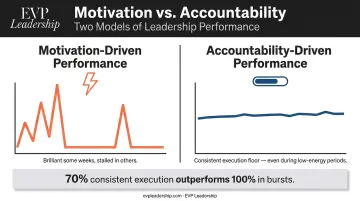
- Motivation-dependent performance creates an inconsistent execution floor — brilliant some weeks, stalled in others
- Accountability-driven performance creates a baseline that holds even during low-energy periods
- Entrepreneurs who consistently execute at 70% capacity outperform those who execute at 100% only in bursts
KPIs impacted: Weekly task completion rate, goal achievement rate, time-to-decision on deferred priorities
When it matters most: During scaling phases, when complexity increases and emotional bandwidth thins — precisely the moments when motivation dips but consistent execution matters most.
Advantage 2: Sharp Prioritization When Everything Feels Urgent
Everything in entrepreneurship feels urgent. Customer issues, team decisions, financial reviews, and growth strategy all compete for the same limited hours. Without an external structure, most entrepreneurs default to whatever is loudest — not what's most important.
A survey by The Alternative Board of 323 business owners found that owners spent only 32% of their time working on the business, while 73% preferred spending time on strategic activities. The gap between what they wanted to prioritize and what actually consumed their day was stark.
Accountability coaching addresses this directly. In each session, the entrepreneur identifies the 2–3 commitments that will most move the business forward. The coach holds that focus between sessions, preventing the drift toward easier or louder tasks. The APA's research on task-switching adds a sharp cost estimate: switching between tasks can create mental blocks that reduce productive time by up to 40%. Every reactive pivot carries that hidden tax.
Why this matters operationally:
- Without external prioritization pressure, entrepreneurs spend most of their capacity on what's urgent, not what's important
- Unfocused time has a direct impact on growth rate, profitability, and decision quality
- EVP Leadership's PressurePoint System includes a specific step — "Prioritize the Critical Move" — designed to train exactly this discipline under pressure
KPIs impacted: Revenue-generating activity ratio, strategic project completion rate, decision cycle time
When it matters most: For entrepreneurs managing multiple functions simultaneously — when there's no leadership team to distribute responsibility, prioritization coaching shifts from a nice-to-have into a core performance lever.
Advantage 3: Habit Conditioning That Outlasts the Coaching Relationship
The highest-value outcome of accountability coaching isn't what gets done during the engagement. It's the behavioral conditioning that remains after it ends.
Repeated, reviewed, and reinforced behavior creates operating patterns that become default. EVP Leadership's entire methodology is built on this distinction between training and conditioning. As their core thesis holds: leaders don't rise to expectations — they fall back on conditioning.
The behavioral science supports this framing. Research published in European Journal of Social Psychology by Lally et al. found that habits take an average of 66 days to form, with a range of 18 to 254 days depending on the behavior and individual. A 90-day structured engagement — like EVP Leadership's 90-Day PressurePoint System — sits squarely within the window where real behavioral conditioning can take hold.
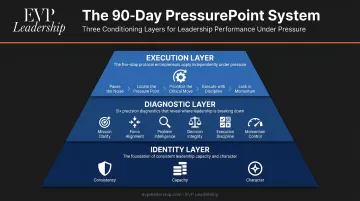
The system builds this through consistent cycles across three layers:
- Identity Layer — consistency, capacity, and character
- Diagnostic Layer — Mission Clarity, Force Alignment, Problem Intelligence, Decision Integrity, Execution Discipline, and Momentum Control
- Execution Layer — a five-step protocol entrepreneurs apply independently after the engagement ends
Why this matters operationally:
- One-time training fades within weeks; conditioned habits compound indefinitely
- An entrepreneur who has internalized follow-through, prioritization, and reflection operates at a permanently higher performance baseline
- The 90-Day PressurePoint System is specifically designed so clients leave with "a sustainable approach you can continue beyond coaching"
KPIs impacted: Decision consistency under pressure, operational reliability, leadership presence during high-stakes moments
When it matters most: For entrepreneurs in growth transitions — when the skills that built the business are no longer enough to scale it, conditioning new leadership habits stops being optional.
What Happens When Accountability Is Missing
When there's no external accountability structure, a predictable set of consequences follows. Goals get set — then reset — without follow-through. Strategic projects stay in "planning" for months. Reactive work fills every available hour, crowding out the high-impact decisions that actually move the business.
These aren't character flaws. They're predictable outcomes of working without structure.
The execution gap is well-documented at the organizational level. A Brightline/Economist Intelligence Unit survey found that nearly 90% of respondents failed to achieve all strategic goals because of poor implementation — and 53% said inadequate delivery capability put those goals at a disadvantage from the start. For solo founders and small business owners operating without the infrastructure of a large organization, that implementation gap is even harder to close.
The compounding cost goes deeper than delayed results:
- Organizational drift — the business gradually loses direction as priorities shift without completion
- Confidence erosion — the entrepreneur loses trust in their own ability to follow through, which compounds hesitation on future decisions
- The founder bottleneck — when the business relies entirely on the owner's motivation rather than structured systems, growth stalls at the founder's personal capacity
Closing this gap requires more than renewed commitment — it requires structure. EVP Leadership's Delegation, Accountability & Operating Discipline work addresses exactly this: treating delegation, accountability, and operating discipline as three connected disciplines that reinforce each other, and intervening at the point where the founder's growth and the business's growth start to pull in different directions.
How to Get the Most Value from Accountability Coaching
Accountability coaching delivers its highest value when approached as a conditioning practice, not a consulting service. The coach isn't there to validate decisions or provide answers. They're there to ensure that what was committed to actually gets done — and gets reviewed.
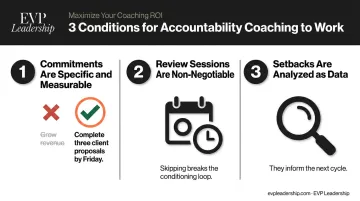
Three conditions determine whether the engagement performs at its highest:
- Commitments are specific and measurable — "grow revenue" is not a commitment. "Complete three client proposals by Friday" is.
- Review sessions are treated as non-negotiable — consistency of the session is part of the conditioning; skipping it breaks the loop
- Setbacks are analyzed as data, not treated as personal failures — what blocked execution this week is exactly the information the next cycle needs
Preparing for Each Session
The quality of a coaching session is largely determined before it starts. Entrepreneurs who maximize ROI typically arrive having:
- Reviewed commitments from the prior session
- Identified what specifically blocked execution (time, clarity, competing priorities, decision paralysis)
- Prepared a priority list for the next period — not a wish list, a ranked list
Session cadence is part of the conditioning itself. A 90-day commitment window gives behavioral patterns enough time to take hold — Lally's research on habit formation puts the average at 66 days, with many behaviors requiring longer.
That timeline shapes how EVP Leadership's 90-Day PressurePoint System is structured. Each cycle reinforces the habit loop until consistent execution no longer depends on external enforcement. The endpoint isn't accountability from the outside. It's a leader who operates that way by default.
Conclusion
Accountability coaching for entrepreneurs works because it builds the structural conditions under which consistent, high-impact habits actually form — and stay. Willpower and motivation are unreliable inputs. Structure is not.
The advantages compound when the practice is treated as ongoing conditioning rather than a one-time intervention. Motivation dependency gives way to consistent follow-through. Reactive firefighting gives way to ruthless prioritization. The habits that form during the coaching engagement outlast it — that's the entire design.
For entrepreneurs who want to stop relying on inspiration and start operating with the consistency of a prepared leader, accountability coaching isn't an add-on to the strategy. It's what turns strategy into daily execution. EVP Leadership has spent 17 years helping founders and executives build exactly that kind of operating discipline — not through motivation, but through conditioning.
Frequently Asked Questions
What are the 5 C's of accountability?
The 5 C's commonly referenced in business contexts are Clarity, Commitment, Communication, Collaboration, and Consequences — covering everything from knowing exactly what's expected to understanding the real cost of not following through. Together, they form a practical framework for holding yourself and your team accountable.
How much does an accountability coach cost?
According to the 2025 ICF Global Coaching Study, active coach practitioners charge an average of $234 USD per hour, with experienced coaches (10+ years) averaging $270 USD per hour. Structured 90-day programs typically represent better ROI than ad hoc hourly sessions because the conditioning effect requires time and consistency.
How is accountability coaching different from business coaching?
Business coaching addresses strategy and problem-solving. Accountability coaching addresses execution — whether the strategy you have actually gets done, consistently, over time. The two work well together: one builds the plan, the other makes sure it doesn't sit on a shelf.
How long does it take to build lasting habits with an accountability coach?
Research by Lally et al. found habit formation averages 66 days, ranging from 18 to 254 days depending on the behavior. EVP Leadership's 90-Day PressurePoint System is built around this window specifically — long enough to produce real behavioral conditioning, not just temporary momentum.
What should I look for in an accountability coach for my business?
Prioritize three criteria: experience working specifically with entrepreneurs (not just corporate executives), a structured methodology with defined cycles of commitment and review, and a coaching style that balances support with direct challenge — someone who holds the line when you rationalize slipping on a commitment.
Can accountability coaching work if I already have a business coach or consultant?
Yes — accountability coaching complements, not replaces, strategic advisors. Your business coach or consultant provides the strategy; the accountability coach ensures that strategy actually gets executed consistently over time rather than remaining a well-documented plan.