This is not a hypothetical. For founders, CEOs, and executive teams leading small and mid-size businesses, competing stakeholder demands are a constant operational reality. According to PMI's 2025 Pulse of the Profession, 94% of project professionals prioritize stakeholder management under timeline constraints and 91% under budget constraints — which means the pressure is near-universal.
This guide covers what drives stakeholder conflicts, why resolving them is fundamentally a leadership capacity issue, and the concrete strategies that allow leaders to navigate competing demands with clarity rather than chaos.
Key Takeaways
- Stakeholder conflicts are structurally inevitable — not a sign of poor management
- Leaders without clear organizational priorities default to people-pleasing or conflict avoidance
- Mission clarity is the anchor that makes competing demands manageable
- Structured decision frameworks reduce paralysis when stakeholder demands collide
- Proactive alignment is far less costly than resolving conflict after it erupts
What Are Conflicting Stakeholder Priorities — and Why They're Inevitable
Conflicting stakeholder priorities occur when different individuals or groups hold competing expectations that can't all be satisfied with the same resources at the same time.
The scenarios are familiar:
- An investor pushing for cost cuts while a department head argues for headcount growth
- A customer demanding faster delivery while the operations team flags quality risks
- A board prioritizing profitability while employees push for expanded benefits
None of these stakeholders is wrong. They're each viewing the same organization through a different lens — different risk tolerances, different definitions of success, different time horizons.
The Root Causes (And How to Recognize Them)
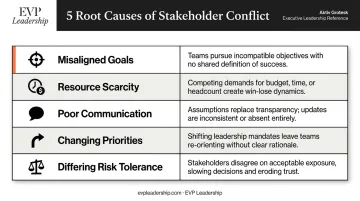
Conflict isn't a management failure. It's a structural outcome of how organizations work. Understanding which root cause applies to your situation determines which resolution strategy to use:
| Root Cause | What It Looks Like |
|---|---|
| Misaligned goals | Departments optimize for metrics that conflict with each other |
| Resource scarcity | Budget, time, or talent can't satisfy every stakeholder's request |
| Poor communication | Assumptions were made that were never explicitly stated |
| Changing priorities | Strategy shifted but not all stakeholders were updated |
| Differing risk tolerance | One stakeholder sees an opportunity where another sees a threat |
PMI's research on communications found that two in five projects fail to meet original goals, with 50% of those failures linked to ineffective communications. In most of those cases, the breakdown traced back to misaligned expectations that were never surfaced — before a single deliverable was missed.
Why Stakeholder Conflict Is a Leadership Problem, Not Just a Process Problem
Most stakeholder conflict frameworks focus on tools and processes. They offer templates, matrices, and meeting structures. These are useful — but they miss the real issue.
A leader who lacks clarity about their own organizational priorities will default to one of two failure modes:
- People-pleasing — attempting to satisfy everyone and ultimately delivering nothing of value to anyone
- Conflict avoidance — delaying the difficult conversation until the conflict escalates into a crisis
Neither is a process failure. Both are leadership capacity failures.
Mission Clarity as the Decision Anchor
When a leader has a clearly defined mission and set of strategic priorities, they have an objective standard for evaluating competing stakeholder demands. The question stops being "Who is louder?" and becomes "Which of these demands creates more value for what we're actually trying to accomplish?"
Mission Clarity is the first diagnostic component in EVP Leadership's PressurePoint System, anchored on a single question: Do we know exactly what must be achieved, and why it matters now? Without that anchor, stakeholder pressure fills the vacuum.
The Emotional Dimension Leaders Overlook
According to McKinsey, 70% of change programs fail largely due to employee resistance and lack of management support. Resistance, broken trust, and unspoken motivations often drive stakeholder conflict far more than the surface-level demands being stated.
The Harvard Program on Negotiation's Getting to Yes framework makes a critical distinction here: positions (what stakeholders ask for) versus interests (what they actually need). A stakeholder demanding weekly status reports may actually need reassurance that the project is on track.
Effective leaders learn to ask: What does this person actually need here? That reframe shifts the entire resolution strategy — from negotiating demands to addressing the underlying concern.
Conditioning vs. Training
Performing consistently under stakeholder pressure requires conditioned responses that hold up when pressure is real and decisions carry real consequences — not just frameworks understood in theory.
EVP Leadership's core thesis is that leaders don't rise to expectations under pressure; they fall back on their conditioning. The PressurePoint System's Identity Layer specifically builds the emotional capacity and resilience leaders need to navigate competing demands without defaulting to reactive instinct or paralysis. That conditioning is built through repeated, deliberate practice — which is why a 90-day engagement produces different results than a single training day.
Strategies for Managing Conflicting Stakeholder Priorities
Map and Segment Your Stakeholders First
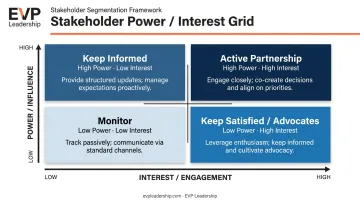
Before conflict escalates, build a stakeholder map. The Power/Interest Grid — first published by Mendelow in the early 1990s and referenced extensively by PMI — segments stakeholders by their level of influence and their level of interest in outcomes.
The practical allocation logic:
- High influence + high interest → Active partnership and frequent engagement
- High influence + low interest → Keep informed; don't overwhelm
- Low influence + high interest → Keep satisfied; leverage as advocates
- Low influence + low interest → Monitor with minimal effort
This segmentation stops leaders from spending equal energy on every stakeholder — a common and costly mistake.
Diagnose the Conflict Accurately Before Attempting Resolution
Not all conflicts are the same type. Misdiagnosing a trust issue as a scheduling conflict produces solutions that don't hold. Before acting, identify which category applies:
- Resource conflict — Competing demands on a fixed budget, timeline, or team
- Goals conflict — Stakeholders are optimizing for fundamentally different outcomes
- Communication breakdown — Misunderstanding of scope, roles, or decisions
- Trust issue — A stakeholder's stated demand is actually a symptom of broken confidence
The resolution strategy must match the conflict type. Applying a scheduling fix to a trust problem doesn't resolve anything — it just delays the same conflict resurfacing with more friction attached.
Facilitate Structured Dialogue — Not Just Meetings
There's a significant difference between a standard update meeting and a structured conflict resolution session. The latter requires:
- A defined agenda focused on interests, not positions
- Active listening protocols — stakeholders speak to be understood, not just heard
- Documented decisions — what was agreed upon, what was deferred, who owns what
- Clear outcome ownership — every action item has a named responsible party
Teri Evans, EVP Leadership's Leadership Facilitator, designs and leads exactly these kinds of sessions for executive teams, leadership teams, and nonprofit boards — with measurable objectives built into each engagement rather than generic discussion formats.
Anchor Decisions to Organizational Goals
The leader's role in stakeholder conflict is not to make everyone happy. It's to make the right decision for the organization.
A practical test when two stakeholder demands are in direct conflict:
- Which demand, if fulfilled, creates more value toward the organization's stated mission?
- Which carries less risk to long-term organizational health?
- Which is more reversible if it turns out to be the wrong call?
EVP Leadership's Decision Integrity component within the PressurePoint System asks the core question directly: Are decisions grounded in truth — or distorted by noise and emotion? That question cuts through the political pressure of stakeholder conflict and returns the leader to what actually matters.
Transparency about that reasoning builds more long-term trust than simply announcing a decision. Stakeholders who understand why a call was made can accept outcomes they don't prefer.
Document Agreements and Follow Through
Unresolved or poorly communicated agreements are a primary reason stakeholder conflicts recur. After every conflict resolution conversation:
- Document what was agreed upon and what was deferred
- Assign clear ownership for each commitment
- Set a review date to confirm follow-through
Done consistently, this creates accountability in the current situation — and makes it far less likely the same conflict resurfaces three months later.
Prioritization Frameworks to Resolve Competing Demands
When stakeholder demands arrive simultaneously and all feel urgent, leaders need a structured decision lens — not just gut instinct.
MoSCoW Method
The MoSCoW Method, documented by the Agile Business Consortium, categorizes demands into four buckets:
- Must Have — Non-negotiable; the initiative fails without it
- Should Have — High value, but the initiative can proceed without it short-term
- Could Have — Desirable if resources allow
- Won't Have — Explicitly deferred for now
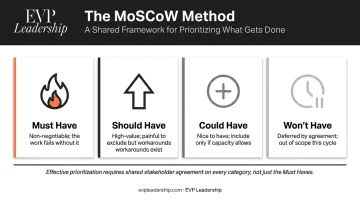
The key is running this exercise with stakeholders, not for them. Shared categorization creates shared accountability for trade-offs.
Eisenhower Matrix
HBR research confirms that people systematically prioritize tasks with the shortest deadlines, even when those tasks aren't the most important. The Eisenhower Matrix counters this bias by separating what feels urgent from what is strategically important.
Four quadrants:
| Urgent | Not Urgent | |
|---|---|---|
| Important | Do now | Schedule it |
| Not Important | Delegate it | Eliminate it |
Under stakeholder pressure, almost everything feels like Quadrant 1. The matrix forces an honest conversation about which demands actually belong there.
Stakeholder Priority Tiers
Not all stakeholders carry equal weight in every category of decision. Establish a hierarchy before conflict arises — not during it:
- Customer experience decisions → Weight end-users and frontline teams heavily
- Financial decisions → Weight board members and investors
- Operational decisions → Weight department heads and execution teams
A pre-established hierarchy speeds up decisions when pressure is high. EVP Leadership's Force Alignment diagnostic asks exactly this question — are the right people in place, fully aligned and accountable? — as part of the broader PressurePoint System.
Scenario Analysis
When competing stakeholder demands look equally valid, map the realistic downstream consequences of each path before committing to one. HBR notes that scenario planning works best when leaders analyze specific variables — revenues, margins, operational capacity — rather than working in abstractions. Map out what actually happens under each choice before committing to a path.
How to Prevent Stakeholder Conflicts Before They Escalate
Most stakeholder conflicts don't arrive without warning — they build from assumptions that were never tested and concerns that were never surfaced.
Set Expectations in Writing at the Start
Most stakeholder conflicts are partially caused by assumptions that were never explicitly stated. At the outset of any initiative, document:
- Scope and decision rights
- Communication cadence and format
- What "success" looks like for each stakeholder group
- What falls outside the scope of this engagement
PMI's research found that high performers create formal communication plans for 68% of projects, compared with 38% for low performers — and communication plans in high-performing organizations are more than three times as effective as those in low-performing ones.
Conduct Proactive Alignment Check-Ins
Don't wait for concerns to become conflicts. Brief, structured check-ins between key stakeholders surface emerging tensions before they harden into positions.
An effective check-in is:
- Scheduled, not reactive
- Focused on "What's shifted since we last spoke?" rather than status updates
- Short enough to actually happen regularly
This practice also signals to stakeholders that their perspective is valued — which reduces adversarial dynamics before they develop.
Build Psychological Safety Around Disagreement
In organizations where stakeholders feel penalized for voicing concerns, conflicts go underground. When they eventually surface, they show up as passive resistance, missed deadlines, and side conversations that quietly undermine decisions already made.
Amy Edmondson's research on psychological safety defines it as a shared belief that the team is safe for interpersonal risk-taking. Leaders model this by treating surfaced disagreement as constructive — not disruptive — and by responding to early concerns without defensiveness.
Translating that research into practice is where most leaders struggle — knowing the concept is different from building it into how a team actually operates. Teri Evans integrates psychological safety practices directly into leadership team development sessions at EVP Leadership, working with teams across healthcare, nonprofit governance, and executive leadership contexts to make disagreement a feature of how they function, not a threat to it.
Frequently Asked Questions
Frequently Asked Questions
How do you handle conflicting stakeholder requirements?
Map each stakeholder's underlying interest — not just their stated requirement — and anchor the resolution to organizational goals. Facilitate a structured dialogue to surface trade-offs clearly, then document the agreed-upon outcome with named ownership so it holds.
What are the 7 C's of stakeholder management?
PMI's practitioner framework identifies seven elements for project success: Customers, Competitors, Capabilities, Cost, Channels, Communication, and Coordination — a structured lens for evaluating how thoroughly you're managing stakeholder relationships.
What are the most common sources of stakeholder conflict?
The primary sources are misaligned goals, competition for limited resources (budget, time, talent), poor or inconsistent communication, resistance to change, and differing risk tolerances among stakeholder groups.
How do you prioritize when multiple stakeholders have equally urgent demands?
Use a prioritization framework — MoSCoW or an organizational impact assessment — to evaluate each demand against strategic goals. Being transparent about your criteria preserves trust, even when stakeholders don't get the outcome they wanted.
When should a leader escalate a stakeholder conflict rather than resolve it themselves?
Escalate when the conflict involves decisions above your authority, when trust has broken down to the point where a neutral senior party is needed, or when structured resolution attempts have stalled and the conflict is actively threatening business outcomes.