This isn't a personal wellness problem. It's a leadership performance problem.
Most work-life balance advice targets general employees. Senior leaders face structurally different challenges — role isolation, identity fused to performance, always-on visibility, and organizational systems that were built around their constant availability. Generic stress-management tips don't touch any of that.
This article covers what executive coaching actually does to address work-life imbalance in senior roles, why it matters operationally, and what measurable outcomes it drives.
Key Takeaways
- Work-life balance coaching for senior leaders is a structured performance system, not stress management
- Senior leaders face structural imbalance drivers that personal wellness habits can't fix
- Effective coaching builds three compounding capabilities: stronger boundaries, faster pressure recovery, and real delegation discipline
- Ignoring imbalance at the senior level degrades decisions, erodes team culture, and creates succession risk
- Lasting change requires 90+ days of consistent engagement, not a single intervention
What Is Executive Coaching for Work-Life Balance?
Executive coaching for work-life balance is a confidential, structured partnership where a coach helps a senior leader identify where their current operating model is generating unmanageable demands — then builds practical systems to resolve them.
Unlike therapy or a wellness retreat, it's an operational intervention — focused on how a leader functions, decides, and sustains performance over time.
The leaders who need it most aren't struggling because they lack discipline or self-awareness. They're C-suite executives, founders, VPs, and senior business owners performing at a high level — yet experiencing declining energy, deteriorating relationships, or the slow erosion of capacity that precedes burnout.
The goal isn't to work less. It's to ensure the way a senior leader works doesn't gradually destroy their capacity to lead.
That distinction matters at the organizational level, not just the personal one. EVP Leadership's 90-Day PressurePoint System is built on this premise: leader well-being and organizational performance are not separate concerns. When leadership breaks down under pressure, the downstream effects are concrete — slow decisions, inconsistent execution, missed opportunities, and lost revenue. Sustainability isn't a personal achievement. It's an organizational infrastructure requirement.
Key Advantages of Executive Coaching for Work-Life Balance
The advantages below are tied directly to operational and leadership outcomes. For senior leaders, personal sustainability and organizational performance are inseparable — which means the return on this work shows up in business metrics, not just mood.
Advantage 1: Structural Boundary Setting
Most senior leaders already know they're overextended. The problem isn't self-awareness — it's that they lack a structural roadmap to change it. Coaching externalizes the problem from character to design.
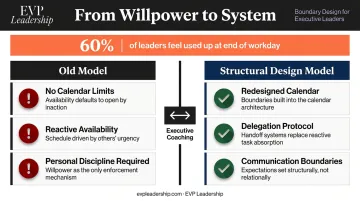
The real work here is redesigning how a leader's time, attention, and availability are organized — so that limits are built into systems rather than left to willpower.
In practice, a coach examines the leader's actual calendar, communication patterns, and delegation habits to locate where the operating model is generating unsustainable load — then redesigns it. The problem stops being "I need more discipline" and becomes "this system is broken, so let's fix the system."
The urgency is real. DDI's 2021 Global Leadership Forecast, drawing on data from more than 15,000 leaders, found that nearly 60% reported feeling used up at the end of the workday — and burned-out leaders were nearly four times more likely to plan to leave their role within the next year.
The cognitive cost is just as real. Peer-reviewed neuroscience research confirms that chronic stress shifts decision behavior away from flexible, goal-directed thinking toward reflexive, rigid patterns. Managing cognitive load through structural design — not willpower — produces more deliberate decisions and fewer reactive ones.
KPIs this advantage impacts:
- Decision response time
- Number of escalations handled personally
- Delegation rate
- Weekly meeting load
When it matters most: Rapid growth phases, post-acquisition periods, new role transitions, or any sustained crisis period where temporary overload quietly became permanent.
Advantage 2: Pressure-Calibrated Recovery
Senior leaders in high-pressure roles don't need to get tougher — they need to recover faster so performance stays consistent across peaks and troughs. Recovery capacity, not raw endurance, is what separates leaders who sustain high performance from those who quietly degrade it.
Coaching creates it by identifying a leader's individual stress triggers, recovery gaps, and the behavioral patterns — overworking, skipping self-care, avoiding delegation — that prevent real recovery between high-demand periods.
Gallup research consistently shows that 70% of the variance in a team's engagement is attributable to their manager. A leader running on empty doesn't just hurt themselves — they reshape their team's environment.
A peer-reviewed panel study reinforces this: roughly 10% of a manager's stress increase spills over into employee stress, with that effect remaining detectable a full year later.
Unrecovered stress in senior leaders manifests as poor communication, erratic decisions, and reduced psychological safety — all of which carry downstream organizational costs that don't appear on any wellness dashboard.
Leaders who build genuine recovery capacity arrive at the next high-pressure moment intact — which means better decisions, stronger communication, and a team that doesn't absorb the cost of their depletion.
KPIs this advantage impacts:
- Leadership tenure
- Team engagement scores
- Decision quality under pressure
- Health-related performance disruptions
When it matters most: Industries with cyclical pressure peaks — fiscal quarters, fundraising seasons, product launches — where recovery windows are short but essential.
Advantage 3: Role Identity Clarity and Delegation Capacity
Many executives unconsciously tie their sense of worth to constant availability and hands-on involvement. Delegation feels like losing control — not because they lack trust in their team, but because releasing work requires releasing part of how they've defined themselves.
Coaching addresses this at the identity level. Through structured reflection and values alignment work, coaches help leaders separate who they are from what they do. That shift makes it possible to delegate without anxiety — and to build team capability rather than dependency.
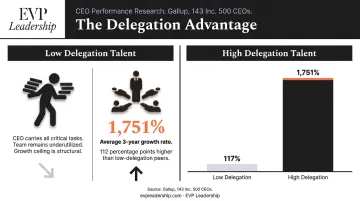
The operational payoff is substantial. Gallup research on 143 Inc. 500 CEOs found that CEOs with high delegation talent posted an average three-year growth rate of 1,751% — 112 percentage points greater than CEOs with limited delegation talent. The same study found only one in four entrepreneurs had high delegation capacity.
EVP Leadership's Founder Leadership Coaching explicitly names "identity-fusion-with-the-business" as a distinct challenge — and the PressurePoint System's Identity Layer addresses it directly. The goal is conditioning a leader whose core identity shifts from "the person who does" to "the person who develops others to do." That shift doesn't happen from a skills workshop. It requires sustained identity work.
KPIs this advantage impacts:
- Direct report performance levels
- Decisions escalated to the senior leader
- Leadership pipeline strength
- Executive workload hours
When it matters most: Founders transitioning from operator to strategist, senior leaders managing significantly larger teams after promotion, or executives preparing for succession.
What Happens When Work-Life Balance Coaching Is Ignored
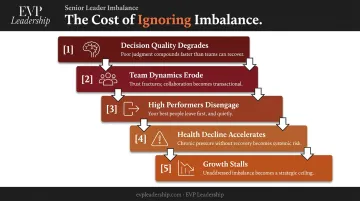
The consequences aren't sudden. They compound.
- Decision quality degrades. Cognitive fatigue accumulates, and reactive thinking replaces strategic thinking. Research confirms chronic stress produces short-term-biased decision patterns and reduced risk perception.
- Team dynamics erode. A leader's chronic stress and unavailability creates ambient anxiety across the organization — and that anxiety is measurable at the team level a year later.
- High performers disengage. Direct reports who see no sustainable leadership model to aspire to quietly start looking elsewhere.
- Physical and mental health decline accelerates. This leads to abrupt exits, forced transitions, and health-related disruptions to business continuity.
- Growth stalls. The leader becomes the organizational bottleneck — all decisions route through them, and they're running on empty.
A Korn Ferry survey found that nearly six in ten C-suite leaders globally anticipated moving to a new role within three years, with roughly one-third citing work-life balance as a primary reason. When those departures happen abruptly, organizations don't just lose a person — they lose the institutional knowledge, relational capital, and strategic continuity that took years to build.
How to Get the Most Value from Executive Coaching
Executive coaching for work-life balance delivers the greatest return when treated as a conditioning process — not a corrective one.
That means engaging before the breaking point, not only after it. Proactive coaching builds the structural capacity to handle pressure before it accumulates into damage. Reactive coaching after burnout focuses on restoration: a slower, harder process that disrupts both the leader and the business.
Three conditions for maximum impact:
- Honest diagnosis — The leader must be willing to examine where their operating model is failing, not just their personal habits. The operating system is usually the problem, not the individual.
- Tracked outcomes — Progress must be reviewed against real metrics, not just discussed in conversation. Behavior change requires accountability structures.
- Insights converted to systems — An insight that doesn't produce a structural change produces nothing. Every realization must translate into something concrete: a redesigned calendar, a delegation protocol, a recovery practice built into the week.
A 2023 peer-reviewed meta-analysis of 20 randomized controlled trials found executive coaching had significant positive effects on behaviors, attitudes, and personal characteristics — with the strongest effects on behavioral outcomes. The research also found that program length, not just session count, mattered for attitudinal change.
That finding points to a structural requirement: programs need defined milestones, not just recurring sessions. EVP Leadership's 90-Day PressurePoint System is built around this principle, providing the consistency and accountability framework that makes lasting behavioral change possible. Open-ended coaching without built-in progress checkpoints rarely produces the structural shifts senior leaders actually need.
Conclusion
Work-life balance for senior leaders is not a personal achievement to chase. It's a leadership infrastructure decision with direct consequences for organizational performance, team stability, and long-term growth capacity.
The three advantages of executive coaching in this area — structural boundary architecture, pressure-calibrated recovery, and delegation identity clarity — compound over time when practiced consistently. Practiced in isolation, they offer temporary relief. Built into a conditioned system, they produce durable performance that holds under pressure.
Effective leaders don't rise to balance through motivation alone. They build systems — and then they condition themselves to operate inside those systems when pressure is high. That's the work EVP Leadership's PressurePoint System is designed to do: move senior leaders from reactive coping to structured, repeatable performance. The coaching engagement doesn't just name the framework. It conditions the behavior until the framework becomes habit.
Frequently Asked Questions
What are common coaching rules for work-life balance, like the 70/30, 80/20, and 8-8-8 rules?
The 8-8-8 rule divides the day into 8 hours each for work, sleep, and personal time. The 80/20 rule focuses energy on the highest-impact 20% of activities. The 70/30 rule reserves a fixed 30% of time as non-negotiable personal capacity. A coach's job is to diagnose which framework — if any — maps to a specific leader's role demands, constraints, and decision-making load before recommending one.
How is executive coaching for work-life balance different from regular life coaching?
Executive coaching addresses structural, organizational, and leadership-specific drivers of imbalance — calendar design, delegation systems, role identity, operating rhythm. Life coaching tends to focus on personal habits and mindset. Senior leaders need both dimensions addressed together, because fixing mindset without fixing the operating model rarely produces lasting change.
Can executive coaching help prevent burnout in senior leaders?
Yes — especially when coaching begins before burnout is acute. Proactive coaching builds recovery capacity and boundary systems that reduce cumulative stress load over time. Reactive coaching after burnout is slower — restoration and structural rebuilding require more disruption before improvements take hold.
How long does it take to see results from executive coaching focused on work-life balance?
Early shifts in awareness and behavior typically emerge within the first 30–60 days. Structural change — particularly in delegation habits and boundary systems — generally requires 90 days or more, which is why structured 90-day programs consistently outperform open-ended arrangements.
What signs indicate a senior leader needs work-life balance coaching?
Key indicators include declining decision quality, inability to disconnect after hours, chronic fatigue despite adequate sleep, and strained personal relationships. When every urgent issue routes through the same person, that's not a time-management problem — it's an operating model problem.
Is work-life balance coaching relevant for small business owners and entrepreneurs?
It's especially relevant. Small business owners often carry both operational and strategic load without the infrastructure larger organizations provide. Coaching helps them build delegation systems, operating rhythms, and structural boundaries that create sustainability — without requiring them to step back from growth.