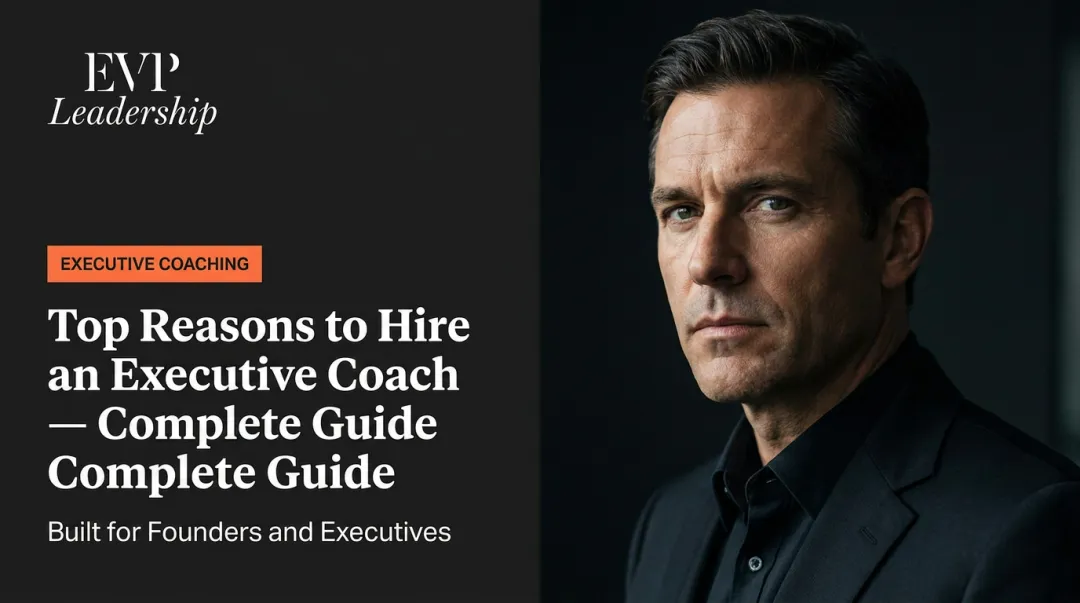

The moment an attorney steps into a managing partner role, practice group chair seat, or firm-wide leadership position, they discover a hard truth: the skills that built their legal career — analytical precision, adversarial thinking, technical mastery — don't automatically translate into the ability to manage partners, develop business, or run a firm as a functioning enterprise. Nobody taught them that part.
Executive coaching for law firm leaders fills that gap. Unlike therapy (which processes the past) or mentorship (which shares experience), executive coaching is future-focused and performance-driven. It builds specific leadership capabilities through structured, accountable engagement.
This guide covers why law firm leaders specifically need coaching, what it addresses, how it accelerates career growth at every stage, and what to look for when selecting a coach.
Key Takeaways
- Law firms promote based on legal merit, not managerial aptitude — coaching closes that gap
- Partnership structures create distinct pressures that generic business coaching isn't built to handle
- Core coaching areas include communication, EQ, business development, financial literacy, and strategic decision-making
- Career growth in law is no longer linear — coaching provides the intentional roadmap each transition demands
- Choosing the right coach comes down to context, methodology, outcomes, and fit
Why Law Firm Leaders Need Executive Coaching
The Structural Gap Nobody Talks About
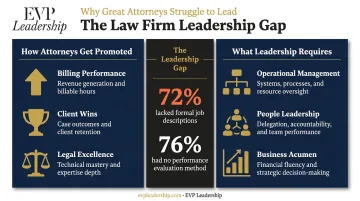
Most attorneys become leaders the same way: they bill well, win clients, and get promoted. Then they inherit a management role with no job description, no performance framework, and no training. According to Managing Partner Forum research, 72% of law firm leaders had no formal job description and 76% lacked any formal performance-evaluation method.
Law firms are structured as partnerships where leadership authority is distributed, decision-making is consensus-driven, and the path to the top runs through legal excellence — not operational or people-management capability. That structure produces a predictable leadership gap when technically excellent attorneys step into management without the tools to lead.
Leading Under Chronic Pressure
Few executives carry the specific pressure combination that law firm leaders face daily:
- Client crises with direct financial consequences
- Partner disputes among equity stakeholders
- Talent retention battles in a mobile market
- High-stakes deadlines that don't pause for internal conflict
- The expectation to keep billing while running a business
A NALP survey on attorney burnout found lawyers reported feeling burned out 44% to 52% of the time. That figure, alarming on its own, intensifies for those who add management responsibilities without the conditioning to carry both loads.
Deliberate leadership conditioning — not just self-awareness — is what prepares attorneys for this level of sustained pressure. EVP Leadership's approach is built on exactly this premise: under pressure, leaders don't rise to expectations. They fall back on their conditioning.
The "I'll Figure It Out" Barrier
Legal culture rewards self-reliance and projects expertise. Asking for help, or acknowledging that you don't know how to lead a partnership, runs against every instinct the profession reinforces. This "I'll figure it out" mindset is one of the most common — and most costly — barriers to leadership development in law.
The Accelerating External Pressure
Technology is compounding this. Thomson Reuters reports that the U.S. legal industry is facing significant pressure from three directions: technology disruption, talent dynamics, and rising client demand. Clients now expect commercial awareness alongside legal skill. Generational workforce shifts mean younger associates have different expectations of leadership. The attorneys who rise to firm-wide leadership over the next decade will need business acumen that most legal training programs never touch. Coaching is the mechanism to build it.
What Executive Coaching Covers for Law Firm Leaders
Leadership and Communication Skills
Senior attorneys are often strong advocates — in court, in negotiations, in client settings. Internal leadership communication is a different discipline entirely.
Coaching develops the specific skills that legal practice doesn't:
- Giving effective feedback to associates in ways that develop rather than deflate
- Managing across the partnership by influencing peers who don't report to you
- Running productive meetings with equity partners who have competing priorities
- Presenting strategy persuasively to a room full of skeptics with their own views
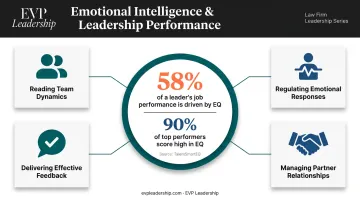
Emotional intelligence sits at the center of this work. Research from TalentSmartEQ found that EQ accounts for 58% of a leader's job performance, and that 90% of top performers score high in EQ. For law firm leaders whose default mode is analytical and adversarial, developing the ability to read team dynamics and regulate emotional responses isn't soft — it's a measurable performance variable.
Tools like 360-degree feedback surface the blind spots that technically skilled attorneys often carry for years without realizing: a communication style that shuts down input, a conflict-avoidance pattern that lets partner disputes fester, or an intensity that drains team morale over time.
Business Development and Commercial Acumen
Most partners reach leadership positions through referral-based origination. Coaching helps attorneys make a deliberate shift toward intentional, relationship-driven business development — building consistent pipelines, cross-selling across practice groups, and thinking commercially about how their behavior affects firm-wide revenue.
BTI Consulting's research found that 54% of attorneys describe their firm's business development culture as inconsistent, apathetic, or indifferent. That's a systemic gap that individual effort rarely fixes without structured support.
Business development culture is only half the equation. Many practice group leaders manage significant revenue without a working understanding of the financial mechanics behind it:
- Realization rates and what drives them down
- Revenue per matter and matter profitability
- Pricing models beyond hourly billing
- Cash flow dynamics that affect firm health
Coaching builds this acumen practically by applying it directly to the leader's actual practice group and current decisions — not through an MBA curriculum, but through work that's grounded in real numbers and live situations.
Strategic Decision-Making and Partner Alignment
Translating firm strategy into partner-level priorities is harder than it sounds. Equity partners answer to no one in the traditional org-chart sense. Getting alignment requires a different skill set than managing employees.
Coaching in this area focuses on:
- Converting firm-wide strategy into concrete commitments each partner owns
- Navigating governance structures where authority is diffuse
- Resolving partner conflicts before they calcify into factional disputes
- Facilitating shared goal-setting across competing interests
EVP Leadership's PressurePoint System is designed for exactly this kind of pressure. The Diagnostic Layer addresses Mission Clarity — ensuring partners understand what must be achieved and why — alongside Force Alignment, which moves people from passive presence to genuine accountability.
A third component, Decision Integrity, builds the capacity to make decisions grounded in reality rather than partnership politics. For law firm leaders navigating partner dynamics, that distinction is often where strategy succeeds or stalls.
How Executive Coaching Drives Career Growth for Attorneys
The Transitions That Define a Legal Career
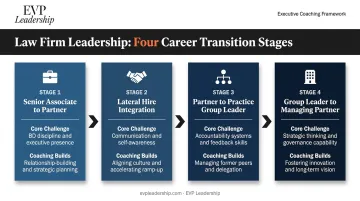
Career growth in law happens in stages, and each stage demands a different leadership capacity:
| Transition | Core Challenge | What Coaching Builds |
|---|---|---|
| Senior associate → partner | Business origination, peer influence | BD discipline, executive presence |
| Lateral hire integration | Cultural fit, relationship capital | Communication, self-awareness |
| Partner → practice group leader | Team management, delegation | Accountability systems, feedback skills |
| Group leader → managing partner | Firm-wide strategy, partner alignment | Strategic thinking, governance capability |
Research from Major, Lindsey & Africa found that proper integration was the single biggest predictor of lateral partner satisfaction — and that 74% of firms cited cultural-fit issues as the reason laterals don't stay past five years. Coaching accelerates the integration curve by building self-awareness and relationship skills that most lateral hires are expected to have but rarely develop on their own.
The Accountability Gap in Self-Directed Development
Self-directed development has a ceiling. Most attorneys who commit to improving their leadership skills without external support make progress for a few weeks, then regress when pressure peaks — reverting to familiar patterns precisely when new behavior matters most.
A coach provides what self-development can't match. That structure shows up in three concrete ways:
- Accountability to specific behavioral commitments made between sessions
- Tracking of measurable change over time, not just intentions
- Interruption of default habits before they reassert under pressure
EVP Leadership's conditioning philosophy names this directly — leadership performance under pressure is built through repeated conditioning, not one-time insight.
Succession Planning as a Growth Strategy
Thomson Reuters data shows that only 37% of firms had a formal succession-planning process in place. The attorneys being groomed for expanded leadership scope rarely know what skill gaps they need to close before moving up. Those gaps tend to surface as visible liabilities after the transition, not before.
Working with a coach before taking on increased scope allows the leader to identify and address those gaps proactively rather than reactively. EVP Leadership's engagement portfolio includes succession planning work directly — preparing leaders for the next level of responsibility before the transition happens.
Executive Presence as a Career Differentiator
Research from Coqual found that executive presence accounts for 26% of what it takes to get promoted, with gravitas (67%), communication (28%), and appearance (5%) as its core components. Between two technically excellent attorneys, presence is often what separates the one who rises to firm-wide leadership from the one who doesn't.
Coaching builds presence through targeted, consistent work: sharpening how an attorney communicates under pressure, steadying composure in high-stakes moments, and developing the grounded behavior that generates trust with partners and clients. That consistency, practiced repeatedly, is what makes presence durable rather than situational.
What to Look for in an Executive Coach for Law Firm Leaders
Three Non-Negotiable Criteria
Coaching is an unregulated field. Anyone can call themselves an executive coach, which makes due diligence on credentials and track record genuinely important. Before committing, evaluate any prospective coach on three criteria:
Relevant professional context — Do they understand law firm economics, partnership dynamics, and billable culture? A coach who has only worked with corporate HR teams will miss the nuances that make legal leadership different.
Structured methodology — Conversational accountability is not a system. Look for a coach who works from a defined framework with clear phases, behavioral targets, and progress tracking — not just open-ended reflection sessions.
Demonstrated outcomes — Ask for specific examples of leadership change in comparable clients, not testimonials about the coaching experience itself.
Conditioning vs. Conversation
The most effective coaches for law firm leaders don't just facilitate insight — they combine behavioral coaching with practical implementation. Awareness without a system to act on it doesn't move the needle.
EVP Leadership's 90-Day PressurePoint System addresses this directly. Rather than a series of conversations, the program conditions leaders to perform consistently under pressure through structured frameworks covering identity, diagnostics, and execution.
For law firm leaders making high-stakes calls in real time — partner disputes, client crises, governance conflicts — that kind of conditioning matters more than inspiration.
Chemistry and Confidentiality
Methodology matters, but fit determines whether you'll actually use it. The coach-client relationship requires genuine trust. In a profession where perceived vulnerability can affect standing with partners and clients, attorneys need to be certain that what surfaces in coaching stays there.
Before committing to any engagement:
- Run at least one trial session to assess fit
- Confirm confidentiality protocols explicitly and in writing
- Evaluate whether you can say difficult things to this person without self-censorship
EVP Leadership keeps all engagements explicitly confidential — particularly in crisis leadership, burnout recovery, and 1:1 executive coaching contexts where professional reputation is directly at stake.
What to Expect from the Coaching Process
The Engagement Arc
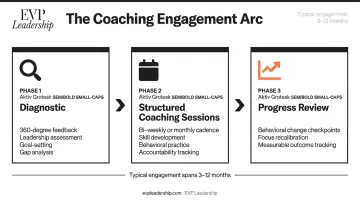
A well-structured coaching engagement follows a defined arc:
- Diagnostic phase — 360-degree feedback, leadership behavior assessment, goal-setting conversations, gap analysis. This phase establishes a baseline and identifies where development will have the highest leverage.
- Structured coaching sessions — Typically bi-weekly or monthly, focused on targeted skill development, behavioral practice, and accountability against commitments made.
- Progress review — Built-in checkpoints to assess behavioral change, recalibrate focus, and ensure the engagement is tracking toward measurable outcomes.
Realistic Timeline for Change
Meaningful behavioral change takes time. Most coaching engagements run between three and twelve months, with the AMA/i4cp finding that 28% of programs lasted three to six months and 30% lasted six to twelve months. The first 90 days build momentum. Sustained improvement compounds across six to eighteen months — that's where behavioral change stops being effortful and starts being automatic.
Coaching isn't a one-time intervention. The initial engagement builds the foundation; periodic check-in sessions afterward prevent regression and reinforce the gains made.
Measuring Progress
Effective coaching programs establish clear KPIs at the outset. For law firm leaders, these typically include:
- Originations growth over the engagement period
- Partner satisfaction or trust scores
- Associate retention and feedback quality
- Delegation frequency and outcomes
- Specific leadership milestones tied to firm goals
Progress should be reviewed at regular intervals throughout the engagement — not only at the end. Without structured checkpoints, there's no mechanism to course-correct when behavior reverts under pressure or priorities shift.
Frequently Asked Questions
What are the 3 C's of coaching?
One widely used framework defines the 3 C's as clarity, commitment, and competence — establishing what you're working toward, your dedication to doing the work, and the skills you're building. In law firm leadership coaching, these map directly to goal clarity, accountability to behavioral change, and developing specific leadership capabilities.
What are the 7 pillars of coaching?
No single universal framework exists — different providers use different models. The ICF's standards-backed approach identifies 8 core competencies, including active listening, powerful questioning, goal-setting, and facilitating client growth. For law firm leaders, the most practice-relevant are accountability, goal-setting, and action-oriented feedback tied to measurable behavioral change.
How is executive coaching different from mentorship for lawyers?
Mentorship is typically relationship-based, advice-driven, and flows from a more experienced practitioner to a less experienced one. Executive coaching is structured, future-focused, and built around the coachee generating their own solutions — with behavioral change as the measurable outcome. A coach does not need to have been a lawyer.
How long does executive coaching for law firm leaders typically last?
Most engagements run between three and twelve months. The minimum effective period for meaningful behavioral change is three to six months. Ongoing periodic check-in coaching is common after an intensive initial engagement to maintain gains under pressure.
How much does executive coaching for attorneys typically cost?
Costs vary based on coach experience, scope, and duration. HBR's benchmark survey placed many experienced executive coaches around $500 per hour, with elite coaches reaching $3,500 per hour. For most firms, originations growth, partner retention, and reduced leadership-driven attrition outweigh the cost of a well-scoped engagement.
When is the right time for a law firm leader to hire an executive coach?
Key inflection points include transitions into partnership, practice group leadership, or managing partner roles. Also: periods of stagnation, burnout, or visible leadership friction. Coaching is most effective when the leader is ready to engage, rather than in acute crisis where immediate clinical or intensive intervention is the more appropriate first step.