Introduction
Picture this: a client calls at 4:47 PM on a Friday to cancel a contract worth 30% of your quarterly revenue. Your stomach drops. In the next two hours, you'll either spiral into reactive damage control: firing off emails you'll regret, making hasty decisions about staffing, snapping at your operations manager. Or you'll pause, locate the real pressure point, and lead through it with your judgment intact.
What separates those two responses is conditioning — not personality, not natural toughness, not some inherited capacity for stress.
EVP Leadership's core belief puts it plainly: "Leaders don't rise to expectations—they fall back on conditioning." Most leaders have been trained, but not prepared for real pressure. That gap is exactly what the data reflects.
Future Forum's 2022 pulse report found executive work-related stress and anxiety had worsened by 40% over the prior year — while non-executive sentiment held relatively stable. The pressure at the top is compounding, and most leaders are managing it with improvised coping rather than conditioned capability.
This guide covers what emotional resilience actually means in a leadership context, the five pillars that build it, why it's harder for leaders than most people acknowledge, how coaching accelerates its development, and the daily habits that make it stick.
Key Takeaways
- Emotional resilience is a conditioned capability, not a fixed trait—it can be deliberately developed
- Five pillars structure resilience: self-awareness, emotional regulation, cognitive flexibility, values-anchored identity, and relational support
- Leaders face resilience challenges—the performance mask, the accountability paradox—that generic wellness advice never reaches
- Consistent small habits build lasting resilience; intensity matters far less than repetition
- Recognizing depletion early is itself a leadership skill—not an admission of weakness
What Is Emotional Resilience in Leadership?
The APA defines resilience as "the process and outcome of successfully adapting to difficult or challenging life experiences" through mental, emotional, and behavioral flexibility. In a leadership context, that means something specific: not staying calm at all costs, but staying functional when the pressure is real.
For a leader, emotional resilience is the capacity to:
- Absorb pressure without losing judgment
- Recover from setbacks without extended dysfunction
- Regulate emotional responses in high-stakes moments
- Sustain clear decision-making across sustained adversity
Emotional Resilience vs. Emotional Intelligence
These two constructs are related but distinct, and conflating them creates confusion.
Emotional intelligence (EI) is the skill of perceiving, understanding, managing, and influencing emotions—in yourself and in others. A 2023 review of 104 peer-reviewed articles on EI in leadership frames it as a capability that affects leadership performance and team dynamics.
Emotional resilience is what allows you to apply that EI capability when the pressure is real and the emotions are intense. You can have strong emotional intelligence and still collapse under sustained adversity — resilience is the durability of the skill under load. EI gives you the self-awareness to notice your emotional state; resilience gives you the capacity to stay functional within it.
Why Leaders Face Unique Exposure
C-suite executives, small business owners, and founders occupy a specific structural position: they are simultaneously the decision-maker, the team's emotional anchor, and the strategic visionary. There is no one above them to absorb the pressure.
As EVP Leadership frames it: "the ability to handle responsibility, complexity, pressure, and growth involves emotional capacity and resilience." That capacity doesn't come standard with the title. It has to be built deliberately — and that's precisely where most leadership development frameworks fall short.
The 5 Pillars of Emotional Resilience for Leaders
Emotional resilience in leaders isn't a single skill. It's a system built on five interconnected pillars that address how a leader thinks, feels, responds, connects, and recovers.
Pillar 1: Self-Awareness
Self-awareness is the foundation. Before you can manage an emotional state, you have to recognize it in real time—not 48 hours later when the damage is done.
Unexamined patterns erode resilience quietly. Reactive behaviors, conflict avoidance, chronic overwork—these don't announce themselves as resilience problems. They present as productivity habits or management style. Coaching surfaces them by forcing a direct look at the gap between intention and impact—and naming what's actually driving the behavior.
Within EVP Leadership's PressurePoint System, the Identity Layer begins here: developing leaders who show up consistently aligned with their own standards.
Pillar 2: Emotional Regulation
Emotional regulation is the ability to pause between stimulus and response—especially in high-stakes moments like public failure, financial pressure, or team conflict.
Practical tools leaders build into their routines:
- Somatic grounding — physical anchoring techniques that interrupt the physiological stress response
- Structured breathing — evidence-based protocols that activate the parasympathetic nervous system
- Decision-delay tactics — deliberately scheduling non-urgent decisions for a defined window, rather than responding reactively
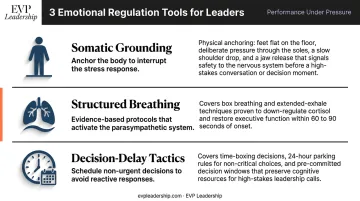
EVP Leadership's Execution Layer puts this into practice through the first step of its pressure protocol: Pause the Noise—"control the moment before the moment controls you." That pause is not passive. It's a conditioned behavior.
Pillar 3: Cognitive Flexibility
Cognitive flexibility is the ability to challenge your own conclusions. It's the capacity to resist catastrophizing, black-and-white thinking, and premature judgment when uncertainty is high.
This pillar has direct implications for decision quality. Leaders who can hold ambiguity without collapsing into reactive decisions make better calls over time. The difference isn't intelligence—it's a conditioned pause between perception and conclusion.
The PressurePoint System's Diagnostic Layer addresses this through Decision Integrity: grounding decisions in truth rather than noise and emotion.
Pillar 4: Values-Anchored Identity
Resilient leaders are grounded in a clear sense of who they are and what they stand for. When external conditions shift—market downturns, team disruption, personal setbacks—their values function as an internal compass.
A 2025 workplace study of 345 full-time employees linked self-concept clarity with enhanced decision-making, reduced stress, and greater intrinsic motivation. For leaders, this translates to a question worth asking in any pressure moment: What can I control right now, and does my response align with who I want to be as a leader?
EVP Leadership's Identity Layer is built on this pillar—defining consistency as "acting in alignment with your values and expectations over time."
Pillar 5: Relational Support Systems
For leaders, deliberate connection is a resilience mechanism—one most wait too long to build.
The structural loneliness of positional leadership is well-documented. Harvard Business Review, citing RHR International, reported that 50% of CEOs feel lonely in the role—and among those, 61% said loneliness hindered their performance. Loneliness at the top isn't just a personal burden—it directly degrades the quality of decisions.
Leaders who can't process stress with direct reports (for obvious reasons) need deliberate external support structures: trusted advisors, peer networks, or a coaching relationship that provides a confidential space for honest reflection. Resilient leaders don't wait until they're depleted to build these systems.

Why Emotional Resilience Is Harder for Leaders Than Most People Think
The Performance Mask
Leaders are expected to project stability and confidence. This is legitimate—teams need anchors, not additional anxiety sources. But the cost is that leaders often suppress or delay processing their own emotional strain.
Unprocessed stress doesn't disappear. It accumulates and depletes resilience reserves faster than the same load would for someone without positional performance expectations attached to how they're allowed to feel.
Research on emotional labor in school leadership found that emotional labor combined with job-related stress explained approximately 80% of variance in burnout in that population. The suppression itself is the risk.
The Accountability Paradox
Leaders are perceived to have more control than they actually hold. When outcomes fall short, they absorb disproportionate blame—externally from stakeholders, and internally from themselves.
This creates a chronic sense of inadequacy that erodes confidence over time. The gap between "I'm responsible for this outcome" and "I actually had limited control over that outcome" is one of the most psychologically corrosive patterns in senior leadership. It rarely surfaces as a resilience conversation. It shows up as a performance conversation instead.
The Small Business Compounding Effect
Both of the pressures above—suppressed emotion and misplaced accountability—intensify when there's no organizational infrastructure to absorb the strain. That's the reality for most small business owners and founders, who carry the operational and emotional weight of their organizations without the support systems—HR, legal, a peer executive team—that exist in larger companies.
Capital One's 2024 small business research found 52% of small business owners said their role caused them stress over the past year. EVP Leadership's work with this population consistently surfaces a specific compounding factor: identity fusion with the business—when the business struggles, the owner's sense of self struggles with it.
How Coaching Builds Emotional Resilience in Leaders
Training transfers information. Coaching builds capability.
A 2009 randomized controlled study of 41 executives found that executive coaching enhanced goal attainment, resilience, and workplace well-being. A 2023 meta-analysis of 20 RCTs confirmed that coaching effects are strongest for behavioral outcomes—the exact domain where resilience lives.
What Coaching Actually Does
The mechanism matters. Coaching builds resilience through four specific functions:
- Pattern recognition: Guided questioning and structured debriefs surface the behavioral cycles that drain resilience. You can't interrupt a pattern you haven't seen clearly.
- Safe processing: A coaching relationship creates space to explore emotional reactions without judgment. De Haan's outcome research with 156 client-coach pairs found coaching relationship quality correlated with perceived effectiveness at r = 0.61—the relationship itself is the active ingredient.
- Cognitive reframing: Skilled coaches help leaders examine the stories they tell themselves about failure and setbacks. Not by dismissing the difficulty, but by challenging interpretations that are limiting without being accurate.
- Real-time practice: Unlike a seminar, coaching happens across actual leadership moments. The leader brings a real situation; the coach helps them process and respond differently. That repetition is what builds conditioning.
The EVP Leadership Approach
EVP Leadership's conditioning philosophy is precise on this point: "Unlike traditional coaching, which focuses on advice and accountability, leadership conditioning builds the resilience, capacity, and discipline leaders need to navigate complexity, make confident decisions, and execute effectively in high-stakes situations."
The 90-Day PressurePoint System structures this across three layers. The Identity Layer builds the values-anchored foundation. The Diagnostic Layer trains clear thinking under pressure. The Execution Layer conditions a repeatable protocol:
The 90-Day PressurePoint System structures this across three layers. The Identity Layer builds the values-anchored foundation. The Diagnostic Layer trains clear thinking under pressure. The Execution Layer conditions a repeatable five-step protocol:
- Pause the Noise
- Locate the Pressure Point
- Prioritize the Critical Move
- Execute with Discipline
- Lock in Momentum
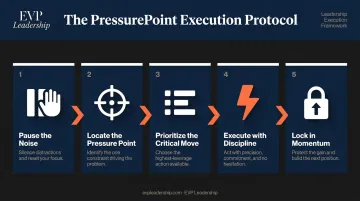
Under pressure, leaders don't improvise. They execute.
Ninety days creates enough repetition and accountability to produce measurable behavioral change. By the end of the engagement, a founder or executive isn't just better at managing pressure—they have a conditioned response to it.
Daily Habits That Condition Emotional Resilience Over Time
Coaching provides the framework. Habits make it stick.
EVP Leadership's core value is direct: "Actionable change starts with small habits practiced consistently over time." Consistency outperforms intensity every time. Four habits that specifically build resilience pillars:
1. Morning Emotional Temperature Check Takes 2-3 minutes. Before the day's demands arrive, name where you're actually starting from — not where you wish you were. This builds the self-awareness pillar through daily noticing rather than reactive processing. It's not journaling for 45 minutes; it's a brief, honest read before the noise begins.
2. Daily Control Audit At the start of high-pressure days, briefly identify what falls within your sphere of influence — and what doesn't. This is a practical filter, not wishful thinking. It prevents powerlessness from draining your reserves before the real work begins. The PressurePoint System's Locate the Pressure Point step applies the same logic in real-time.
3. Intentional Recovery Rituals Movement, disconnection, structured reflection — whatever replenishes your specific capacity. The critical word is intentional. Recovery that isn't designed into your operating rhythm simply disappears under pressure. Leaders who run on empty don't recover by accident.
4. Weekly Values Alignment Review A brief weekly check on whether your decisions and reactions stayed anchored to your core values. Think of it as a compass check, not a performance review. Done consistently, it catches drift before drift becomes pattern — and reinforces the values-anchored identity pillar that holds under real pressure.
Tracking these patterns over time — through coaching notes, journaling, or peer feedback — creates the accountability that makes the habits sustainable. And when leaders can see their own growth, that visibility compounds the conditioning rather than leaving it to chance.
Signs You're Leading on Empty
These warning signs are often misread as time management or strategy problems. The real issue is emotional depletion.
Look for these behavioral and emotional indicators:
- Reactive decision-making — Decisions driven by the need to relieve discomfort, not by clear judgment
- Increased irritability or withdrawal — Shorter fuse, reduced patience, pulling back from team interactions
- Difficulty concentrating in high-stakes conversations — Distraction, rumination, or blank-mind moments during the discussions that matter most
- Avoidance of conflict — Delaying difficult conversations that would normally be handled directly
- Persistent fatigue that rest doesn't resolve — Sleep doesn't help; the exhaustion is emotional, not physical
- Growing sense of powerlessness — A creeping belief that your actions don't change outcomes
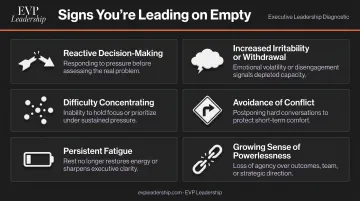
The Maslach Burnout Inventory, the validated clinical standard for burnout measurement, measures depletion across three dimensions: emotional exhaustion, depersonalization/cynicism, and reduced professional efficacy. The behavioral signs above map directly onto all three. If you're recognizing more than two of them, you're not managing a time problem. You're managing a capacity problem.
That distinction matters. Time problems respond to better scheduling. Capacity problems require deliberate recovery and conditioning — which is exactly where leadership coaching delivers.
Frequently Asked Questions
What are the 5 pillars of emotional resilience?
The five pillars are self-awareness, emotional regulation, cognitive flexibility, values-anchored identity, and relational support systems.
What is emotional resilience coaching?
Emotional resilience coaching is a structured, action-oriented partnership in which a coach helps a leader build the skills to manage stress, recover from setbacks, and lead effectively under pressure. It's distinct from therapy: the focus is forward-facing capability development, not clinical treatment.
Can emotional resilience be learned, or is it a natural trait?
Resilience is not a fixed personality trait. It's a developable capability built through intentional practice, reflective coaching, and repeated exposure to managed challenge — conditioned like any performance skill, not inherited.
What is the difference between emotional resilience and emotional intelligence?
Emotional intelligence is the ability to recognize and manage emotions in yourself and others. Emotional resilience is the capacity to maintain effectiveness under pressure when those emotions are intense. They reinforce each other: EI provides the self-awareness, and resilience provides the durability under load.
How does emotional resilience affect a leader's decision-making?
Emotionally resilient leaders can pause before reacting, access clearer judgment under stress, and avoid the reactive or avoidant decisions that erode team trust and business outcomes. Depletion doesn't just affect mood. It directly compromises the quality of decisions.
How long does it take to build emotional resilience as a leader?
Resilience builds incrementally through consistent practice. Structured programs like EVP Leadership's 90-Day PressurePoint System create enough repetition and real-world application to produce measurable behavioral change within a focused timeframe — more reliably than ad hoc coping or unstructured effort.