Introduction
Most CTOs have completed at least one agile certification. Many have rolled out Scrum frameworks, built sprint cadences, and trained engineering teams on Kanban. But when headcount doubles, the board starts demanding answers the roadmap can't provide, or friction with the product team hits a wall—the certification doesn't hold.
That gap is where leadership coaching begins. The pressure CTOs face today goes well beyond technical execution.
Deloitte's 2024 research found that 63% of US technology leaders now report directly to the CEO, up from 41% in 2015. The role has moved into business value creation, board-level visibility, and organizational change leadership—territory that Scrum training was never designed to cover.
Agile methodology training teaches a system. Agile leadership coaching builds the judgment to lead within that system when pressure is real and stakes are high. This article covers why that distinction matters for CTOs specifically, five coaching strategies worth implementing now, and how to measure whether it's working.
Key Takeaways
- Agile leadership coaching builds judgment and consistency—not just framework familiarity
- CTOs must develop their own agile leadership behaviors before scaling them across teams
- The most effective strategies focus on repeatable coaching systems, not episodic improvement
- Conditioning under pressure produces reliable performance — training alone does not
- Measuring ROI means tracking DORA delivery metrics alongside qualitative signals: team trust and decision quality
Why CTOs Need Agile Leadership Coaching Today
The Role Has Expanded Significantly
The CTO title used to signal technical depth. Today it signals something broader. PwC's 2025 survey of technology leaders found a telling split: 60% of tech leaders are very confident they can scale AI technically, but only 44% are very confident they can deliver tangible business results. That 16-point gap points directly to a leadership capacity problem, not a technical one.
CTOs now set engineering culture, manage board expectations, manage cross-functional friction, and lead change at scale. Agile certifications and sprint frameworks cover execution mechanics — not the operating model shifts, communication demands, and organizational pressure that define the CTO role.
Three Inflection Points Where Coaching Becomes Critical
Agile leadership coaching isn't a continuous need for every CTO. It becomes urgent at three specific moments:
- VP of Engineering to CTO transition — The operating model shifts from managing execution to setting direction. Leaders who don't adjust their approach quickly become bottlenecks.
- Rapid team scaling — Growth creates structural ambiguity. Roles blur, communication breaks down, and informal norms stop working. Coaching helps CTOs design the operating model before the chaos forces it.
- Friction with CEO, product, or board — Alignment problems at the top almost always reflect a leadership communication gap, not just a strategy gap. Coaching builds the capacity to close it.
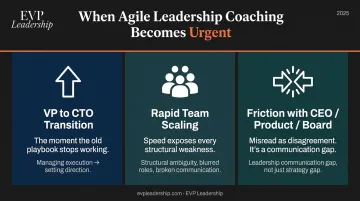
Each of these moments exposes the same underlying gap: the frameworks that got a CTO to the role aren't the ones that sustain performance inside it.
Agile Leadership Coaching vs. Agile Methodology Training: What CTOs Get Wrong
Training Produces Knowledge. Conditioning Produces Behavior.
Scrum certification teaches a framework. SAFe training teaches a scaling model. Neither one prepares a CTO for the moment a key engineer quits mid-sprint, a board member questions the technical roadmap, or two senior leaders stop communicating.
The distinction matters because knowledge under normal conditions isn't the same as performance under pressure. EVP Leadership's core thesis captures it directly: leaders don't rise to expectations—they fall back on their conditioning. Most technology leaders have been trained extensively. Far fewer have been conditioned to think clearly, stay focused through complexity, and execute with discipline when it counts.
That's not a critique of agile training. It's simply what training alone is built to do — and what it isn't.
The Real Bottleneck Isn't Time or Technical Knowledge
CTOs typically believe their constraints are hours and expertise. In practice, the actual bottleneck is decision quality and leadership judgment—and both of those are built through coaching, not certification.
McKinsey's research across 189,000 people in 81 organizations found that four behaviors explained 89% of the variance in leadership effectiveness: solving problems effectively, operating with a strong results orientation, seeking different perspectives, and supporting others. None of those are framework skills. All of them are coaching targets.
What Structured Agile Leadership Coaching Looks Like
A structured coaching engagement for a CTO looks different from a training program in three ways:
- Ongoing, not episodic — Regular sessions tied to live leadership challenges, not one-time workshops
- Diagnostic by design — Effective coaching identifies where leadership judgment is breaking down, not just which frameworks to apply
- Anchored in behavior change — EVP Leadership's 90-Day PressurePoint System conditions leaders across three layers: the Identity Layer (consistency, capacity, character), the Diagnostic Layer (Mission Clarity, Force Alignment, Problem Intelligence, Decision Integrity, Execution Discipline, Momentum Control), and the Execution Layer (Pause the Noise → Locate the Pressure Point → Prioritize the Critical Move → Execute with Discipline → Lock in Momentum)
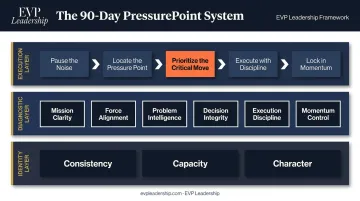
The result is a CTO who performs consistently under pressure — including in the moments that don't show up on any planning calendar.
5 Agile Leadership Coaching Strategies Every CTO Should Use
1. Establish an Agile Coaching Cadence for Yourself
Before coaching your teams agilely, you need a personal coaching rhythm. Weekly or bi-weekly sessions structured around current leadership challenges—not general development topics—create the compounding effect that single workshops cannot.
Think of it the way you think about sprint ceremonies. No individual stand-up is transformative. The discipline of doing it consistently, at a regular cadence, with structured reflection built in—that's what changes behavior over time.
A personal coaching cadence removes reactive leadership. When you have a consistent structure for reflection and planning, you stop firefighting by default and start operating with intention.
2. Apply the 80/20 Principle to Leadership Capacity Building
Most CTOs overinvest in high-visibility work—architecture debates, reorg planning, cross-functional escalations—while underinvesting in the compounding foundations: team health, communication clarity, hiring process discipline, feedback loops.
The McKinsey data reinforces this. The leadership behaviors that explain nearly 90% of effectiveness variance are relational and judgment-based, not technical. Gallup found that 70% of the variance in team engagement is directly tied to management behavior—which means a CTO's daily leadership habits matter more than any single strategic initiative.
The coaching strategy here is an honest audit:
- Where are you spending leadership energy each week?
- What percentage goes to foundations versus high-visibility work?
- Which of McKinsey's four core behaviors are you currently underusing?
Rebalance toward what actually builds the base.
3. Build Psychological Safety as the Agile Performance Foundation
Agile ceremonies only work when team members feel safe enough to use them honestly. Without psychological safety, retrospectives become theater, stand-ups become status reports, and feedback loops stop surfacing real information.
Google's Project Aristotle studied 180 teams and identified psychological safety as the single most important dynamic in team effectiveness—more important than team composition, experience, or resources. Teams with stronger psychological safety were rated effective twice as often by executives.
Coaching behaviors that build safety:
- Ask questions before offering answers
- Name your own uncertainty out loud — it signals that honest signals are welcome
- Create structured space for dissent during sprint reviews
- Separate personal accountability from blame in post-mortems
Teri Evans, Leadership Facilitator at EVP Leadership, grounds her executive team development work in exactly this approach—designing facilitated team sessions around listening, psychological safety, and experiential growth as the preconditions for honest performance.
4. Develop the "Coach vs. Deliver" Leadership Mindset
The default for most technical executives is deliver mode: step in, solve the problem, move on. It's faster in the moment. Over time, it creates dependency and limits scale.
The shift required is knowing when each mode is appropriate:
- Choose coaching when the gap between where a team member is and where they need to be can be closed through guided discovery. The short-term cost is time; the long-term return is capability.
- Step in directly when a critical, time-sensitive decision requires experience the team doesn't yet have. But always debrief afterward.
EVP Leadership's delegation and accountability work addresses this directly—treating the tendency to over-deliver as one of the primary causes of founder bottleneck and executive burnout. The practical output is a delegation protocol: what gets handed off, to whom, with what decision authority, and against what accountability standard.
5. Practice Iterative Feedback Loops at the Leadership Level
Agile teams get feedback built into their process. CTOs rarely do.
Boards and direct reports almost never volunteer candid criticism unprompted. The result is a CTO operating on incomplete information about their own leadership effectiveness—making confident decisions with blind spots they can't see.
The fix is structural, not cultural:
- Implement a lightweight leadership retrospective monthly or quarterly
- Review your own performance against defined leadership goals
- Gather structured input from direct reports, peers, and executives—not just downward
An ongoing coaching engagement creates this feedback loop by design. It's not a feature of good culture—it's a built-in structural mechanism that doesn't depend on anyone else's willingness to tell you the hard thing.
How to Integrate Agile Coaching Into Existing Engineering Workflows
The most common mistake is trying to change everything at once. Sudden cultural overhauls create resistance, particularly from engineers who've seen methodology initiatives come and go.
Start With Leadership Rituals Before Addressing Culture
Introduce agile coaching gradually:
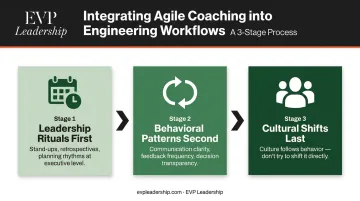
- Begin with leadership-level rituals — Consistent stand-ups, retrospectives, and planning rhythms at the executive level before cascading them to the broader team
- Address behavioral patterns second — Once rituals are stable, work on the habits underneath: communication clarity, feedback frequency, decision transparency
- Tackle cultural shifts last — Culture follows behavior. Don't try to shift it directly
Coach Through Resistance, Don't Mandate Around It
The 17th State of Agile Report found that 47% of organizations cite organizational resistance to change as a top barrier to scaling agile, with 41% pointing to lack of leadership participation as a reinforcing barrier. Both issues share the same solution: the executive leader demonstrating the behaviors they want to see, consistently, before expecting the organization to follow.
Identify internal champions — team leads and high-performers who already exhibit agile behaviors — and empower them as informal coaches within their teams. Cultural momentum builds faster from distributed examples than from top-down mandates.
Use Operational Tools as Coaching Surfaces
Kanban boards, sprint dashboards, and shared retrospective documents aren't just workflow tools. A leader who regularly references and engages with these surfaces in leadership conversations signals that they matter—and models the transparency agile depends on.
How to Measure the ROI of Agile Leadership Coaching for CTOs
Quantitative Metrics at the Team Level
Use DORA metrics as the delivery spine. DORA's 2023 report benchmarks elite engineering teams at:
- Deployment frequency: On demand
- Lead time for changes: Under one day
- Change failure rate: Around 5%
- Failed deployment recovery time: Under one hour
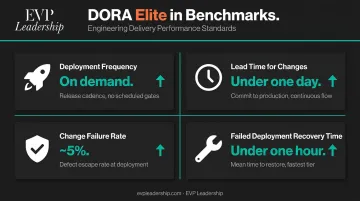
Track where your team sits against these benchmarks before and after coaching engagement. DORA also found teams with generative cultures showed 30% higher organizational performance and teams with strong user focus showed 40% higher organizational performance—both of which coaching directly influences.
Qualitative Signals at the Leadership Level
Numbers alone won't capture coaching impact at the CTO level. Watch for:
- Increased frequency of candid feedback from direct reports
- Stronger alignment between technical roadmaps and business goals
- Reduced friction in cross-functional relationships with product and executive leadership
- Improved team morale and voluntary retention
- Higher-quality decision-making in escalation scenarios
Tracking Your Own Leadership Development
Start every coaching engagement with structure:
- Define 3–5 personal leadership goals upfront
- Review progress at consistent intervals throughout the engagement
- Gather structured 360 feedback at the midpoint and at close
A coaching relationship without defined outcomes is difficult to sustain. It's also hard to justify to your leadership team or key stakeholders when they ask whether the investment is working.
Frequently Asked Questions
What is the 70/30 rule in agile leadership coaching for CTOs?
The 70/30 rule allocates 70% of coaching focus to building on existing strengths—technical credibility, systems thinking—and 30% to closing gaps or developing new skills. For CTOs, this prevents overinvesting in remediation at the expense of what's already working.
What are the 5 C's of coaching in agile leadership for CTOs?
The 5 C's—Clarity, Competence, Commitment, Communication, and Consistency—each map to a concrete leadership behavior for CTOs. In practice, they connect everything from setting clear engineering goals to building the repeatable habits that hold agile performance together under scaling pressure.
What are the 3 C's of coaching in agile leadership for CTOs?
The 3 C's—Clarity, Commitment, and Confidence—are most useful during high-pressure transitions. When a CTO is navigating rapid team growth or stepping into a new executive role, grounding coaching in these three areas prevents the behavioral drift that derails agile adoption before it takes hold.
What is the difference between an agile coach and an agile leader for CTOs?
An agile coach facilitates teams toward agile practices. An agile leader—the CTO—embodies and models those principles directly through their own decisions and behavior. The most effective CTOs develop both capacities, using coaching to sharpen how they lead rather than simply how their teams operate.
How do CTOs measure the success of agile leadership coaching?
Success is measured through team-level metrics (velocity trends, deployment frequency, morale) and leadership-level indicators (decision quality, feedback quality, cross-functional alignment), ideally tracked against goals set at the start of the engagement.
How long does agile leadership coaching typically take to show results for CTOs?
Early behavioral shifts typically appear within 60–90 days. Team-level metrics and sustainable agile performance usually require 90 days or more—consistent with research showing new habits take an average of 66 days to become automatic, with complexity extending that range significantly. Expect meaningful, measurable change on a 90-day horizon, not a 30-day one.